
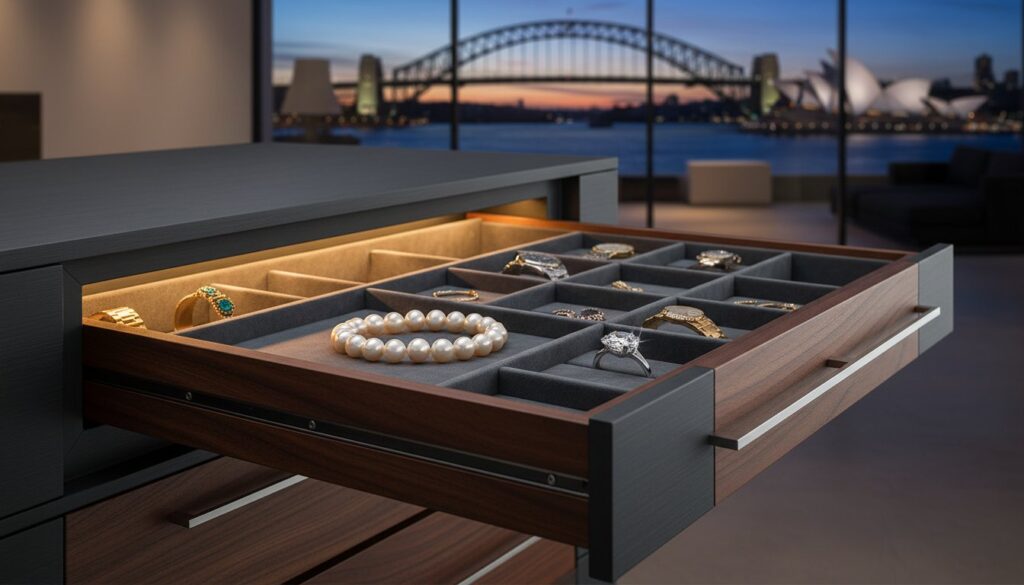
A fine jewelry collection is an investment in craftsmanship that demands more than a simple velvet-lined drawer. The best way to store fine jewelry is to treat it like a high-performance machine; isolation and environment are the primary engineering specifications. You shouldn’t have to face the heartbreak of a scratched sapphire or a tangled necklace after a long journey. It’s a frustration many collectors know well, especially when high-value items represent an annual insurance cost of 1% to 2% of their appraised value.
We believe your pieces, like the handcrafted Pearl String Bracelet, deserve a sanctuary that balances grit with glamour. This guide reveals the professional standards for preserving luxury through material-specific science and travel-ready solutions. You’ll discover how to navigate the 2026 Customs Baggage Regulations for international travel, the technical requirements for UL-rated fireproof safes, and the exact routine needed to keep your collection unbound by time or wear. From the chemistry of cloudy pearls to the security of biometric locks, we’ve engineered a roadmap for your most precious cargo.
Key Takeaways
- Master the engineering of isolation to shield your collection from atmospheric oxidation and physical abrasion.
- Identify the unique survival requirements for every material, ensuring “apex predator” diamonds don’t damage softer gems.
- Discover why the best way to store fine jewelry requires a hybrid approach that prioritizes security without sacrificing your daily routine.
- Learn to prepare your collection for the horizon with travel solutions engineered to withstand vibration and movement.
- Understand the transition from your home sanctuary to professional servicing to keep your luxury pieces unbound by wear.
The Engineering of a Jewelry Sanctuary: Why Storage Matters
The foundation of a lasting collection isn’t just the acquisition; it’s the preservation. Think of your storage as the chassis that protects a high-performance vehicle from the elements. For the modern collector, the best way to store fine jewelry is to create a dedicated sanctuary that mitigates the harsh realities of the environment. In the Australian outback or the humid coastal regions, the climate acts as a relentless catalyst for degradation. Heat and moisture don’t just sit on the surface. They penetrate the microscopic structure of your pieces, accelerating chemical reactions that can dull the luster of a Pearl String Bracelet in a matter of months. A well-crafted sanctuary provides the same quiet confidence as a premium off-road interior, offering a controlled environment where delicate engineering remains untouched by the chaos outside.
Atmospheric Protection and Humidity Control
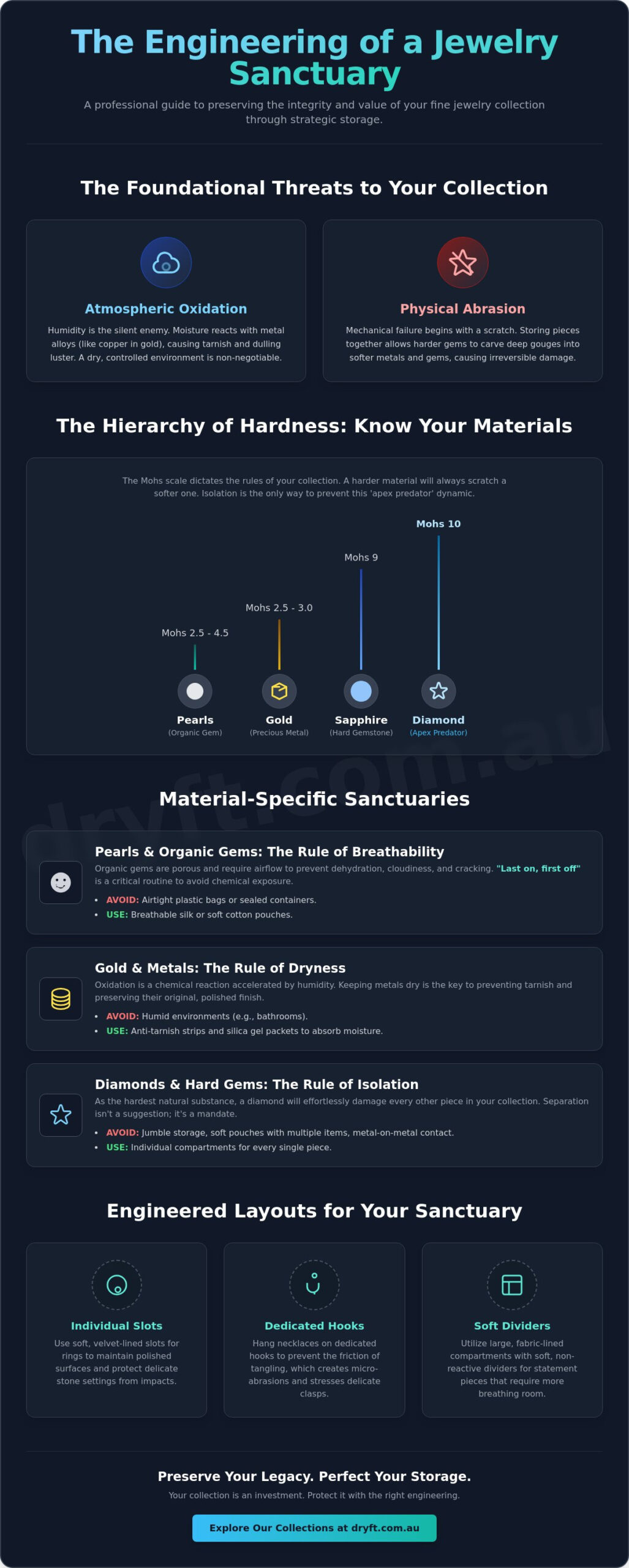
Humidity is the silent enemy of metallic integrity. When moisture levels rise, water vapor reacts with the copper or silver alloys found in 14k or 18k gold. Oxidation in gold alloys is the chemical process where base metal components react with oxygen and moisture to form a dark surface layer of tarnish. To combat this, a modern sanctuary must be engineered for dryness. Utilizing anti-tarnish strips and silica packets is a pragmatic necessity rather than an optional luxury. These components act as a filtration system, absorbing corrosive elements before they reach your investment. Regular Jewellery cleaning can remove existing tarnish, but a controlled environment prevents its return and preserves the original finish of handcrafted luxury.
The Physics of Abrasion: Why Separation is Non-Negotiable
Mechanical failure in jewelry often begins with a single scratch. The Mohs scale of mineral hardness dictates the hierarchy of your collection, and it’s a brutal reality. A diamond, sitting at a 10 on the scale, is the undisputed apex predator. It will effortlessly carve deep gouges into gold bands or the nacre of Baroque Pearl Drop Earrings if left to rattle in a soft-sided pouch. Jumble storage is a recipe for structural compromise and unnecessary wear. Engineering a layout requires intentional separation to eliminate the risk of physical abrasion. Every piece needs its own compartment to prevent metal-on-metal contact.
- Individual velvet-lined slots for rings to maintain polished surfaces and stone settings.
- Dedicated hooks for necklaces to prevent the friction of tangling and tension on delicate clasps.
- Soft, non-reactive dividers for larger statement pieces that require more breathing room.
By treating your storage as a technical sanctuary, you ensure that “out of sight” never results in “out of commission.” Proper storage is the baseline for a collection that remains unbound by the passage of time or the rigors of your lifestyle. It’s about maintaining the integrity of the piece so it’s always ready for the next horizon.
Material-Specific Storage: Pearls, Diamonds, and Gold
A curated collection is a diverse inventory of chemical compositions and physical hardness. It isn’t a monolith. The best way to store fine jewelry is to acknowledge that a diamond’s strength is a pearl’s weakness. You wouldn’t pack high-precision optics with heavy recovery gear without adequate padding. Your jewelry requires the same level of technical consideration. While diamonds are the apex predators of the jewelry box, capable of scratching any other surface, organic gems require a breathable environment to maintain their structural integrity. You are building a sanctuary, not a tomb. Every material has a survival threshold that must be respected to keep your investment unbound by time.
The Pearl Exception: Breathability and Hydration
Organic gems like pearls and opals are fundamentally different from minerals. They are porous. They require a “living” environment with consistent airflow and a hint of moisture to prevent dehydration. Storing handcrafted pearl jewelry australia in airtight plastic bags is a fatal engineering error. It suffocates the nacre, leading to a cloudy, brittle surface that eventually cracks. Instead, utilize breathable silk or cotton pouches. This allows the pearls to draw minute amounts of moisture from the air, preserving the deep luster found in pieces like our Pearl String Bracelet. Adhering to the “last on, first off” rule ensures that pearls are never exposed to the harsh chemicals in perfumes or hairsprays, which can be trapped against the gem in a closed storage environment.
Hard Gems and Soft Metals: A Balancing Act
Diamonds demand absolute isolation. Sitting at a 10 on the Mohs scale, a diamond solitaire will effortlessly ruin a 14k or 18k gold band if they collide during movement. This risk is amplified for ethical jewelry australia, where conscious designs often feature intricate, delicate settings that can be easily crushed. Gold is a remarkably soft metal. A herringbone necklace, for instance, can suffer permanent kinking if it is coiled too tightly or buried under the weight of heavier items. Following expert jewelry care tips means ensuring every item has its own dedicated footprint. Protective isolation is the only way to prevent the physical abrasion that dulls a polished finish.
- Individual Chamois Bags: Ideal for gold chains to prevent tangling and kinking.
- Padded Slots: Essential for diamond rings to lock the “apex predator” in place.
- Lined Compartments: Necessary for the Baroque Pearl Drop Earrings to protect the organic surface from metal contact.
By engineering your sanctuary to match the specific needs of each material, you transition from simple storage to active preservation. It’s a commitment to quality that ensures your pieces are always ready for the next adventure, whether it’s a refined evening or a journey toward the horizon. If you haven’t yet secured a dedicated home for your collection, consider starting with a soft-lined tray designed for modular organization.
Evaluating Storage Solutions: From Vaults to Visual Displays
Choosing your storage is an exercise in balancing aesthetic visibility with technical defense. Many collectors are torn between the desire to see their collection and the need to protect it. The best way to store fine jewelry is to understand that your storage is the final layer of engineering between your investment and the world. While an open-air display might offer a sense of daily inspiration, it lacks the atmospheric isolation required for long-term preservation. Isolation is the priority; UV radiation is a silent thief of color, a challenge also faced by First4Frames Gallery when preserving fine art. Airborne particulates are the precursors to abrasion, and a true sanctuary must mitigate these invisible threats while remaining accessible for your daily routine.
The Traditional Jewelry Box: A Refined Classic
The traditional jewelry box remains the gold standard for a reason. It provides a solid chassis against physical impact and accidental drops. When selecting a box, the internal specifications matter most. Look for acid-free linings. Many mass-market options use glues and fabrics that off-gas over time, causing rapid tarnishing of gold and silver alloys. For high-value investments like bespoke engagement rings melbourne, a lockable, heavy-set box is a pragmatic necessity. These units are designed to prevent damage and tarnish by creating a stable micro-climate. It’s about security that doesn’t sacrifice the refined ritual of dressing for the horizon.
Visual Organizers and Open Displays
Open displays, such as jewelry trees or wall-mounted hooks, offer a “hybrid” utility for the modern adventurer. They are excellent for managing tangles in daily-wear chains, but they come with a trade-off. Dust accumulation is more than a cosmetic nuisance. It acts as a microscopic abrasive that can dull the polished surface of your pieces over time. If you prefer a visual system, limit it to your “routine” tray. This staging area should only house your frequent staples, like the Pearl String Bracelet. By rotating pieces from your primary vault to a routine tray, you maintain a seamless transition from storage to wear without exposing your entire collection to the elements.
- Staging Trays: Perfect for temporary placement of daily-wear items.
- Wall Hooks: Best for longer necklaces that are prone to kinking if coiled.
- Closed Drawers: Essential for any piece containing light-sensitive gemstones.
Ultimately, your storage solution should reflect the value and variety of your collection. It’s a commitment to craftsmanship that ensures your jewelry remains unbound by the passage of time. Whether you choose the fortified protection of a vault or the accessibility of a modular tray, the goal is a controlled environment. A well-engineered sanctuary is the quiet partner in every journey you take.
The Voyager’s Guide: Storing Fine Jewelry on the Move
Movement is the catalyst for chaos. Whether you are navigating the corrugated tracks of the Kimberley or boarding a long-haul flight to London, the vibration of travel poses a significant risk to your collection. The best way to store fine jewelry during transit is to embrace a “Hybrid” philosophy: grit on the outside, sanctuary on the inside. This means utilizing a travel case with a rugged, impact-resistant exterior and a soft, non-reactive interior that prevents pieces from shifting. Just as you might use specialized lifestyle accessories from JellyPenny to secure your tech, your jewelry requires a portable chassis that absorbs kinetic energy before it reaches the delicate settings of your most prized investments.
A high-quality travel roll is an essential piece of equipment for the sophisticated trailblazer. It must feature individual zippered compartments, padded ring bars, and reinforced necklace stays. These aren’t just aesthetic choices; they are functional requirements. Security is equally paramount. Never place fine jewelry in checked luggage. The risk of loss or theft is too high. Always keep your collection in your carry-on bag. For high-value items, ensure you have digital copies of appraisals ready for customs declarations. Mastery of these protocols ensures your pieces arrive at the horizon in the same condition they left home.
Tangle-Free Necklace Engineering
The “straw hack” is a rudimentary solution for the amateur traveler, but a professional organizer offers superior protection. Threading a chain through a straw might prevent a knot, but it does nothing to protect the metal from vibration-induced abrasion. Professional travel rolls utilize tension-based stays to lock each chain in place. This prevents the “travel knot” that can lead to permanent kinking or clasp failure. Layer necklaces by placing each in a separate padded sleeve to prevent friction and surface wear. This level of technical detail ensures your chains remain unbound by the rigors of the road.
Protecting the Statement Pieces
Statement items like baroque pearl drop earrings require dedicated cushioning to survive the impact of transit. Pearls are organic and susceptible to chipping if they collide with harder gemstones or the interior of a hard-shell case. A soft-shell travel pouch provides the necessary flexibility to nestle these pieces securely. However, for maximum protection against crushing, a hard-shell exterior is preferred for the overall case. This creates a secondary sanctuary that shields your collection from the weight of other carry-on items. Before you set out on your next adventure, ensure your travel kit is up to the task.
Beyond the Box: Integrating Care into Your Lifestyle
A sanctuary is only effective if the items within it are maintained. Storage represents the defensive phase of ownership, but true preservation requires an active offense. The best way to store fine jewelry is to view it as one component of a broader jewelry care guide. This “Storage-to-Service” pipeline is the logistical framework that keeps your collection expedition-ready. It ensures that your pieces don’t just sit in a vault, but remain in peak mechanical condition for a lifetime of discovery. At Dryft, our commitment to craftsmanship extends beyond the point of sale. We engineer our pieces, like the Baroque Pearl Drop Earrings, to endure the harsh realities of the wild, but the longevity of handcrafted luxury ultimately depends on the ritual of care you establish at home.
The Six-Month Audit
A biannual inspection is your primary insurance policy against loss. Before placing a piece into long-term rest, perform a technical audit. Check for loose stones and worn prongs that may have been compromised during your recent travels. Even the most secure setting can succumb to the rigors of an active lifestyle over time. Professional cleaning is essential at this stage to remove accumulated body oils and environmental residues. If left on the metal, these substances can harden and become more difficult to remove later. Documentation is the final step. Maintain a digital ledger of your collection, including high-resolution photos and up-to-date appraisals. With specialized jewelry insurance typically costing between 1% and 2% of the appraised value annually, accurate records are a pragmatic necessity for every serious collector.
The Gift of Longevity
Fine jewelry is a vessel for stories and a legacy for the next generation. When gifting fine jewelry, you aren’t just passing on a precious object; you’re sharing a philosophy of movement and freedom. Teaching a recipient how to maintain their new sanctuary ensures the emotional value of the heirloom remains unbound by neglect. A well-preserved piece, like a Pearl String Bracelet, carries the weight of history and the promise of future horizons. It’s a testament to quality that survives the dust of the trail and the passage of decades. This is the essence of conscious luxury. It’s a commitment to things that last.
Your journey with fine jewelry is a continuous evolution of discovery and protection. By engineering a sanctuary that balances technical precision with refined comfort, you ensure your collection is always ready for the next horizon. We invite you to join the Dryft community for more expert insights on preserving your most valued investments. Explore our collection and find your next partner in adventure today. Your sanctuary is waiting.
Securing Your Legacy for the Next Horizon
Your collection is more than a series of acquisitions; it’s a map of your journey. Mastering the best way to store fine jewelry ensures that these markers of your history remain as vivid as the day you found them. We’ve explored how isolation prevents the physical abrasion caused by hard gemstones and how controlled airflow preserves the deep luster of organic pearls. By engineering a sanctuary that accounts for the harsh Australian climate and the vibrations of the road, you protect the mechanical integrity of every handcrafted setting.
True luxury is found at the intersection of grit and glamour. It’s a commitment to quality that demands ethically sourced materials and Australian-made authenticity. Our pieces are built for the modern adventurer who values both technical precision and the quiet confidence of a well-maintained heirloom. Whether you’re navigating the outback or a city skyline, your jewelry should remain unbound by wear and ready for discovery.
Explore the Dryft Collection of Handcrafted Luxury and discover pieces engineered for the long haul. We provide expert repair and maintenance services to ensure your personal sanctuary remains intact for decades. Your next adventure is waiting. Go out and find it.
Frequently Asked Questions
Is it bad to store jewelry in a bathroom?
Storing jewelry in a bathroom is a critical error due to fluctuating humidity and heat. These environmental factors act as catalysts for chemical reactions on metal surfaces. High moisture levels can cause gold alloys to tarnish much faster than in a dry, stable environment. You should seek a climate-controlled sanctuary like a bedroom closet to maintain the mechanical integrity and luster of your collection.
Can I store all my gold jewelry together in one pouch?
You should never store all your gold jewelry in a single pouch. Gold is a relatively soft metal; it sits between 2.5 and 3 on the Mohs scale. When pieces rattle together, they create microscopic scratches and physical abrasion that dull the finish. The best way to store fine jewelry is to provide each item with its own dedicated, soft-lined compartment to ensure total isolation.
Do pearls really need to ‘breathe’ in storage?
Pearls absolutely require airflow to maintain their structural integrity and deep luster. Because they are organic gems, they draw minute amounts of moisture from the atmosphere to stay hydrated. Storing items like the Baroque Pearl Drop Earrings in airtight plastic bags can lead to fatal dehydration. This causes the nacre to become brittle and eventually crack, destroying the piece’s value and beauty over time.
What is the best way to prevent silver from tarnishing?
The most effective way to prevent silver tarnish is to control the atmospheric conditions of your storage. Use anti-tarnish strips or silica packets to absorb sulfur and moisture before they react with the silver surface. Keeping your collection in a dark, low-humidity environment significantly reduces the rate of oxidation. This pragmatic approach keeps your silver unbound by dullness and ready for your next adventure.
Should I keep my jewelry in the original boxes?
Keeping jewelry in its original box is often a sound strategy if the materials used are acid-free. These containers are specifically engineered to fit the dimensions and technical requirements of the piece. However, you must ensure the box isn’t made of mass-produced materials that off-gas harmful chemicals. For high-value items, a dedicated, multi-compartment jewelry vault often provides superior protection against the harsh Australian elements.
How often should I clean my jewelry before putting it away?
You should perform a basic cleaning after every wear before returning a piece to its storage sanctuary. Removing skin oils, salts, and cosmetic residues prevents these substances from reacting with the metal alloys during long periods of rest. A 10-second wipe with a soft chamois cloth is a simple ritual that pays significant dividends in longevity. It’s the first line of defense in your maintenance pipeline.
Is a safe-deposit box good for long-term jewelry storage?
A safe-deposit box provides excellent security but may lack the necessary environmental controls for organic gems. While it’s a fortified chassis for diamonds and gold, the stagnant, dry air can be detrimental to items like the Pearl String Bracelet. If you use one for long-term storage, ensure the pieces are wrapped in breathable fabric. Always maintain digital copies of your insurance appraisals for all items stored off-site.
How do I stop my necklaces from tangling in a jewelry box?
To stop necklaces from tangling, you must utilize tension-based stays or individual hooks. Tangling is more than a nuisance; it causes friction that leads to metal fatigue and permanent kinking. The best way to store fine jewelry chains is to hang them vertically or lay them flat in dedicated, padded channels. This engineering approach eliminates the risk of knots and preserves the chain’s structural flexibility.