

The most expensive gold in the showroom is often the least prepared for the reality of an unbound life. While a high price tag suggests resilience, the soft nature of pure gold means that choosing between 14k and 18k gold becomes a critical decision for protecting your investment against the dust and grit of the Australian landscape. You likely want a piece that mirrors the engineering of a high-end off-road chassis; it should be visually stunning yet built to endure the rigours of the trail without losing its lustre.
Deciding on the right purity leads to a crossroad where luxury meets longevity. We’ll show you how to find that perfect equilibrium so your jewelry remains a sanctuary of style rather than a source of stress. This guide breaks down the technical hardness ratings, explains why certain alloys cause skin reactions for roughly 15 percent of the population, and identifies which gold purity will truly last a lifetime under the harsh Australian sun.
Key Takeaways
- Master the technical anatomy of purity to understand how the 2026 karat system defines the engineering and material integrity behind your most prized possessions.
- Navigate the aesthetic landscape of “Quiet Luxury” by comparing the deep, buttery warmth of 18k gold with the understated, rugged resilience of 14k.
- Utilise the Vickers Hardness scale as a professional guide when choosing between 14k and 18k gold to ensure your jewelry survives the demanding conditions of an active lifestyle.
- Apply a strategic selection framework to match gold purity with specific jewelry types, ensuring high-impact pieces like engagement rings offer both a sanctuary for gemstones and long-term durability.
- Align your investment with the Dryft standard of ethical craftsmanship, where the origin of the gold is as vital as its purity in creating luxury that respects the wild.
The Anatomy of Purity: Understanding the Karat System in 2026
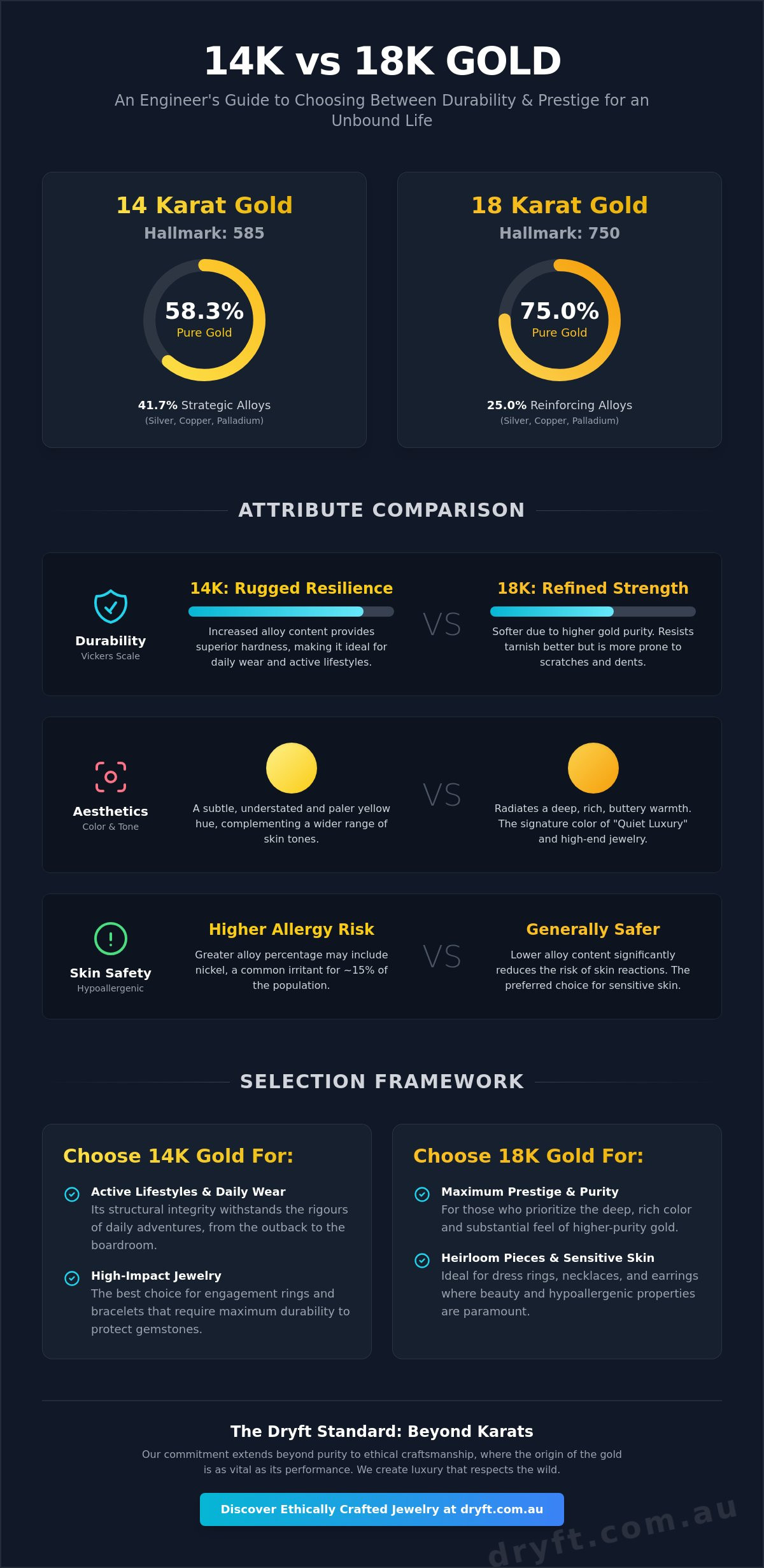
Gold is a legacy metal, but in its raw 24-karat state, it’s often too malleable for the grit of the Australian landscape. It lacks the structural chassis needed for daily wear. The karat system breaks purity into 24 parts, providing a clear metric for gold content. When you’re choosing between 14k and 18k gold, you’re deciding on the balance between raw prestige and engineered durability. 18-karat gold contains 75% pure gold, while 14-karat sits at 58.3%. The remaining percentage isn’t filler; it’s a strategic reinforcement of silver, copper, or palladium designed to withstand the rigours of an active life.
Pure 24k gold is a sanctuary of tradition, yet it’s impractical for fine jewelry meant to be worn beyond the boardroom. It scratches easily and can warp under pressure. Modern jewelry engineering in 2026 focuses on “rugged refinement,” where the goal is to maintain the deep, rich luster of gold while ensuring the piece can survive a weekend in the Kimberley. This is why 18k and 14k have become the standards for those who value both aesthetics and reliability.
Decoding the Hallmarks: 750 vs 585
In Australia, jewelry standards follow strict international conventions. You’ll find a laser-etched or stamped “750” on an 18k piece, signifying that 750 parts per thousand are pure gold. A “585” stamp marks a 14k piece. These hallmarks are the certification of authenticity, providing the same peace of mind as a VIN on a premium off-road vehicle. They’re usually tucked away on the inner band of handcrafted rings or the clasp of a necklace, invisible to the casual observer but vital for the discerning owner.
The Science of the Alloy
The true performance of gold lies in the secondary metals. Pure gold is too soft to hold a diamond securely or maintain its shape over decades of use. By integrating silver, copper, and palladium, jewelers create a metal that is both beautiful and resilient. Understanding the science of colored gold allows for the creation of specific hues and hardness levels. Palladium is often preferred over nickel in high-end Australian workshops because it’s hypoallergenic and won’t cause skin reactions in the heat of the outback. This careful blending ensures that handcrafted pieces maintain their structural integrity, even when exposed to the elements. Choosing between 14k and 18k gold is ultimately a decision about how much of that raw prestige you want to balance against the grit of a reinforced alloy.
The Aesthetic Profile: Colour, Tone, and the Richness of 18k Gold
The visual distinction between gold grades is immediate to the trained eye. 18k gold radiates a deep, buttery warmth that stems from its high concentration of pure metal. It contains 750 parts per 1,000 of gold, providing a saturated yellow glow that 14k gold cannot replicate. When choosing between 14k and 18k gold, you’re deciding on the intensity of that signature hue. 14k gold, containing 583 parts per 1,000, presents a more subtle, paler yellow. It’s a pragmatic choice for those who prefer a muted aesthetic, but it lacks the visceral richness found in higher-karat alloys.
This richness defines the “Quiet Luxury” movement. 18k gold doesn’t shout for attention; it hums with a heavy, prestigious presence. The weight is a key factor. Because gold is a dense element, an 18k piece feels noticeably more substantial against the skin than a 14k equivalent. This physical gravity aligns with the FTC guidelines on gold purity, which mandate strict disclosure of these metal ratios to ensure consumers understand exactly what they’re wearing. For the modern adventurer, this density represents a sanctuary of value that survives the rigours of travel.
The nuances extend to rose and white gold variants. 14k rose gold often appears “pinker” or more copper-toned because it contains a higher percentage of copper alloy (roughly 41.7%). In contrast, 18k rose gold leans toward a sophisticated peach or champagne tone. White gold is the outlier. Because most white gold is finished with rhodium plating to achieve a mirror-like silver sheen, the karat choice becomes virtually invisible. Here, the decision rests on the internal integrity of the piece rather than the surface colour.
Visual Harmony with Natural Materials
The intense Australian sun creates a high-contrast environment where metal tones are tested. 18k gold excels here, providing a vibrant foundation for handcrafted pearl jewelry australia. The deep gold tones enhance the organic, iridescent lustre of a South Sea pearl, creating a seamless transition between mineral and biological beauty. This combination complements sun-bronzed complexions and holds its own against the sharp, clear light of the coast or the red dust of the interior. When paired with ethical diamonds, 18k gold acts as a warm anchor that amplifies brilliance without overwhelming the stone’s clarity.
The Longevity of Colour
Pure gold is chemically inert and does not tarnish. However, the base metals used in alloys can react with the environment. 14k gold, with its higher alloy content, may show a slight shift in tone over several decades if exposed to harsh chemicals or extreme conditions. 18k gold is more resistant to this chemical change. Over time, both metals develop a “patina”—a series of microscopic marks that soften the finish. This patina adds character, reflecting a life lived unbound. Maintaining that original “out-of-the-box” glow is simple; a professional polish every 24 months restores the engineered precision of the piece. If you’re ready to find a piece that matches your trajectory, consider how a bespoke gold setting can elevate your daily kit.
Engineering for the Horizon: Durability and Resilience in Daily Wear
Gold is more than a symbol of status; it is a material that must perform under pressure. When you’re choosing between 14k and 18k gold, you’re essentially selecting the chassis for your daily adventures. The technical distinction lies in the Vickers Hardness scale. Standard 14k yellow gold typically registers around 140 to 160 HV, while 18k gold often sits lower, between 120 and 140 HV. This 12% to 15% difference in hardness determines how well your piece survives the transition from the red dust of the Kimberley to a high-end gallery opening in the city.
14k gold is the rugged choice for an active Australian lifestyle. Because it contains a higher percentage of alloy metals like copper and zinc, it possesses a structural stiffness that 18k gold lacks. Understanding the Karat System helps clarify why this matters. With 58.3% gold content, 14k provides a mechanical advantage in thin, delicate bands that might otherwise warp or bend under the weight of a heavy pack or the vibration of a steering wheel on a corrugated track. It’s the “Hybrid” of the jewelry world, offering enough purity to retain value while maintaining the grit needed for the field.
18k gold functions as a premium sanctuary for high-value gemstones. Its 75% purity makes it more malleable, allowing master jewellers to secure diamonds with a level of precision that harder metals can’t always match. While it’s prone to surface scratches, it doesn’t “snap.” It flows. This makes it a preferred medium for bespoke engagement rings melbourne designers often recommend for those who appreciate the weight and warmth of high-purity metal, even if it requires a bit more care.
Scratch Resistance vs. Structural Strength
There’s a common myth that softer gold is prone to breaking. In reality, 18k gold is incredibly tough but lacks surface hardness. It will develop a “patina” of fine scratches over time, recording the history of your movements. 14k gold resists this daily grit much better. It maintains its polished finish longer when exposed to abrasive environments. For the modern explorer, choosing between 14k and 18k gold often comes down to whether you view those scratches as scars of honor or as imperfections to be avoided.
Maintenance and Long-Term Care
Living the Dryft lifestyle means your gear takes a beating. 18k gold items typically require professional polishing every 12 to 24 months to maintain their high-gloss luster. 14k items can often go three to five years before needing similar attention. You can use a comprehensive jewelry care guide to manage minor cleaning at home. However, if you notice a prong moving or a band losing its perfect circle, seek professional servicing immediately. High-wear items like rings should be inspected annually to ensure the structural integrity remains unbound by the rigors of travel.
The Selection Framework: Matching Karat to Your Jewelry Type
The architecture of your jewelry dictates the gold purity you require. When choosing between 14k and 18k gold for an engagement ring, the setting style acts as your engineering blueprint. If you prefer a delicate pavé band or a tension setting, 14k gold provides the rigid chassis necessary to secure stones against the vibration and impact of an active lifestyle. For a classic solitaire, 18k gold offers a deep, saturated hue that complements the fire of a high-grade diamond, creating a visual sanctuary of light and metal.
Earrings and necklaces occupy a different functional space. These pieces sit close to the face where the skin is often more reactive. Approximately 10% of the Australian population experiences some form of contact dermatitis from base metals like nickel or zinc. Because 18k gold contains 75% pure gold, it acts as a safer harbour for those with metal sensitivities. The visual weight of 18k gold also performs better in these “near-face” positions, catching the light with a richness that 14k gold, with its 58.3% gold content, cannot quite replicate.
High-quality South Sea pearls require a specific companion. The organic luster of a premium pearl finds its soulmate in 18k gold. The warmth of the higher karat matches the depth of the pearl’s nacre, ensuring the metal never outshines the gem but rather elevates its natural glow. Using 14k gold with heirloom-quality pearls can sometimes appear too sharp or industrial, lacking the soft, buttery transition that 18k gold provides.
Choosing for Everyday Staples
Bracelets and bangles endure the most environmental stress. They strike tabletops, catch on gear, and face the grit of the outdoors. 14k gold is the engineered choice for these high-impact pieces because its higher alloy content resists deformation. When learning how to style gold jewelry for daily resilience, don’t fear mixing karats. Layering a 14k gold cuff with an 18k gold timepiece creates a sophisticated texture that speaks to a life lived at the intersection of grit and glamour.
Choosing for Legacy and Gifting
Milestones demand a different standard. 18k gold is the global benchmark for gifting fine jewelry intended to last generations. Its 75% purity ensures it retains significant intrinsic value regardless of market fluctuations. When you create an heirloom, you are choosing a karat that stands the test of time; 18k gold develops a unique patina that tells the story of its journey. It is the preferred medium for those who view jewelry as both a personal sanctuary and a lasting investment in craftsmanship.
The Dryft Standard: Beyond Karats to Ethical Craftsmanship
Gold purity is a technical specification, but the origin of that metal is a moral one. At Dryft, we believe the story of your gold should be as clean as the Australian horizon. While the chemistry of your ring matters, the impact on the land matters more. Choosing a piece from our workshop means making a firm commitment to ethical jewelry australia. We source materials that respect the rugged ecosystems they come from. It’s a philosophy of luxury without the destructive footprint, ensuring your sanctuary on the road is matched by a conscience that’s equally clear.
When you’re choosing between 14k and 18k gold, the decision often hinges on the specific demands of your lifestyle. 18k gold offers that rich, buttery hue characteristic of high-purity metal. 14k gold provides the structural integrity required for a life lived off the beaten track. Our design process blends these options into a bespoke narrative. We don’t just sell karats; we engineer legacies. Your choice of gold reflects a commitment to quality that survives the red dust of the interior and the salt spray of the coast.
The Value of Handcrafted Excellence
Artisan casting is the antithesis of mass production. Most high street jewelry is thinned out or made hollow to maximize retail margins, leading to structural failure under pressure. A Dryft piece is solid and intentional. Because of this focus on density and form, a bespoke piece in 14k gold can easily outlast a factory-made 18k item. We design for the modern trailblazer who requires gear that performs. There’s a significant emotional weight in wearing jewelry that’s been hand-forged to withstand the elements. It represents a shift from disposable fashion to a permanent, rugged refinement that mirrors your own resilience.
Next Steps: Your Personal Gold Consultation
Selecting the right metal requires more than an online search. It requires a conversation about where you’ve been and where you’re going. We invite you to reach out for a custom design session to finalize your choice. During a consultation, we’ll help you determine your gold needs based on your daily environment and aesthetic goals. Consider bringing the following to your session:
- Examples of textures or landscapes that inspire your sense of adventure.
- An overview of your daily physical activity levels to test durability requirements.
- Notes on existing heirlooms you might want to complement or contrast.
Join the Dryft community today. We build jewelry for the unbound, for those who appreciate the finer details of a well-crafted life. Your journey is unique; your gold should be too. It’s time to invest in a piece that’s as uncompromising as your spirit.
Defining Your Horizon in Gold
Deciding on the right metal isn’t just about a hallmark; it’s about how that piece survives the journey. 14k gold offers a structural resilience engineered for the most demanding daily wear, containing 58.5% pure gold for maximum durability. In contrast, 18k gold provides a deep, saturated tone with 75% purity that echoes a life of refined discovery. When choosing between 14k and 18k gold, you’re balancing the technical precision of alloy strength against the prestige of higher karat values. At Dryft, we bridge this gap by ensuring every piece is handcrafted in Australia to withstand both the boardroom and the coastal trail.
We use 100% ethically sourced materials to build jewelry that serves as a personal sanctuary, no matter how far you wander. Our designs focus on rugged elegance, ensuring your investment remains as timeless as the landscape that inspired it. Whether you prioritize the hard-wearing nature of 14k or the luxurious weight of 18k, the choice remains a testament to your personal standard of excellence. Build a legacy that lasts as long as the path ahead.
Explore our handcrafted 14k and 18k gold collections
Frequently Asked Questions
Which is better for an engagement ring, 14k or 18k gold?
Choosing between 14k and 18k gold for an engagement ring depends on your daily environment. 14k gold contains 58.3% pure gold, making it a rugged choice for those with an active lifestyle. It resists bending better than the softer 18k alternative. If your journey involves hands-on work or outdoor exploration, 14k offers the durability you need. 18k provides a richer colour but requires more frequent maintenance to stay pristine.
Does 18k gold scratch easier than 14k gold?
18k gold scratches more easily than 14k because it contains a higher percentage of pure gold. Pure gold is a soft metal. It measures only 2.5 on the Mohs scale of hardness. By blending 14k gold with 41.7% stronger alloys, jewellers create a metal that withstands the grit of the Australian outback. A 14k band keeps its polished finish longer when faced with the friction of daily gear and rough terrain.
Is 14k gold “real” gold or is it a lower quality?
14k gold is genuine, hallmarked gold that meets high international and Australian standards. It consists of 14 parts gold and 10 parts alloy, a ratio engineered for strength rather than a lack of quality. The Perth Mint and local artisans use 14k to create pieces that bridge the gap between elegance and endurance. It’s a reliable choice for any adventurer who wants a sanctuary of style that doesn’t fail under pressure.
Can I wear 18k gold every day if I have an active lifestyle?
You can wear 18k gold every day, but it demands a mindful approach. The 75% gold content makes the metal more malleable, meaning it can wear down over decades of use. When choosing between 14k and 18k gold for daily wear, roughly 60% of active individuals select 14k for its toughness. If you prefer the luxury of 18k, ensure the settings are checked by a professional every 12 months.
Why is 18k gold more expensive than 14k gold?
18k gold is more expensive because it contains approximately 28% more pure gold by weight than 14k gold. Since gold is a precious commodity traded on the ASX, the higher concentration of the metal directly increases the price of the piece. You’re investing in a higher volume of raw gold rather than the alloy mix. This results in a heavier feel and a saturated glow that represents a premium level of refined luxury.
Is 18k gold better for people with sensitive skin or metal allergies?
18k gold is the superior choice for individuals with sensitive skin. Because it’s 75% pure gold, it contains a smaller percentage of base metals like nickel that cause irritation. Approximately 15% of the population has a nickel allergy, which is more likely to be triggered by the higher alloy content in 14k gold. Choosing 18k provides a hypoallergenic sanctuary, ensuring your jewellery remains comfortable during long journeys in the Australian heat.
Will 14k gold tarnish or change colour over time?
14k gold won’t tarnish in the traditional sense, though it can show signs of wear when exposed to harsh chemicals. The 41.7% alloy content can react to high levels of chlorine in pools or heavy sulfur in certain environments. This might cause a slight change in the metal’s brightness over time. A quick polish usually restores the original lustre. It remains a durable companion that handles the salt and dust of the Australian landscape.
Can you tell the difference between 14k and 18k gold just by looking at it?
Roughly 80% of observers can distinguish the two metals by the saturation of the colour. 18k gold has a deep, buttery yellow tone that looks rich and traditional. 14k gold is slightly paler because the 41.7% alloy content dilutes the natural yellow of the gold. The difference is especially clear when you compare two rings side by side in natural light. 18k offers an unmistakable glow that feels like a piece of the sun.