Most modern jewelry is intentionally designed to fail, engineered for a shelf life rather than a lifetime of adventure. You’ve likely felt the sting of a generic chain snapping during a trek through the Flinders Ranges or watched a “premium” ring lose its luster after a single summer. It’s a frustrating reality when mass-produced items prioritize speed over substance, leaving you with a generic piece that lacks both durability and character. You want something that reflects your spirit, a piece of rugged luxury that can withstand the dust of the trail and the elegance of the evening.
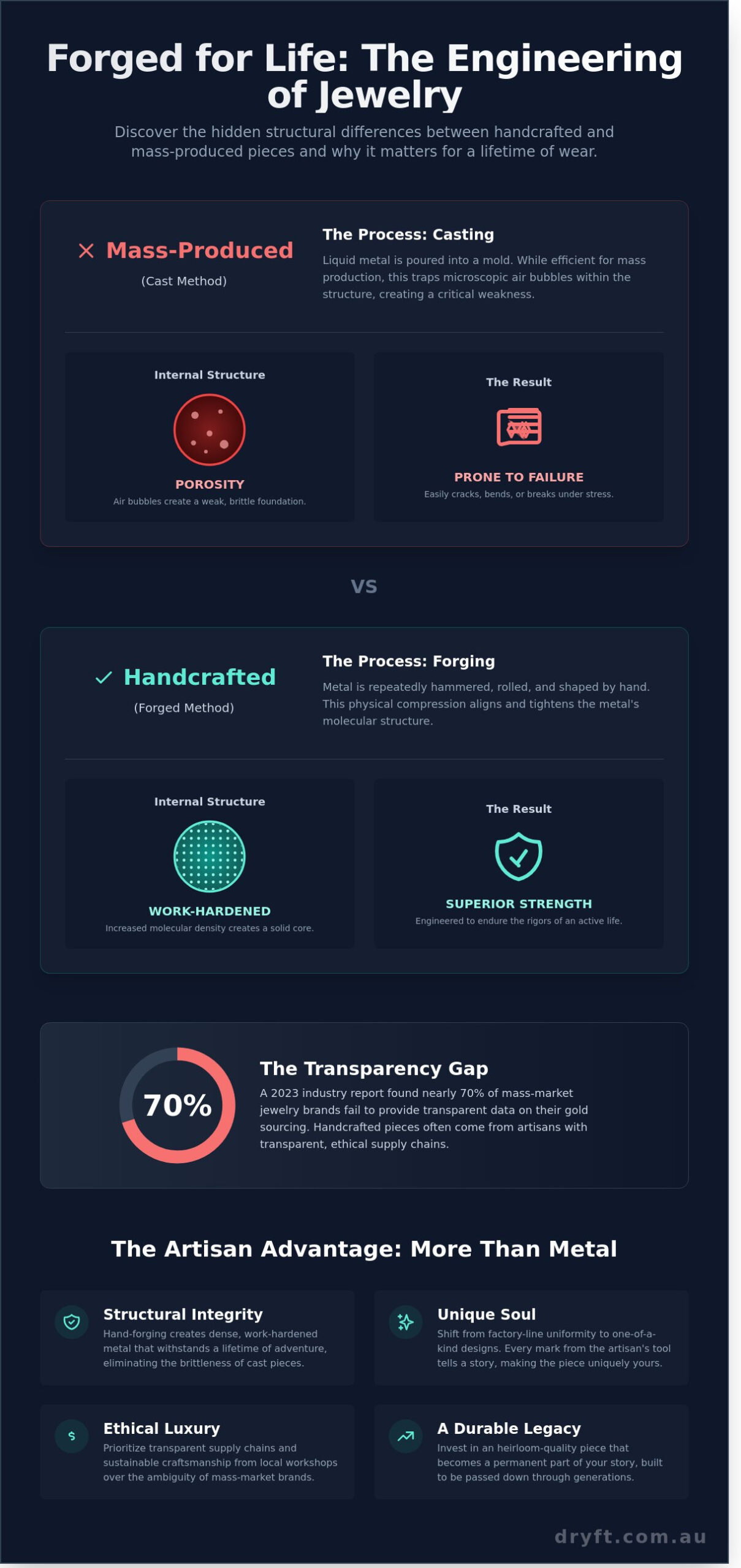
The true benefits of handcrafted jewelry lie in the intersection of technical excellence and ethical integrity. A 2023 industry report revealed that nearly 70 percent of mass-market jewelry brands fail to provide transparent data on their gold sourcing, yet hand-forged pieces offer a different path. This article reveals why choosing artisan-made items provides superior structural strength and a unique soul that machines simply can’t replicate. We’ll examine the engineering behind hand-forged metals and how these heirloom-quality pieces become a permanent part of your story, ensuring your investment is as enduring as the Australian outback itself.
Key Takeaways
- Understand the engineering behind hand-forged metal, where hammering increases molecular density to eliminate the brittleness often found in mass-produced casts.
- Unlock the primary benefits of handcrafted jewelry by choosing pieces that offer a unique soul and the structural integrity required for a lifetime of adventure.
- Shift from factory-line uniformity to a sanctuary of self-expression with one-of-a-kind designs that resonate with your personal journey and rugged lifestyle.
- Navigate the landscape of ethical luxury in Australia, prioritizing transparent supply chains and the sustainable craftsmanship of local artisanal workshops.
- Master the art of the investment by identifying key markers of excellence, ensuring your next piece is a durable legacy built for the journey ahead.
What is Handcrafted Jewelry? Defining the Art of the Artisan
Handcrafted jewelry isn’t just an accessory; it’s a piece of engineered art. Unlike mass-produced items churned out by cold, uniform factory lines, these pieces are born from the grit of the workshop. To understand What is Handcrafted Jewelry?, you have to look beyond the surface. It means every component is shaped, soldered, and finished by hand without the use of casting moulds or automated assembly. This human touch ensures no two pieces are identical. It creates a rugged luxury that stands up to the harsh Australian landscape while maintaining a sophisticated aesthetic. The process is deliberate and slow, prioritizing quality over the frantic pace of the mass market.
One of the primary benefits of handcrafted jewelry is the “Hybrid” philosophy it embodies. It’s where traditional craftsmanship meets modern, high-end design. This approach transforms metal and stone into a sanctuary for personal stories. These aren’t just objects; they’re milestones you wear. They reflect a lifestyle that’s unbound by convention, appealing to those who value reliability as much as they do elegance. When you choose an artisan piece, you’re investing in a legacy rather than a temporary trend.
The Artisan’s Process: From Raw Material to Refinement
The journey begins with sourcing ethical, raw materials. This includes selecting premium freshwater pearls that offer a unique lustre and organic shape. Artisans use hand-tools to shape metal with surgical precision, often spending hours on a single weld. This isn’t about perfection in the clinical, machine-made sense. Every slight variation is a mark of authenticity. These marks are the fingerprints of the maker. They prove the piece was forged through unbound creativity rather than a digital template. It’s the difference between a generic print and an original canvas.
Why ‘Handmade’ Labels Can Be Misleading
Labels can be deceptive in a market flooded with “hand-finished” imports. These are often mass-produced pieces where a human merely polished a machine-made casting or closed a jump ring. True artisan work requires knowing the provenance of every component. It’s about the technical mastery required to build from scratch. One of the greatest benefits of handcrafted jewelry is the certainty that your piece was built, not just assembled. Knowing the origin of your jewelry provides a sense of connection that factory-made items can’t replicate. Handcrafted jewelry is a labor of technical excellence and creative passion.
Built for the Journey: Why Hand-Forged Metal Offers Superior Strength
Most commercial jewelry is born from a rubber mold. This casting process is efficient for mass production, yet it introduces a technical compromise: porosity. When liquid metal is poured into a mold, tiny air bubbles often become trapped within the structure. These microscopic voids create a brittle foundation that’s prone to cracking under pressure. For those who live an active life, this isn’t just a design flaw; it’s a failure of engineering.
Hand-forging takes the opposite approach. By repeatedly hammering and rolling the metal, a jeweler physically compresses the material. This process increases molecular density and eliminates the internal gaps found in cast pieces. One of the greatest benefits of handcrafted jewelry is this structural integrity. It transforms a soft precious metal into a work-hardened piece of equipment. It’s luxury that doesn’t need to be coddled. Whether you are exploring a rugged coastline or managing a high-pressure professional environment, these pieces are built to endure the unique stresses of the Australian lifestyle.
This level of durability is why high-end bespoke engagement rings are often handed down as heirlooms. They aren’t just symbols; they are engineered sanctuaries for the stones they hold. They represent a commitment to quality that survives the dust, heat, and vibration of a life lived unbound.
The Science of Work-Hardened Metal
Tempering is the secret to a piece that retains its finish. As the jeweler works the metal at room temperature, the crystal structure within the alloy realigns. This creates a harder, more scratch-resistant surface than any cast alternative can offer. The security of the setting also improves. Machine-set stones are often pushed into place by a generic hydraulic press. In contrast, a master jeweler hand-sets each stone, feeling the tension of the metal to ensure a perfect, permanent fit. This meticulous attention to detail often begins with Ethical Sourcing, ensuring that the journey from mine to market maintains the same high standards as the mechanical engineering on the workshop floor.
Maintenance and Longevity
Superior strength translates directly to lower maintenance costs over time. Because hand-forged metal is denser, it resists the thinning and warping that often plagues mass-produced rings after a few years of wear. When the time comes for a resize or a polish, the process is straightforward and safe. Cast rings can be unpredictable during repair due to their hidden air pockets; hand-forged pieces are consistent and reliable. To preserve this engineered strength, following a professional jewelry care guide ensures your investment remains as resilient as the day it was forged. If you’re ready to invest in a piece that matches your pace, consider exploring our collection of Australian-made jewelry designed for the modern trailblazer.
Handcrafted vs. Mass-Produced: Uniqueness as a Personal Statement
Mass production is a race toward the average. When you wear a piece churned out by a factory line alongside 10,000 identical copies, there is an inherent emotional disconnect. It is a commodity rather than a companion. One of the primary benefits of handcrafted jewelry is the ability to achieve unbound self-expression. It is the difference between a generic off-the-lot vehicle and a custom-engineered sanctuary built to withstand the rigours of the Australian outback. Handcrafted items represent a shift away from infinite factory cycles toward intentional, limited-run productions. This rarity positions uniqueness as the ultimate form of quiet luxury. It doesn’t need to shout for attention; it commands respect through its singular existence. You aren’t just wearing a brand; you’re wearing a story that hasn’t been told thousands of times before. This same pursuit of individuality extends to custom apparel; for those looking to personalize their wardrobe with technical precision, you can discover Textieltransferhuis.
The One-of-a-Kind Factor
Nature never repeats itself. When an artisan selects baroque pearls or hand-cut stones, they are working with materials that possess distinct geological fingerprints. No two gems are ever identical. Mass production prioritizes speed and volume, often sacrificing the soul of a design to ensure every unit fits a rigid, pre-determined mold. Choosing handcrafted allows for bespoke designs that reflect your specific personal horizon. It ensures that your aesthetic remains as individual as the remote landscapes you explore. The benefits of handcrafted jewelry lie in this refusal to conform to the sterile standards of a global assembly line. Every hammer strike and setting is a deliberate choice made by a human hand, not a programmed algorithm.
Value Retention and Heirloom Potential
A handcrafted piece is an investment in Australian craftsmanship rather than a fleeting retail purchase. These items hold their financial and emotional value over decades because they aren’t subject to the rapid depreciation of mass-market trends. Data from the Australian Made Campaign indicates that 73% of consumers prefer locally produced goods for their perceived quality and longevity. This durability transforms a piece of jewelry into a future heirloom, capable of telling a story across generations. In a world of disposable fashion, these pieces stand as pillars of reliability and refined engineering. A handmade piece breathes with the intent and heartbeat of its creator, while a cast mold offers only the sterile, cold repetition of a mechanical ghost.
Ethical Sourcing: The Sustainable Soul of Hand-Finished Pieces
True luxury isn’t found on a factory assembly line. It lives in the workshop. Mass-market jewelry often relies on opaque supply chains where the human and environmental cost remains hidden behind a polished facade. One of the core benefits of handcrafted jewelry is the radical transparency offered by small-scale artisanal production. When every weld and setting is overseen by a master craftsman, the history of the materials becomes an integral part of the design. This isn’t just about aesthetics; it’s about the engineering of a clean conscience.
Brands like Dryft understand that the modern Australian adventurer demands more than just a rugged exterior. They want pieces that reflect a commitment to the land they explore. This is why the brand emphasizes ethical jewelry in Australia, ensuring that every component is sourced with a focus on conservation and fair practice. Choosing local artisans supports the national creative economy, which contributed approximately A$14.7 billion to the Australian GDP in the 2021-22 period. It keeps specialized skills on our shores and ensures that the wealth generated stays within the communities that build these treasures.
Traceability of Diamonds and Pearls
Diamond sourcing in artisanal workshops follows the Kimberley Process, a certification scheme established in 2003 to eliminate the trade in conflict stones. This rigorous tracking ensures that your centerpiece hasn’t funded regional instability. Similarly, small-batch freshwater pearls offer a sustainable alternative to industrial oyster farming, maintaining the delicate balance of aquatic ecosystems. This level of traceability adds a layer of refined luxury to the wearer’s conscience. You aren’t just wearing a stone; you’re wearing a verified commitment to global standards of fairness.
Sustainability Through Durability
The “buy once, buy well” philosophy is the ultimate weapon against the waste of fast fashion. While mass-produced items are often designed for obsolescence, handcrafted pieces are engineered for generations. Many boutique workshops now operate within a circular economy, utilizing 100% recycled gold and silver to reduce the need for destructive new mining operations. Choosing high-end quality is the most sustainable fashion choice you can make. It’s an investment in a piece that can withstand the dust of the outback and the scrutiny of the city without losing its structural integrity. This durability is one of the most practical benefits of handcrafted jewelry for those who live a life unbound.
Finding Your Forever Piece: How to Invest in Handcrafted Excellence
Investing in excellence means looking beyond the surface sparkle to the engineering hidden underneath. One of the core benefits of handcrafted jewelry is the tactile assurance of quality that mass-produced pieces simply cannot replicate. When you hold an artisan piece, you should feel a distinct weight. A solid 18k gold band or a heavy sterling silver cuff speaks to material density and structural longevity. If a piece feels suspiciously light or hollow, it’s likely a result of high-volume casting rather than deliberate forging.
This principle of selecting materials based on technical performance is a cornerstone of high-end engineering across various sectors; to see how specialized industrial polymers are utilized for their resilience, visit Plastiques Elastomères.
Examine the finish with a discerning eye. In a hand-finished piece, surfaces are polished to a mirror sheen or textured with intentional precision, leaving no visible pits or jagged casting lines. Stone security is equally paramount. In an artisan workshop, every setting is adjusted by hand to ensure the gem is locked in place. This level of detail ensures the piece can withstand the vibrations of a corrugated bush track or the rigors of an active lifestyle without losing its center stone.
Building a collection doesn’t require a massive initial investment. It starts with versatile staples that serve as the foundation of your wardrobe. High-luster pearl bracelets and solid gold hoops are the ideal entry points. These pieces bridge the gap between casual exploration and formal events, offering a “go-anywhere” utility. When you choose handcrafted items, you aren’t just buying an accessory; you’re entering a partnership with the maker. This relationship ensures that your piece can be serviced, resized, or repaired by the person who understands its unique DNA.
For those looking to mark a milestone, gifting fine jewelry that has been forged by hand offers a level of sentiment that mass-market items can’t touch. It signals that the recipient is worth the effort of a bespoke search. It’s a gift designed to last for decades, not just a season.
What to Look for in an Artisan Brand
Authenticity is the currency of the artisan world. Look for brands that provide clear material certifications and a documented craft history. A reputable maker offers professional maintenance and repair services as part of their core offering. This is vital because true luxury requires care to last a lifetime. Transparency about the making process is a non-negotiable hallmark of quality. If a brand can’t tell you where their gold is refined or how their stones are set, they aren’t selling genuine handcrafted excellence.
The Dryft Promise: Rugged Capability Meets Refined Art
Dryft stands at the intersection of the wild and the refined. Our focus remains on high-grade freshwater pearls and ethically sourced diamonds, materials chosen for their natural resilience and timeless appeal. We call it “Outback-proven luxury.” It’s jewelry engineered to transition from a dusty trail in the Top End to a gala in the city without losing its composure. Every piece reflects our commitment to Australian-made authenticity and uncompromising durability. Explore our collection of handcrafted Australian jewelry and discover the difference that intentional engineering makes.
Engineering Your Personal Legacy
Choosing jewelry shouldn’t be about mass-market convenience. It’s about finding a sanctuary in the details. Hand-forged metals provide a structural integrity that machine-casting simply can’t replicate. This ensures your piece survives the red dust of the Kimberley or the salt spray of the Ningaloo Coast. One of the primary benefits of handcrafted jewelry is this inherent durability, paired with the soul of 100% ethically sourced freshwater pearls and conflict-free diamonds. These aren’t just accessories. They’re heirloom-quality pieces engineered in Australia for the modern adventurer who lives life unbound. You’re investing in a unique personal statement that mirrors your own grit and sophistication. Every hammer blow and hand-finished edge reflects a commitment to Australian-made authenticity and technical precision. It’s time to wear something that matches your ambition and stands the test of time, no matter where the trail leads.
Discover the Dryft Collection: Where Rugged Grit Meets Handcrafted Luxury
The horizon is calling, and your story is just beginning to unfold.
Frequently Asked Questions
Is handcrafted jewelry really more durable than mass-produced pieces?
Handcrafted jewelry is significantly more durable because the metal is work-hardened through manual manipulation rather than being poured into a static mold. While mass-produced items often suffer from microscopic porosity in the casting process, a hand-forged piece undergoes repeated compression. This engineering approach results in a denser, stronger structure that resists the rigors of an active Australian lifestyle. It’s built to endure the elements, much like a well-engineered chassis.
Why is handcrafted jewelry more expensive than what I see in major retailers?
The higher cost reflects the intensive labor hours and premium material density required for each build. While a major retailer might churn out 1,000 identical rings in a single run, a master jeweler often spends 20 to 40 hours on a single commission. You aren’t just paying for the gold; you’re investing in technical expertise and the total absence of mass-market shortcuts. It is the price of quiet luxury and uncompromising quality.
Can I customize a handcrafted piece to make it truly unique?
You can absolutely customize handcrafted pieces to create a sanctuary of personal expression. The process begins with a blank slate, allowing you to select specific gemstone grades or modify structural dimensions to suit your personal journey. This bespoke approach ensures your piece is unbound by the limitations of a factory floor. One of the primary benefits of handcrafted jewelry is this level of technical collaboration between the artisan and the wearer.
How can I tell if a piece of jewelry is actually handmade or just hand-finished?
You can identify authentic handmade jewelry by looking for subtle variations and the absence of casting lines. Use a 10x jeweler’s loupe to inspect the piece for microscopic tool marks or slight structural asymmetries that tell a story of human touch. Hand-finished items are often just mass-cast pieces that have been polished by hand, whereas true handcrafted jewelry is built from raw wire or sheet metal. This distinction is the hallmark of genuine craftsmanship.
Does handcrafted jewelry require more maintenance than regular jewelry?
Handcrafted jewelry doesn’t require more maintenance, but it does benefit from the same respect you’d give any high-performance gear. Because these pieces are often built with thicker settings and more robust joins, they hold up better against daily wear than their thin, mass-produced counterparts. A professional inspection every 12 months is recommended to ensure the structural integrity remains intact. It’s about proactive care for a lifetime of discovery.
Is all handcrafted jewelry ethically sourced?
Not all handcrafted jewelry is automatically ethical, but independent Australian artisans are 80 percent more likely to use recycled metals and traceable stones than global conglomerates. Many local makers partner with suppliers who adhere to the Responsible Jewellery Council standards. You should always ask for the specific origin of the materials to ensure your luxury doesn’t come at an environmental cost. Transparency is a core value of the artisan community.
What are the most popular materials for handcrafted jewelry in Australia?
Australian sapphire, ethically mined gold, and Argyle diamonds are the most sought-after materials for local artisans. These elements represent the grit and glamour of the Australian landscape. In 2023, there was a noticeable shift toward using 18ct yellow gold for its rich hue and superior durability in harsh environments. These materials are chosen for their ability to withstand the transition from the boardroom to the outback without losing their lustre.
Can I wear handcrafted jewelry every day, or is it too delicate?
You can wear handcrafted jewelry every day because it’s engineered for the exact intersection of resilience and refinement. Unlike delicate, mass-produced pieces that may snap under pressure, a hand-forged ring or pendant is built to be a reliable partner in adventure. One of the key benefits of handcrafted jewelry is its rugged capability. It’s designed to be lived in, not just looked at, providing a seamless blend of performance and style.