That shimmering gold ring on your finger shouldn’t have an expiry date. Yet, for many Australians, the reality of high-street luxury is a fading finish that reveals a dull base metal within 180 days of daily wear. You understand that true quality isn’t just about the initial glow; it’s about engineering a piece that survives the friction of a life lived unbound. Understanding the technical nuances of solid gold vs gold plated jewelry durability is the only way to ensure your collection doesn’t surrender its luster to the elements.
This 2026 guide explores the practical differences between these two finishes to ensure your next acquisition remains a permanent sanctuary of style. We’ll break down the science of 2.5-micron plating versus the structural integrity of solid alloys. You’ll gain the clarity needed to invest with confidence, choosing metals that can be repaired, restored, and worn for a lifetime.
Key Takeaways
- Master the technical distinction between homogenous alloys and surface-level bonds to choose pieces engineered for a lifetime of discovery.
- Evaluate solid gold vs gold plated jewelry durability against the daily friction of an active lifestyle and the corrosive effects of Australia’s coastal salt air.
- Learn why skin pH levels act as a slow solvent for plated finishes, making solid gold the only true sanctuary for high-contact items like rings.
- Navigate the investment framework to select materials based on “impact zones,” ensuring your jewelry survives the transition from the dusty trail to refined luxury.
- Uncover the Dryft philosophy of handcrafted excellence, where technical precision meets the evocative beauty of solid gold and high-quality freshwater pearls.
The Golden Dilemma: Defining Solid Gold vs Gold Plated Jewelry in 2026
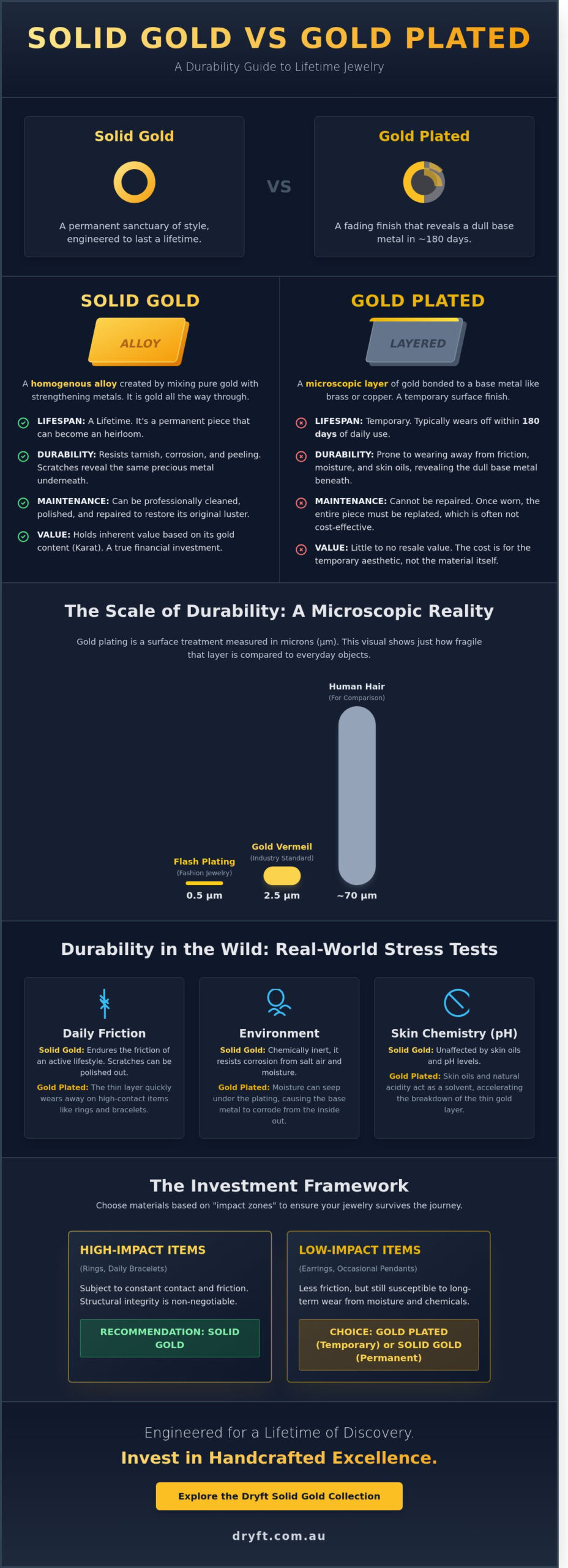
The pursuit of the horizon requires gear that doesn’t falter when the pavement ends. For the modern adventurer, jewelry isn’t just an accessory; it’s a testament to endurance. The fundamental distinction between materials often dictates whether a piece becomes a lifelong heirloom or a discarded memory. When we weigh solid gold vs gold plated jewelry durability, we’re looking at the difference between a homogenous alloy and a surface-level bond. One is built for the long haul; the other is a temporary aesthetic solution designed for the short term.
The glow of gold has long symbolized unbound discovery. It’s the color of the sun setting over the Pilbara and the warmth of a remote campfire. However, achieving that look in 2026 involves a choice between integrity and cost. We now view jewelry through the lens of jewelry engineering. This perspective treats a ring or a necklace like a piece of high-end recovery gear. It must be designed to withstand the elements, sweat, and the mechanical friction of an active lifestyle. Understanding the technical reality of these metals is the first step in selecting a sanctuary of style that lasts.
What is Solid Gold? The Uncompromising Standard
Solid gold is the benchmark for reliability. It’s an alloy created by mixing pure gold with strengthening metals like copper, silver, or zinc. We measure this in karats. A 9k piece contains 37.5% pure gold, 14k contains 58.5%, and 18k reaches 75%. While 24k is 100% pure gold, it’s far too soft for the rugged demands of daily life in Australia. It scratches with the slightest contact; it’s impractical for anyone who actually works with their hands or explores the bush.
The strength of solid gold lies in its consistency. It’s gold all the way through. If you scratch an 18k band while adjusting a tire or hiking a ridge, the metal underneath is the same color and composition. This inherent value ensures that the piece won’t tarnish or peel. It’s a metal that survives the salt spray of the coast and the red dust of the interior without losing its soul. It’s the ultimate symbol of a life lived without limits.
The Mechanics of Gold Plating: A Gilded Surface
Gold plating operates on a different set of physics. It’s a surface treatment where a microscopic layer of gold is bonded to a base metal like brass, copper, or nickel. This is achieved through the gold plating process, which uses an electric current to move gold ions onto the surface of the cheaper metal. While it looks identical to solid gold at the point of purchase, the technical reality is far more fragile.
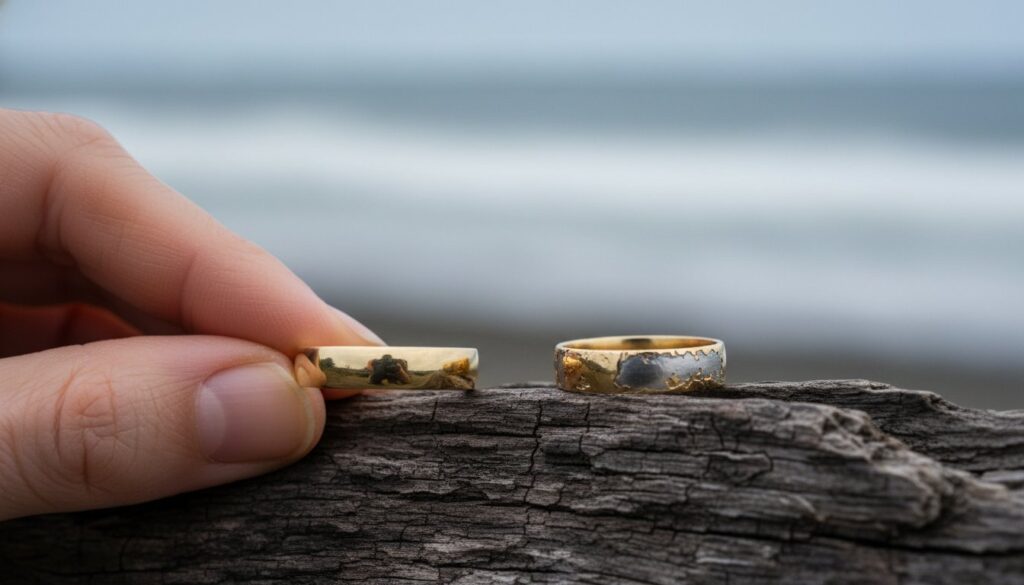
The thickness of this layer is measured in microns. Standard fashion jewelry often features “flash plating” at a mere 0.5 microns. Even high-quality gold vermeil, which uses a sterling silver base, only requires a 2.5 micron layer to meet industry standards. For context, a single human hair is roughly 70 microns thick. This thin skin is destined to return to its base state. Friction, skin oils, and moisture eventually wear the gold away, revealing the duller metal beneath. It’s a finish with a shelf life; it’s unsuitable for those who demand gear as tough as the landscapes they traverse.
Engineering the Glow: Structural Integrity and Resistance to Wear
True luxury isn’t fragile. It’s engineered to survive the dust of the Tanami and the salt of the Ningaloo. When we examine solid gold vs gold plated jewelry durability, the conversation starts at the molecular level. Solid gold functions as an elemental sanctuary. Because it’s chemically inert, it doesn’t react with oxygen or moisture. It won’t oxidize. It won’t tarnish. Base metals like brass or bronze, often hidden under a plated facade, lack this inherent stability. They’re prone to internal corrosion that eventually migrates to the surface, destroying the aesthetic from the inside out.
Mechanical excellence is the foundation of any piece designed for a high-performance lifestyle. Handcrafted jewelry requires a structural integrity that handles the friction of daily movement. Solid gold provides a consistent density throughout the entire piece. This means that if you catch a ring against a gear shifter or a limestone ledge, the metal underneath is the same precious material you see on the surface. According to the FTC guidelines for jewelry, these standards ensure consumers understand the purity and lasting power of their investment.
Hardness vs. Durability: The Alloy Advantage
Pure 24k gold is too soft for the rigours of the Australian outback. It bends. It bruises. To create a piece that’s trail-ready, master jewellers blend gold with silver, copper, and zinc. These alloys act as a chassis, providing the necessary rigidity to hold precious stones and maintain form under pressure.
- 14k gold consists of 58.3% pure gold, offering the highest resistance to bending and scratching in the luxury category.
- 18k gold contains 75% pure gold, providing a richer colour while remaining significantly more durable than pure 24k.
- 14k gold is the industry standard for durability in high-friction items because its 58.3% gold content is perfectly balanced with hardening alloys to resist deformation.
The Failure Points of Gold Plating
Gold plating is a thin skin, often measuring between 0.5 and 2.5 microns. For context, a human hair is roughly 70 microns thick. This microscopic layer is vulnerable to physical abrasion and chemical reactions. In high-friction areas like the joints of a bracelet or the underside of a ring, the gold layer wears away quickly, exposing the dull base metal beneath. This creates a “pitting” effect where moisture reaches the core through microscopic pores, leading to irreversible greening or dark spots.
A scratch on a plated surface is a permanent failure. Unlike solid gold, which can be polished back to its original lustre without losing its colour, a scratched plated piece reveals its utilitarian heart. This compromise is unacceptable for those seeking a sanctuary of enduring quality in their personal kit. When the gold is gone, the piece is effectively retired, proving that the initial savings of plating often result in a higher long-term cost of replacement.
Durability in the Wild: How Real-World Environments Impact Your Pieces
Australia’s landscape is a relentless testing ground. Whether you’re navigating the salt spray of the Ningaloo Coast or the fine, abrasive red dust of the Kimberley, your jewelry faces a constant barrage of environmental stressors. The core of the solid gold vs gold plated jewelry durability debate lies in how these materials respond to the wild. Solid gold is an inert sanctuary. It doesn’t oxidize or react to the high humidity of the tropical north. It remains unchanged by the salt air that quickly corrodes lesser metals.
Gold plating tells a different story. Most plated pieces feature a thin layer of gold, often only 0.5 to 2.5 microns thick, over a base of brass or copper. Real-world environments act as a slow solvent. Your skin’s natural pH, which typically sits between 4.7 and 5.7, is acidic enough to eventually leach through the gold layer and trigger a chemical reaction with the base metal. This leads to the dreaded green skin tint and the eventual peeling of the finish. For the adventurer who wants a piece that never leaves their body, solid gold is the only engineered solution that survives the transition from a dusty trail to a five-star dinner without losing its lustre.
Chemical Exposure: Chlorine, Sweat, and Perfume
Chlorine is a brutal adversary for jewelry. In a swimming pool, the chemicals used for sanitation can cause stress corrosion cracking in the base metals found under gold plating. This structural failure happens from the inside out. Solid gold remains stable. It handles the sweat of a midday hike and the chemicals in your evening fragrance with ease. To protect your horizon of jewelry during outdoor activities, rinse your pieces in fresh water after ocean or pool sessions. This simple habit removes abrasive salts and lingering chemicals. It’s a pragmatic approach to maintaining that “grit and glamour” aesthetic Dryft explorers demand.
The Restoration Factor: Resizing and Repair
The restoration factor is where the divide becomes absolute. Solid gold is a lifetime investment because it’s a homogenous material. A jeweler can solder, resize, or deep-polish a solid gold ring without destroying its essence. It’s built for the long haul. Plated jewelry is essentially disposable once the surface is compromised. The intense heat required for soldering destroys the gold film, leaving the piece scorched and unwearable. If your lifestyle involves heavy-duty exploration, choose metals that can be serviced. You can find more preservation techniques in this jewelry care guide to ensure your handcrafted luxury lasts for decades. Investing in solid gold means your gear is as tough as your rig.
The Investment Framework: Choosing the Right Metal for the Journey
Selecting jewelry is an exercise in engineering. You wouldn’t choose a standard highway tyre for a trek across the Kimberley; similarly, you shouldn’t choose a metal based on its surface shimmer alone. The decision relies on the “impact zone.” This pragmatic framework ensures your collection survives the transition from a refined dinner to the rugged reality of the trail. It’s about aligning the material’s structural properties with the physical demands of your lifestyle.
For readers who are also looking to upgrade their broader range of lifestyle gear and home accessories, you can visit Shopperdot to explore a diverse marketplace of consumer goods.
High-Impact vs. Low-Impact Jewelry
The “Ring Rule” is the foundation of any durable collection. Because your hands are in constant contact with the world, anything worn on the fingers must be solid gold. Plated rings often show significant wear within 12 months of daily use in Australia’s climate, as the thin gold layer succumbs to friction and moisture. Solid gold provides the structural safety required for pieces that encounter high-impact environments. It doesn’t peel or flake; it simply develops a soft patina that tells the story of your travels.
Necklaces and earrings occupy a lower impact zone. They don’t face the same mechanical stress as a ring, allowing more room for experimental fashion or larger statement pieces. However, even in these categories, the setting matters. For example, high-quality baroque pearl drop earrings benefit immensely from solid gold settings. The gold provides a secure, non-reactive sanctuary for the organic pearl, ensuring the piece remains a staple for years rather than a single season.
Building a Legacy Collection
Building a collection is about moving away from disposable accessories and toward an Outback-proven heirloom set. This shift requires a long-term view of value. When you calculate the true cost-per-wear over a ten-year horizon, the math favors solid gold. A solid gold band costing A$1,200 retains its intrinsic metal value and requires zero replacements. A A$150 gold-plated alternative that needs replacing every 18 months will cost you A$1,200 by year twelve, yet you’ll own nothing but a collection of tarnished base metal.
Durability and ethical sourcing are two sides of the same coin. A piece that lasts fifty years is inherently more sustainable than a dozen pieces that end up in a landfill. There’s a profound emotional weight to jewelry that can be passed down to the next generation. It’s a tangible link between your adventures and those who follow. When you weigh solid gold vs gold plated jewelry durability, you’re choosing between a temporary flash and a permanent legacy. You’re investing in quiet luxury that’s built to endure the harsrior conditions without losing its refined edge.
Ready to invest in pieces that match your spirit of discovery? Explore the Dryft collection for gear and inspiration designed for the modern trailblazer.
The Dryft Philosophy: Handcrafted Excellence for the Modern Adventurer
At Dryft, we don’t design for the showroom. We design for the horizon. Our signature pieces prioritize 14k and 18k solid gold alongside high-quality freshwater pearls because these materials possess a technical resilience that matches the Australian landscape. When you’re navigating the salt-heavy air of the Ningaloo Coast or the humid tracks of the Daintree, your jewelry faces a relentless environment. In the context of solid gold vs gold plated jewelry durability, solid gold is the only choice that offers a permanent sanctuary of style. It doesn’t surrender its luster to the elements or flake away after a season of hard use. It remains as steadfast as a well-built chassis.
We see jewelry as a gateway for life-changing experiences. Every piece is a fusion of technical precision and evocative lifestyle design, intended to move seamlessly from a dusty trail to a premium interior. By choosing materials that endure, we ensure your jewelry becomes a physical record of your journey rather than a disposable accessory. The final verdict is simple: durability is the ultimate form of sustainable luxury. A piece that lasts a lifetime is inherently more ethical than a dozen pieces that end up in a landfill.
Craftsmanship Over Mass Production
A machine-stamped plated ring is an exercise in planned obsolescence. It’s built for volume, not for the rigors of an unbound life. Dryft takes a different path, focusing on hand-finished solid gold bands that reflect our “rugged elegance” aesthetic. This approach allows us to inspect every setting and edge, ensuring the piece can handle the vibration and impact of an active lifestyle. Our commitment to quality is deeply rooted in our sourcing standards. You can learn more about our dedication to transparency in our guide to ethical jewelry australia, where we detail how we balance high-end luxury with conscious sourcing.
- Hand-finished pieces offer superior structural integrity compared to mass-produced alternatives.
- Solid gold provides a weight and density that plated metals can’t replicate.
- Our designs are tested against the unique challenges of the Australian outback.
Your Next Step Toward Unbound Luxury
Investing in quality is a pragmatic decision for the modern explorer. We invite you to explore our collection of handcrafted essentials, each one engineered to be a lifelong companion. Because we believe in the longevity of our work, we provide professional maintenance and repair for every Dryft piece. If your adventures leave a mark, our craftsmen can restore the original brilliance of the metal without compromising its strength. It’s time to move beyond the fragile nature of solid gold vs gold plated jewelry durability debates and choose gear that mirrors the strength of the land. Choose a piece that’s as ready for the wild as you are.
Investing in Your Unbound Legacy
True luxury isn’t about the initial flash. It’s about how a piece performs five years into a journey. Engineering your personal aesthetic requires the same precision as a remote expedition. The data is clear. Plated layers typically wear thin within 500 days of active use, whereas 14k or 18k solid gold maintains its structural integrity for generations. This distinction is the core of the solid gold vs gold plated jewelry durability debate. You need a piece that withstands the salt air of the coast and the red dust of the interior without faltering.
We handcraft every item right here in Australia, integrating ethically sourced freshwater pearls and diamonds into designs built for the wild. Our professional repair and maintenance services ensure your investment remains a steadfast companion on every horizon you chase. It’s time to secure a piece that matches your spirit. Explore our collection of handcrafted, solid gold sanctuaries. The path ahead is yours to define; wear something that can keep up.
Frequently Asked Questions
Is solid gold more durable than gold plated jewelry?
Solid gold is significantly more durable than gold plated jewelry because the precious metal exists through the entire cross-section of the piece. When comparing solid gold vs gold plated jewelry durability, the lack of a base metal in solid gold means there’s no layer to flake or wear away. It’s a piece of engineered luxury designed to withstand decades of use without losing its essence or value.
How long does gold plated jewelry actually last before it fades?
Most gold plated pieces maintain their lustre for 6 to 24 months before the base metal begins to surface. This lifespan depends heavily on the thickness of the plating, usually measured in microns. In the harsh Australian sun or high humidity coastal regions, the chemical reaction with sweat and salt air often accelerates this degradation. It’s a fleeting finish compared to the permanence of solid gold.
Can you shower or swim with gold plated jewelry on?
You should avoid wearing gold plated jewelry in the shower or the surf. Chlorine in pools and salt in the ocean act as abrasives that strip the gold layer within weeks. Even the minerals in Australian tap water can dull the finish. To protect your investment, remove these pieces before any water-based adventure to ensure the thin gold coating remains intact.
Does solid gold scratch easily compared to plated jewelry?
Solid gold is softer than the base metals like brass or steel used in plated jewelry, meaning it can develop surface scratches. These marks are often called a patina, reflecting a life of movement and discovery. While the surface might show wear, the value remains. You can easily buff out these scratches, unlike plated items where polishing might remove the gold layer entirely.
What is the best gold karat for everyday durability?
9k or 14k gold provides the optimal balance of purity and resilience for daily wear. In Australia, 9k gold is a popular standard because its higher alloy content makes it harder and less prone to bending. While 24k is pure, it’s too soft for the grit of an active lifestyle. Choosing a lower karat ensures your piece survives the transition from the boardroom to the outback.
Is gold vermeil more durable than standard gold plating?
Gold vermeil is significantly more durable than standard plating because it requires a minimum thickness of 2.5 microns of gold over a sterling silver base. Standard plating is often as thin as 0.5 microns. This fivefold increase in gold content provides a more robust barrier against the elements. It offers a premium feel that bridges the gap between high-street fashion and heirloom quality.
Can gold plated jewelry be replated once it wears off?
You can replate gold jewelry, though the process often costs between A$50 and A$150 depending on the piece’s complexity. Professional jewellers strip the remaining gold and apply a fresh layer through electroplating. While this restores the aesthetic, the cycle of wear will eventually repeat. It’s a maintenance task that many find less practical than simply investing in solid gold from the start.
Why does some gold plated jewelry turn your skin green?
Skin discolouration occurs when the thin gold layer wears down, allowing base metals like copper to react with your skin’s acidity. This chemical reaction creates copper carbonate, which leaves a green residue. High humidity levels in parts of Queensland or the Northern Territory can trigger this faster. Choosing solid gold eliminates this risk, providing a seamless experience for those with sensitive skin. To further support skin health when wearing various jewelry types, BodyJ4You provides specialized care products and high-quality accessories.