
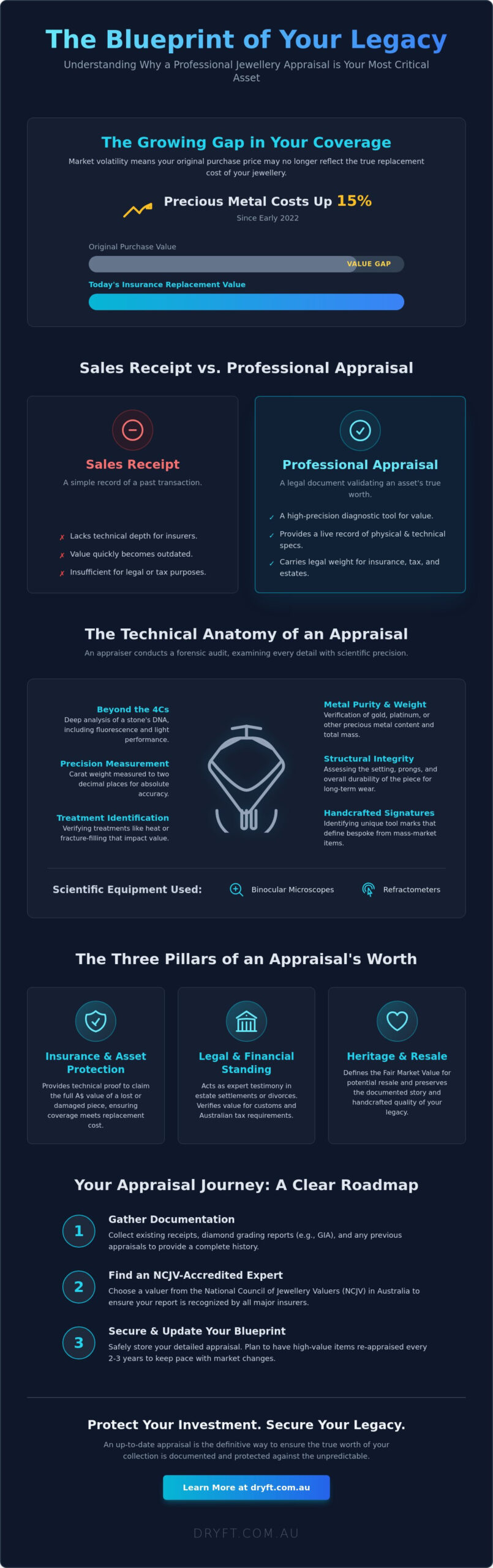
What if the most critical component of your heirloom isn’t the diamond itself, but the technical document that validates its existence? You’ve invested in quality that reflects a life unbound, yet many Australians discover too late that their insurance coverage hasn’t kept pace with the 15% rise in precious metal costs seen since early 2022. It’s unsettling to realize you might be under-insured, or to feel confused by the gap between a retail price tag and actual replacement value.
Understanding exactly what is a jewelers appraisal for provides the ultimate peace of mind for your collection. This article reveals how a professional valuation acts as a sophisticated blueprint, protecting your investment and securing your legacy through rigorous technical validation. We will explore the essential differences between market price and replacement costs, while providing a clear, Australian-specific roadmap for verifying the ethical origins and handcrafted quality of your most precious items.
Key Takeaways
- Move beyond the standard sales receipt to understand how a legal, technical document provides the definitive blueprint of your collection’s true worth.
- Gain insight into what is a jewelers appraisal for by examining how it secures your investment against Australian market shifts and provides the foundation for accurate insurance coverage.
- Explore the engineered approach of professional valuation, where scientific equipment and microscopic analysis verify the technical integrity of every gemstone and setting.
- Learn how to navigate the appraisal journey by identifying NCJV-accredited experts and gathering the documentation required to protect your legacy.
- Discover the synergy between professional maintenance and valuation, ensuring your jewellery retains its refined luxury even throughout a lifestyle of movement and adventure.
Defining the Jewellery Appraisal: More Than Just a Price Tag
A jewellery appraisal isn’t a mere slip of paper handed over at a retail counter. It’s an exhaustive, technical document that maps every facet of an item with surgical precision. To understand what is a jewelers appraisal for, you must view it as a high-precision diagnostic tool. It details metal purity, gemstone weight, and structural integrity with the same rigour an engineer applies to a custom off-road chassis. While a sales receipt records a past transaction, a professional Appraisal serves as a live record of an asset’s physical and technical specifications.
The appraiser operates as your technical guide. They translate the complex language of mineralogy and metallurgy into a document with legal standing. They don’t just guess a price. They verify the authenticity of the materials. In a global market where gold prices in Australia fluctuated by more than 15 percent throughout 2023, these documents are essential. They ensure your collection’s recorded value keeps pace with the volatile reality of the Australian Dollar and global commodity shifts.
Appraisal vs. Valuation: Understanding the Nuance
The terms are often used interchangeably, but the distinction matters for your portfolio. The appraisal is the investigative process, the deep dive into the stone’s clarity and the metal’s weight. The valuation is the resulting figure based on that data. In the Australian market, you’ll typically encounter Replacement Value for insurance or Fair Market Value for resale. Jewellery worth exists at the exact intersection where technical specifications meet the emotional legacy of a personal sanctuary.
The Legal and Financial Weight of the Document
A standard receipt is insufficient for high-value handcrafted items. It lacks the descriptive depth required by insurers or the Australian Taxation Office. Professional appraisals carry significant weight in several areas:
- Legal Disputes: They serve as expert witness testimony during estate settlements or divorces.
- Customs and Tax: They verify ownership and value for national tax requirements or when transporting assets across international borders.
- Asset Protection: They provide the technical proof needed to claim the full A$ value of a lost or damaged bespoke piece.
You can’t rely on a decade-old document. The market moves too fast. When you’re asking what is a jewelers appraisal for, remember it’s about proof of existence and proof of quality. It’s the blueprint that ensures your most refined assets are protected against the unpredictable, whether you’re in the heart of the city or on a dusty trail in the Kimberley.
The Technical Anatomy: What an Appraiser Actually Examines
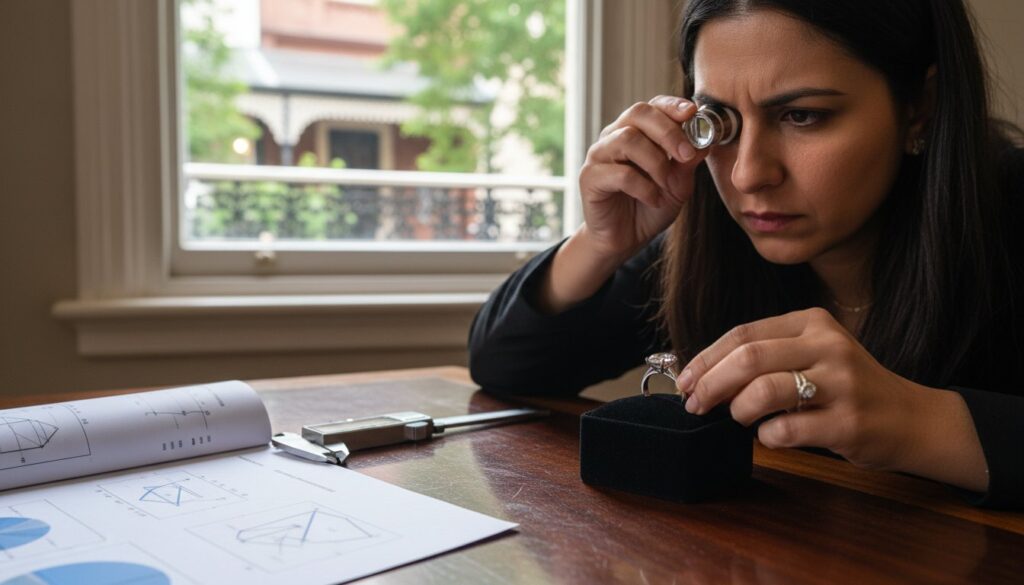
An appraisal is a forensic blueprint of your collection. It represents the intersection of raw geological wonder and human precision. When you ask what is a jewelers appraisal for, you’re looking for a technical validation of an asset. It’s an engineered approach to value. Experts don’t just glance at a ring; they conduct a mechanical audit. They use scientific equipment like binocular microscopes and refractometers to peer into the molecular structure of your pieces. This process verifies that the sanctuary of your collection is built on a foundation of genuine quality.
Appraisers document the handcrafted signature of every piece. They look for the unique tool marks and finishing techniques that separate mass-market items from bespoke luxury. This documentation acts as a digital thumbprint for your jewellery. It ensures that the story of the piece, from the workbench to your hand, is preserved with absolute clarity.
Gemstone Evaluation: Beyond the 4Cs
Precision is the baseline in gemstone analysis. While many know the 4Cs, a professional appraisal goes deeper into the stone’s DNA. Carat weight is measured to two decimal places. Clarity is mapped with a focus on internal characteristics that prove a stone’s natural origin. Appraisers identify treatments like heat or fracture filling that impact long-term durability.
The role of fluorescence and light performance is critical here. These factors determine how a diamond reacts to the harsh, bright light of the Australian sun. To ensure your report carries weight with insurers, it’s essential to find an appraiser who understands these nuances. They integrate ethical sourcing data, such as GIA grading or pearl origin reports, into the final document to confirm the stone hasn’t just been found, but ethically harvested.
Metal Purity and Structural Integrity
The metal is the chassis of your jewellery. It provides the structural strength required for a lifetime of wear. Appraisers test for gold karats, distinguishing between 14k and 18k, or verifying the purity of platinum. They inspect the integrity of the prongs, clasps, and settings. This is a safety check. A loose prong is a mechanical failure waiting to happen.
Documenting hallmarks and maker’s marks is a priority. These stamps signify Australian-made authenticity and heritage. They are badges of honour for local craftsmanship. Understanding what is a jewelers appraisal for means recognizing that your piece is more than an ornament; it’s a piece of high-end engineering. If you value equipment that is built to last, you understand the importance of this outback-proven luxury
The Three Pillars of Worth: Insurance, Resale, and Heritage
Determining what is a jewelers appraisal for requires a shift in perspective. Value isn’t a fixed point on a map; it’s a calculated response to a specific need. A valuation for a bespoke piece engineered for the modern adventurer serves a different master than a report destined for a quick resale. Market volatility in precious metals, like the 15% surge in gold prices seen in 2023, dictates that your coverage must evolve. Bespoke items demand a specialized strategy. They aren’t just accessories; they’re high-end engineering for the soul, requiring a valuation that respects the grit and glamour of their creation.
Insurance Appraisals: Protecting Your Sanctuary
Insurance appraisals focus on “Replacement Value,” which acts as a financial sanctuary against theft or loss. Most Australian insurers mandate a fresh appraisal every 2 to 3 years to keep pace with the rising costs of labor and raw materials. A high-precision report ensures your handcrafted pearl jewelry is replaced with a piece of identical luster and grade rather than a generic substitute. It’s vital to understand the fine print of your policy. “Agreed value” policies pay a fixed sum determined at the time of the contract, while “market value” policies adjust based on the current cost to replace the item at the time of the claim.
Fair Market Value: The Reality of Resale
Fair Market Value defines what your jewellery is worth in an unbound market between a willing buyer and seller. It’s the pragmatic reality of the secondary market. The current “Quiet Luxury” trend has shifted buyer interest toward unique, handcrafted designs, often resulting in a 10% to 15% premium over brand-name items that lack character. Ethical premiums are also a significant factor. Modern buyers in Australia are increasingly willing to pay more for pieces with verified origins and sustainable materials. A professional appraisal captures these nuances, ensuring you don’t leave money on the table during a private sale or auction.
Estate and Tax Appraisals: Securing the Legacy
Appraisals provide the blueprint for a seamless transition of wealth. They allow for the equitable distribution of heirlooms, ensuring each family member receives a fair share of the physical legacy without conflict. Beyond family harmony, these valuations are vital for Australian Capital Gains Tax (CGT) obligations and estate planning. A professional appraisal preserves the narrative of the piece. It bridges the gap between the original explorer and the next generation, documenting the technical excellence and history that make the item a true sanctuary of value. It ensures the story of your collection remains intact as it crosses new horizons.
The Appraisal Journey: How to Prepare Your Collection
Preparing your collection for a formal valuation is much like prepping a high-end hybrid camper for a trek across the Kimberley. It requires a meticulous eye for detail and a commitment to technical precision. Before you book an appointment, you must understand what is a jewelers appraisal for beyond a simple insurance requirement. This process is an engineered audit of your assets, providing a sanctuary of clarity for your investment portfolio. It transforms a beautiful object into a documented asset with a clear, unbound history.
Selecting an Expert Guide
The Australian market demands a high standard of expertise. You should seek a valuer who holds credentials from the National Council of Jewellery Valuers (NCJV). These professionals are trained to provide unbiased reports, which is why choosing an independent appraiser over a floor salesperson is vital. Sales staff often focus on the transaction; an appraiser focuses on the truth. Ask potential experts about their specific experience with ethical jewelry and sustainable sourcing. Ensure they carry professional indemnity insurance and maintain a laboratory equipped with high-grade refractometers and spectrometers. This level of technical excellence mirrors the rugged reliability you expect from premium Australian engineering.
Preparing Your Documentation
A successful appraisal relies on the “provenance” or the documented life story of your piece. Gather every fragment of history you own. This includes original GIA or HRD certificates, sales receipts from the date of purchase, and any past repair logs. If you have followed a consistent jewelry care guide, those maintenance records prove the piece has been preserved in peak condition. Clean your items thoroughly using a soft brush and mild solution before the meeting. Dirt can hide inclusions or mask the true colour of a stone, leading to an inaccurate grade. A clean piece allows the valuer to inspect the “chassis” of the setting and the “engine” of the gemstone without obstruction.
The appraisal typically unfolds in two distinct phases:
- The Inspection Phase: The valuer performs a physical audit. They measure dimensions, weigh the metal in grams, and identify stone characteristics under 10x magnification.
- The Research Phase: This happens behind the scenes. The expert consults current market data, often looking at A$ exchange rates and global diamond indices to determine the replacement value in the current Australian retail climate.
This rigorous approach ensures that your collection is ready for any horizon. Whether you are looking to secure insurance or simply want to understand the true worth of your handcrafted luxury, the blueprint provided by a professional valuer is your most reliable tool.
Ready to explore the pinnacle of craftsmanship? Discover the Dryft philosophy of movement and luxury.
Safeguarding Your Investment: The Intersection of Grit and Glamour
True luxury isn’t meant to be locked in a safe; it’s meant to be lived in. For the modern adventurer, a collection of fine jewelry and precision timepieces, like those curated by Luxury of Watches, is a constant companion through the red dust of the Kimberley and the salt air of the Whitsundays. Understanding what is a jewelers appraisal for becomes critical when your lifestyle involves movement, vibration, and the unpredictability of the Australian wild. It’s the technical bridge between a beautiful object and a secured financial asset. An appraisal acts as a blueprint of worth, ensuring that your investment is documented with the same precision used to engineer a high-end off-road chassis.
Maintenance as Value Protection
Professional appraisals do more than just assign a price tag. They serve as a vital health check for your most prized possessions. Periodic servicing prevents the subtle structural degradation that inevitably lowers an appraised value over time. When you are styling gold jewelry for a rugged expedition, you’re relying on the mechanical integrity of the metal. Our Outback-proven durability ensures that even the most delicate-looking high-end settings can withstand the rigours of off-road travel. If a claw is worn or a setting is compromised, the risk of losing a stone increases significantly. Data from the National Council of Jewellery Valuers (NCJV) indicates that gemstone loss due to unnoticed mechanical wear is one of the leading causes of insurance underpayment. Dryft pieces are specifically engineered to hold their value through superior engineering, using reinforced prongs and high-density alloys that resist the fatigue of a life spent on the move.
Your Next Step: The Professional Consultation
View your next appraisal as a proactive strategy rather than a reactive chore. It’s the final piece of the puzzle in building a collection that’s as resilient as it is refined. Once you’ve clarified what is a jewelers appraisal for, you should integrate your documents into a digital vault. This ensures that whether you’re at a coastal campsite or crossing the Simpson Desert, your certificates and valuations are accessible via secure cloud storage. It’s about the peace of mind that comes from knowing your sanctuary of style is fully documented and protected against the unknown. We invite you to discuss your bespoke needs with the Dryft team to ensure your next investment is built for the horizon. Our expertise in combining mechanical excellence with aesthetic brilliance means your collection will always be ready for the journey ahead, maintaining its prestige and its price point in the Australian market.
Defining Your Collection’s Future
Your collection is more than a set of assets; it’s a narrative of your journeys and a testament to your taste. A professional valuation provides the technical blueprint required for insurance and heritage planning. It transforms a beautiful object into a documented legacy. Understanding what is a jewelers appraisal for ensures your investment remains protected against the unpredictable Australian landscape. You’ve worked hard to curate a life of adventure. Your jewellery should reflect that same standard of resilience and refined luxury. This process provides the technical assurance needed to protect your assets while you pursue the horizon.
At Dryft, we bridge the gap between the rugged outback and sophisticated craftsmanship. Every piece in our collection embodies Australian-made authenticity. We use ethically sourced pearls and diamonds, ensuring your sanctuary of style is built on a foundation of integrity. Our bespoke engineering is designed for the modern adventurer who demands excellence in every environment. Whether you’re navigating the city or the red dust of the interior, quality remains your constant companion.
Explore the Dryft Collection of Handcrafted Luxury
Step into a world where grit meets glamour and your legacy is as enduring as the horizon.
Frequently Asked Questions
How often should I get my jewellery appraised for insurance?
You should update your jewellery appraisal every 2 to 3 years to ensure your coverage keeps pace with global market shifts. Precious metal prices and gemstone values fluctuate constantly. An outdated valuation might leave you underinsured if a loss occurs. Most Australian insurers require a current document, typically less than 36 months old, to guarantee a full replacement at contemporary retail prices.
Is a jewellery appraisal the same as a diamond certificate?
A jewellery appraisal is not the same as a diamond certificate. A certificate, such as one from the GIA, identifies the technical stone characteristics like cut and clarity. Conversely, understanding what is a jewelers appraisal for involves looking at the current market value and replacement cost for the entire piece. One defines the DNA of the stone; the other defines the financial worth.
Can I use a jewellery appraisal to sell my items for the full appraised price?
You cannot typically sell jewellery for the full appraised price because valuations usually reflect retail replacement costs rather than resale value. Most appraisals are written for insurance purposes, representing what it costs to buy the item brand new. When selling, you’ll likely receive 20% to 50% of the appraised value. This depends on whether you sell to a private buyer or a dealer.
What is the average cost of a professional jewellery appraisal in Australia?
The average cost of a professional jewellery appraisal in Australia ranges from A$100 to A$250 for a standard item. Some valuers charge a flat fee per piece, while others may charge based on the time required for complex settings. Avoid appraisers who charge a percentage of the item’s value. This practice is considered unethical by the National Council of Jewellery Valuers because it creates a conflict of interest.
Do I need an appraisal for silver jewellery or just gold and diamonds?
You generally don’t need an appraisal for standard silver jewellery unless it’s a rare designer piece or a significant antique. The cost of the appraisal often exceeds the replacement value of the silver itself. Focus your resources on gold, platinum, and high-quality gemstones. If a silver item retails for over A$500, then a professional valuation becomes a practical investment for your collection records.
What happens if my appraisal is outdated and I need to make an insurance claim?
If your appraisal is outdated during an insurance claim, you risk being significantly underinsured. If a ring valued at A$5,000 in 2018 now costs A$8,000 to replace, the insurer may only pay out the lower original amount. You’ll have to cover the A$3,000 gap yourself. Regular updates ensure your sanctuary of assets remains fully protected against modern market realities and price hikes.
Does a jewellery appraisal include a photo of the item?
A professional jewellery appraisal always includes at least one high-resolution photograph of the item. This visual record is vital for identification if the piece is stolen or lost. The document will also detail measurements, weights, and any unique hallmarks. It provides a complete blueprint of your collection, combining technical data with clear imagery to satisfy both police and insurance requirements during an investigation.
Can an appraiser tell if my diamonds or pearls are ethically sourced?
An appraiser can often verify if modern diamonds are ethically sourced by checking for laser inscriptions or Kimberley Process certification. Understanding what is a jewelers appraisal for includes verifying these origins where possible. However, it’s harder to track the exact provenance of antique pearls or older gemstones. Professional valuers use specialized equipment to detect lab-grown alternatives, ensuring your investment aligns with your personal values.