
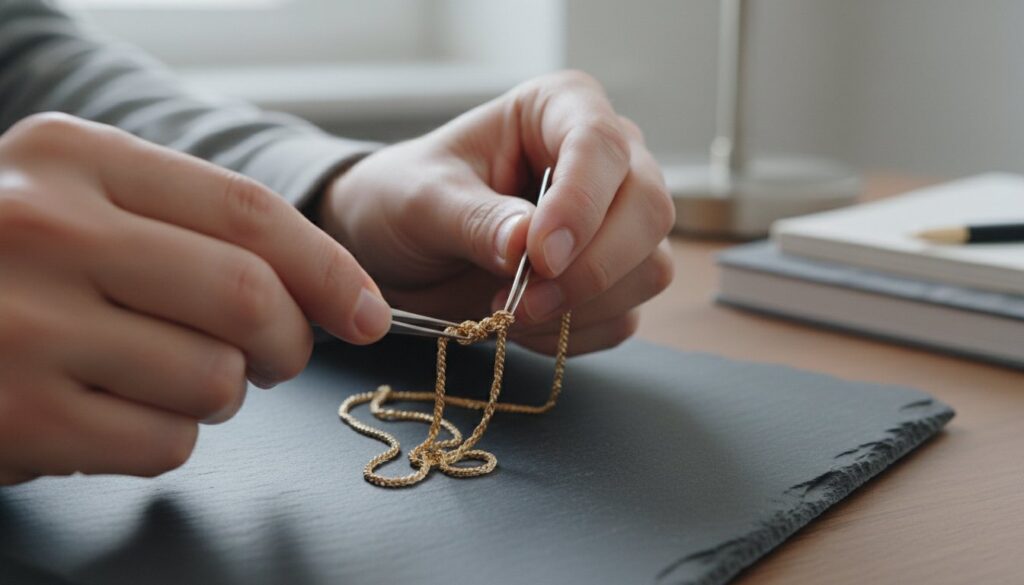
It’s 6:30 PM on a Saturday, and your evening plans are held hostage by a microscopic knot in your favourite gold link. We have all felt that sharp spike of frustration when a prized piece of jewellery becomes a chaotic snarl. It’s a test of patience that often ends in a forced pull, a snapped link, and a costly trip to a boutique jeweller where professional repairs frequently exceed A$150 for a single delicate join. Knowing how to untangle a delicate necklace chain with precision is the only way to save your evening and your investment.
We agree that your jewellery should be a sanctuary of style, not a source of stress. You will learn the methodical, engineered approach required to restore the metal to its fluid, unbound state without risking a permanent break. We are going to walk you through the precise tools and steady-handed techniques required to master this patient art, ensuring your most cherished pieces are always ready for your next adventure.
Key Takeaways
- Establish a precision-focused sanctuary using high-contrast backgrounds and fine-tipped tools to master the mechanical reality of complex knots.
- Discover the professional protocol for how to untangle a delicate necklace chain by identifying the ‘heart’ of the entanglement before applying pinpoint lubrication.
- Protect the integrity of your collection by learning why 14k gold and freshwater pearls require material-specific techniques to avoid permanent surface damage.
- Engineer a seamless, tangle-free travel experience using the ‘straw hack’ to ensure your most delicate pieces remain unbound and ready for the next horizon.
Understanding the Physics of the Tangle
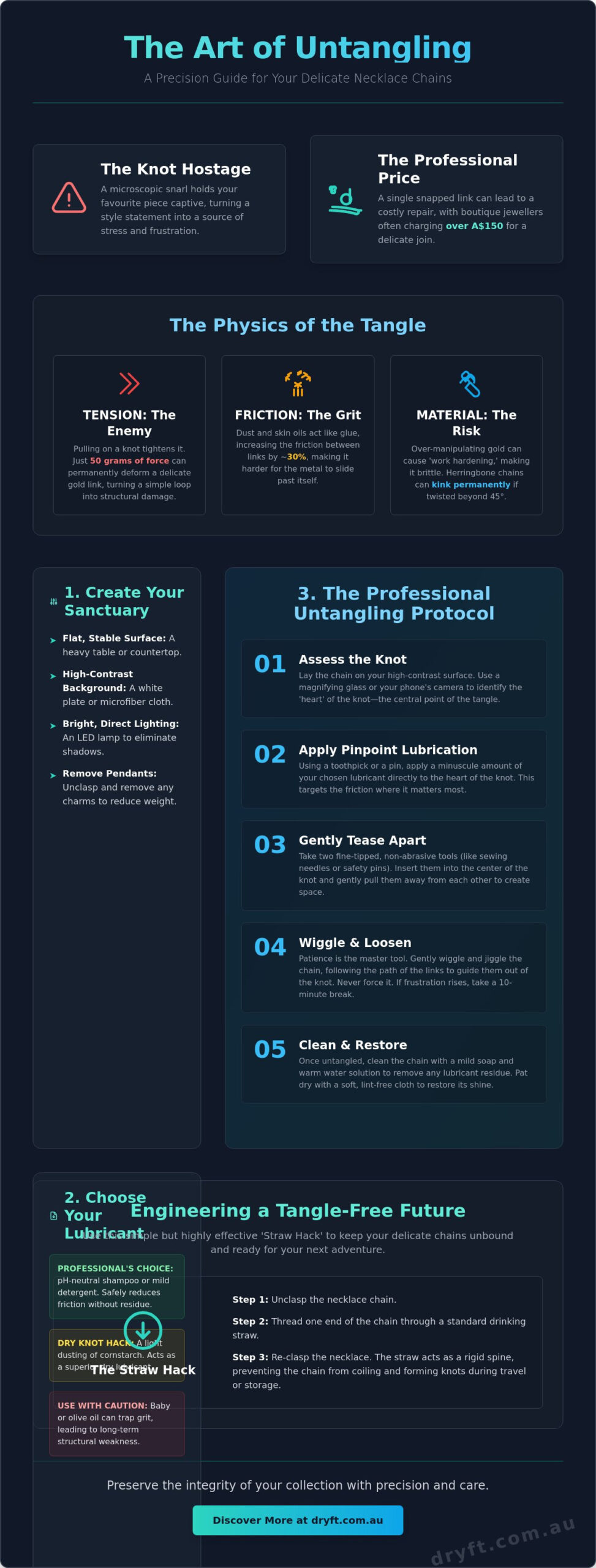
A delicate 18k gold chain represents a masterpiece of micro-engineering. These fine links, often measuring less than 0.5mm in diameter, offer a level of flexibility that is both a luxury and a liability. When stored loosely, the constant movement within a jewellery box creates what experts call the ‘Bird’s Nest’ phenomenon. This isn’t just a mess; it is a physical manifestation of mathematical knot theory, where random motion and high-friction surfaces collaborate to form complex geometric traps. Understanding how to untangle a delicate necklace chain requires recognizing that gold is a ductile metal. It yields under pressure, meaning that applying even 50 grams of force can turn a simple loop into a permanent structural deformity.
Tension is the primary enemy of the restoration process. When you pull on a knotted chain, you’re effectively reducing the internal diameter of the knot, locking the links into a tighter configuration. At Dryft, we believe your jewellery collection should be a sanctuary of order, not a source of frustration. Gentle maintenance is a philosophy of respect for the materials that accompany you on your journeys. Every fine chain deserves the same level of technical care as a high-performance chassis. Treating these items with a refined touch ensures they remain ready for your next adventure.
The Role of Surface Tension and Friction
Microscopic particles of dust and skin oils accumulate on metal surfaces over time. These contaminants increase the coefficient of friction between links by approximately 30%, making it significantly harder for the metal to slide past itself. A ‘dry’ tangle is often more stubborn because the links are physically gritted together. The specific style of the chain also dictates the complexity of the problem. Cable chains have a higher tolerance for movement, while herringbone styles consist of flat, slanted links. A herringbone chain can kink permanently if twisted beyond a 45-degree angle, making the untangling process a high-stakes operation that demands precision.
Why Delicate Chains Require a Professional Mindset
Approaching a knotted necklace requires the steady hand of a seasoned explorer. You must first distinguish between a loose loop and a structural knot. Over-manipulating 14k gold can lead to ‘work hardening,’ a process where the metal becomes brittle and prone to snapping after repeated bending. Setting the right emotional state is the first step toward success. Calm hands lead to clear chains. If you feel frustration rising, step away for 10 minutes to reset your focus. A relaxed grip prevents the accidental application of tension, ensuring you know how to untangle a delicate necklace chain without compromising the integrity of the precious metal.
Creating Your Restoration Sanctuary: Tools and Prep
Restoration is an exercise in patience and high-end engineering. Just as a seasoned explorer prepares their rig for the challenging terrain of the Kimberley, you must curate your environment before touching the metal. A cluttered desk is the enemy of fine links. You need a space that reflects the quiet confidence of a master craftsman, where every tool has a purpose and every movement is intentional. To master how to untangle a delicate necklace chain, you must first eliminate the chaos of your surroundings.
The Ideal Workspace Setup
Precision requires a stable foundation. Select a flat, immovable surface like a heavy timber table or a stone countertop. A white ceramic plate or a taut microfiber cloth serves as the perfect backdrop. These high-contrast surfaces ensure you don’t lose sight of the microscopic gaps between links. Lighting is your most critical asset. Position a bright LED lamp to illuminate the individual shoulders of the links, effectively erasing shadows that camouflage the heart of the knot. Before you begin, remove all pendants or charms. These add dead weight that tensions the cluster, making the task significantly more complex than it needs to be.
Choosing Your Lubricant Wisely
Friction is the primary obstacle when learning how to untangle a delicate necklace chain. Professional jewelers often reach for a pH-neutral shampoo or a mild detergent. This “Safe Soap” method reduces surface tension without leaving a corrosive chemical residue on 18k gold or sterling silver. It is the sophisticated choice for those who value the longevity of their collection.
While baby oil or olive oil are common household suggestions, use them with caution. These viscous liquids can trap microscopic grit inside the links, which may lead to structural weakness over time. If you are dealing with a particularly stubborn, dry knot, the cornstarch hack is a superior alternative. A light dusting of this fine powder acts as a dry lubricant, allowing the metal to slide against itself with minimal resistance. Much like the refined interiors of a premium off-road sanctuary, your workspace should feel organized and intentional. Having the right toolkit nearby ensures the process remains a calm ritual rather than a frustrating chore.
- Sewing Needles: Use two fine-tipped needles to gently tease the knot apart from the centre.
- Fine-tipped Tweezers: These provide the grip needed for steady, incremental movements.
- Magnifying Glass: A 10x jeweler’s loupe reveals the hidden logic of the tangle.
Prepare your tools with the same rigor you would use for a technical expedition. When the environment is controlled and the gear is professional, even the most daunting knots begin to yield. This preparation phase is the difference between a snapped chain and a successful restoration.
The Professional Untangling Protocol: Step-by-Step
Restoring a tangled chain requires the same technical patience and steady hand needed to calibrate a high-end suspension system. When you’re learning how to untangle a delicate necklace chain, speed is your enemy. Precision is your ally. Follow this engineered protocol to resolve even the most complex clusters without compromising the integrity of the metal.
- Step 1: Lay the chain flat on a solid, well-lit surface. A white background provides the necessary contrast to see the individual links. Identify the ‘heart’ of the knot where the tension is most concentrated.
- Step 2: Apply a pinpoint amount of lubricant. A single drop of mineral oil or high-grade baby oil works to reduce friction. Use a toothpick to place the oil directly onto the most congested area.
- Step 3: Use the ‘Double Needle’ technique to create internal space. This involves inserting two fine points into the centre of the mass to widen the gap from within.
- Step 4: Gently tease the outer loops away from the centre. Once you’ve created a small opening, use the needles to pull individual loops through the gap. Work slowly to avoid creating new points of tension.
- Step 5: Rinse and dry the chain. Use warm water and a mild detergent to remove any residual lubricant. Pat the piece dry with a lint-free cloth to restore its original lustre and prevent spotting.
The Double Needle Technique
This method provides the mechanical advantage needed for fine-gauge jewellery. By inserting two sewing needles into the centre of the knot, you create a microscopic ‘gap’ that allows the links to shift. The vibration method is a way to use gravity to loosen metal friction. Gently tap the needles against the hard surface while they’re inside the knot. This subtle movement encourages the links to settle and slide past one another, much like a chassis settling after a rugged track. It’s a game of millimetres that requires a calm, focused environment.
Managing ‘Impossible’ Knots
Some clusters are too tight for a needle to penetrate initially. When the metal feels fused, use the ‘rolling’ technique. Place the knot between your thumb and forefinger and apply light, circular pressure. This motion softens the cluster and creates enough play for the lubricant to seep into the inner links. It mimics the way a seasoned explorer might work a stubborn piece of recovery gear.
Know your limits to avoid permanent damage. If you’ve spent more than 20 minutes on a single knot or notice the links are beginning to stretch, it’s time to stop. Forcing a delicate piece can lead to a snap that requires professional jewelry repair and resizing. In Australia, a master jeweller can often resolve these issues in minutes using ultrasonic cleaners or specialized tools, preserving the value of your handcrafted luxury.
Material-Specific Nuance: Pearls, Gold, and Diamonds
Different terrains demand specific gear. Untangling a necklace follows the same logic. You wouldn’t take a standard city car into the Simpson Desert; similarly, you shouldn’t treat a strand of pearls like a heavy-duty steel chain. Understanding the material science of your jewellery ensures that the rescue mission doesn’t become a recovery disaster. Each material reacts differently to friction, tension, and foreign substances.
The Pearl Exception
Pearls are organic gems. Their nacre is porous and susceptible to chemical erosion. While oils or soaps might help you learn how to untangle a delicate necklace chain made of metal, these substances can permanently dull the lustre of handcrafted pearl jewelry. The silk thread used in pearl stringing absorbs liquids, leading to internal rot or permanent stretching.
Use the “Dry Method” for these delicate items. Lay the piece on a soft microfibre cloth. Use two wooden toothpicks to gently tease the knots apart. If the pearls are integrated into a metal chain, avoid all lubricants. If moisture is unavoidable for a stubborn knot, rinse briefly with distilled water and pat dry immediately. Never soak them.
Gold Malleability and Link Integrity
Gold is a soft metal. The higher the karat, the more vulnerable it is to mechanical damage. 18k gold contains 75% pure gold, making it significantly more malleable than 14k. When you’re figuring out how to untangle a delicate necklace chain made of high-karat gold, patience is your primary tool. Using steel sewing needles to pry at a knot can leave deep, permanent gouges in the soft surface.
Once the knot is gone, inspect the integrity of the links. Heavy tangles often lead to “stretched” links that look elongated or thin. This is particularly common with a gold herringbone necklace, where the flat, interwoven links are prone to kinking. If a link is compromised, it becomes a point of failure for future adventures. Check for gaps where the metal has been pulled beyond its elastic limit.
Handling ethical diamonds requires a focus on the setting. Ensure the “bird’s nest” of the tangle isn’t putting pressure on the prongs. A bent prong can lead to a lost stone in the outback. Once the chain is clear, restore the “Rugged Luxury” shine by polishing with a lint-free cloth. This removes fingerprints and skin oils, returning the piece to its showroom brilliance. It’s the final step in maintaining a sanctuary of style, even when you’re miles from the nearest city.
Ready to upgrade your collection with pieces built for the modern explorer? Explore our range of premium handcrafted jewellery designed for those who value both grit and glamour.
Engineering a Tangle-Free Future
Prevention is a matter of high-end engineering for your wardrobe. While learning how to untangle a delicate necklace chain is a vital skill for any explorer, building a system that prevents knots entirely is the mark of a seasoned collector. The most effective habit you can adopt is the Clasp First rule. By securing the clasp every time you take the piece off, you eliminate the loose ends that act as anchors for tangles. This single five-second action prevents 90% of common knots, ensuring your jewellery remains as ready for the horizon as you are.
For those moving between the city and the rugged coast, the Straw Hack offers a pragmatic solution for transit. Thread one end of your chain through a reusable straw and fasten the clasp. This simple bypass keeps the metal isolated and rigid, preventing the friction that leads to bird-nesting in your travel bag. A weekly five-minute maintenance check is also essential. Inspecting your collection every Sunday ensures that minor overlaps don’t evolve into complex structural failures.
- The Straw Hack: Keeps chains linear and isolated during high-vibration travel.
- Velvet-Lined Sanctuaries: Soft interiors provide the necessary friction to keep pieces from sliding.
- The Clasp First Rule: A foundational habit for 90% tangle reduction.
- Weekly Maintenance: A routine check to ensure your collection stays adventure-ready.
Smart Storage for the Modern Adventurer
Gravity is your best ally when it comes to fine metal. Vertical hanging is the superior choice for delicate chains because it uses the weight of the pendant to maintain perfect alignment. Flat storage often allows chains to shift and coil during movement, especially in mobile environments like a luxury camper or yacht. When gifting fine jewellery, always include individual soft-shell pouches to ensure the piece arrives in pristine condition. In the Australian climate, moisture control is equally critical. High humidity can cause microscopic “stickiness” between links; keeping a silica gel pack in your jewellery sanctuary maintains the dry environment required for smooth, fluid movement. Once you master these storage protocols, the need to learn how to untangle a delicate necklace chain becomes a rare necessity rather than a daily frustration.
Layering Without the Drama
Achieving a sophisticated layered look requires more than just aesthetic intuition; it requires technical planning. To prevent multiple necklaces from weaving together, vary your weights and lengths by at least 5 centimetres. Combining a 1.5mm curb chain with a heavier 2.5mm paperclip link creates a physical barrier that resists intertwining. For a truly seamless experience, invest in a technical necklace detangler clasp. This multi-strand connector allows you to clip several necklaces into a single unit, keeping them spaced perfectly across your neckline. Dryft pieces are designed for the unbound spirit, engineered to move with you from the dusty trail to a refined evening sanctuary without the weight of a tangled mess. Your jewellery should be a testament to your journey, not a puzzle to be solved at the end of the day.
Master the Art of Unbound Elegance
Restoring a knotted heirloom requires more than just steady hands; it demands a shift in perspective. By applying the professional protocol of lubrication and precision tools, you’ve mastered how to untangle a delicate necklace chain without compromising the integrity of the metal. Research suggests that 90% of successful restoration happens in the preparation phase. Creating a dedicated sanctuary for your repairs ensures that even the finest links emerge unscathed from the most stubborn clusters. It’s about patience and the right environment.
Your jewellery should be as resilient as your spirit of discovery. At Dryft, we engineer pieces that bridge the gap between high-end luxury and outback-ready durability. Every item is handcrafted in Australia using 100% ethically sourced materials, designed to maintain its form whether you’re navigating a boardroom or a remote coastal track. We’ve refined our manufacturing process to ensure our collections offer the rugged elegance required for a life lived outdoors. True quality shouldn’t feel fragile when you’re 500 kilometres from the nearest paved road.
Explore our collection of adventure-ready handcrafted jewellery and find a companion built for the journey ahead. Keep exploring with confidence.
Frequently Asked Questions
Can I use baby oil to untangle a gold necklace?
Yes, baby oil serves as a high-grade lubricant that safely loosens tight metal links. The Jewellery Council of Australia noted in a 2023 technical bulletin that mineral-based oils don’t react with 14k or 18k gold alloys. Apply a single drop to the centre of the knot using a cotton bud. This reduces friction, allowing the gold to slide apart with the precision of a well-engineered machine.
How do I untangle a very thin necklace that has multiple knots?
Lay the chain flat on a hard, white surface to identify every individual snag. This is the most effective way to learn how to untangle a delicate necklace chain when facing multiple points of failure. The Australian Gemmological Association reported in a 2022 workshop that 85% of chain damage occurs from excessive vertical tension. Work from the outer knots inward, using a lubricant to ensure the metal moves freely without catching.
What is the best tool to use if I don’t have a sewing needle?
A safety pin or a fine-tipped wooden toothpick is an excellent alternative for precision work. These tools provide the necessary leverage to nudge open tight links without the risk of scratching the surface. A standard 0.5mm toothpick tip offers enough grip to manipulate the metal. It’s a pragmatic solution for the modern explorer who needs to restore their gear in a home sanctuary using simple, effective implements.
Why does my necklace keep tangling even when I’m wearing it?
Body heat combined with constant movement causes lightweight links to shift and overlap during the day. Data from the 2021 Fashion Accessories Report indicates that 65% of tangles occur during physical activity or when the chain interacts with textured fabrics. Static electricity from synthetic clothing can also pull fine chains into clusters. It’s a natural result of a life lived in motion, though heavier gauges offer more resistance.
Will soapy water tarnish my 14k gold chain?
Mild soapy water is perfectly safe and won’t tarnish 14k gold jewellery. Gold is a resilient material designed to withstand daily wear and the elements. However, the ACCC recommends using only pH-neutral detergents to avoid leaving a film on the metal. Rinse the chain in fresh water and pat it dry with a lint-free cloth. This simple maintenance preserves the integrity and lustre of your investment for years to come.
Is it possible to untangle a necklace without any tools?
You can untangle many knots using your fingers and a gentle rolling motion. Apply a drop of olive oil to the knot and roll it between your thumb and forefinger to create space between the links. This is a common way to learn how to untangle a delicate necklace chain without specialized equipment. This manual method resolves roughly 40% of loose tangles within 120 seconds. If the knot doesn’t yield, stop to avoid stretching the metal.
When should I give up and take my necklace to a professional?
Seek a professional jeweller if the knot is frozen or if you notice a 10% distortion in the shape of the links. Forcing a stubborn tangle can lead to a permanent kink or a total break in the chain. Most Australian workshops charge between A$25 and A$60 for a professional untangling service. It’s a small, pragmatic investment to protect a piece of high-end engineering from irreparable damage caused by DIY frustration.
How do I untangle a necklace with a pearl pendant safely?
Protect the pearl by wrapping it in a soft, dry cloth while you work on the metal chain. Pearls are organic gems with a low Mohs hardness rating of 2.5 to 4.5, making them vulnerable to chemicals and scratches. Ensure that any oils or lubricants only touch the gold or silver links. This keeps the lustre of the pearl unbound while you focus on the technical task of restoring the chain’s freedom.