A piece of jewellery that breaks after three months of wear isn’t a bargain; it’s a liability. You value gear that’s engineered to last, whether it’s the vehicle that carries you across the Simpson Desert or the gold around your neck. The debate of handcrafted vs mass produced jewelry is ultimately about durability and the quiet confidence that comes from authentic craftsmanship. While factory-made items often rely on thin 0.5-micron plating and hollow casting to cut costs, artisanal pieces are built with the structural integrity required for an unbound life.
We understand the desire for a signature look that doesn’t sacrifice performance for aesthetics. This article provides a framework to justify a higher investment in local, artisanal creations by exposing the technical and ethical shortcuts of the mass market. You’ll discover the specific hallmarks of quality to look for during your next purchase, from metal density to stone setting security. We’re diving into the mechanical excellence of hand-forged metals and the transparency of Australian supply chains to help you find a piece that survives the grit of the trail and the elegance of the evening.
Key Takeaways
- Understand why solid forged gold is the only choice for pieces engineered to withstand the rigours of the Australian landscape and a life of adventure.
- Learn how to navigate the ethical landscape by choosing small-batch artisans who offer transparent visibility into the origin of every diamond and gold grain.
- Explore the long-term investment value of handcrafted vs mass produced jewelry, focusing on repairability and the creation of heirlooms that hold their worth for generations.
- Master the physical markers of quality, from the weight of the metal to the precision of the joins, ensuring your next acquisition is a sanctuary of craftsmanship.
What is the Difference Between Handcrafted and Mass Produced Jewellery?
Choosing between handcrafted vs mass produced jewelry isn’t merely a matter of aesthetics. It’s a choice between a disposable commodity and a lasting legacy. Mass produced items are defined by high-volume factory output. These facilities rely on automated casting and low-grade alloys to meet global demand at the lowest possible price point. In contrast, handcrafted jewelry consists of pieces forged or finished by skilled artisans. These creators embrace intentional design variations as a mark of quality. Throughout the history of jewelry, the value of a piece was tied directly to the hands that shaped it. Today, we call this the “Soul” factor. Small, unique imperfections aren’t defects. They’re badges of authenticity that prove a human touch guided the process.
This philosophy mirrors the Hybrid lifestyle. It’s designed for the modern adventurer who demands gear capable of transitioning from the grit of an Australian trail to the glamour of a refined sanctuary. Understanding the nuances of handcrafted vs mass produced jewelry allows the explorer to invest in quality that survives the journey. It’s about finding that exact intersection of rugged capability and understated luxury.
The Factory Floor: How Mass Production Works
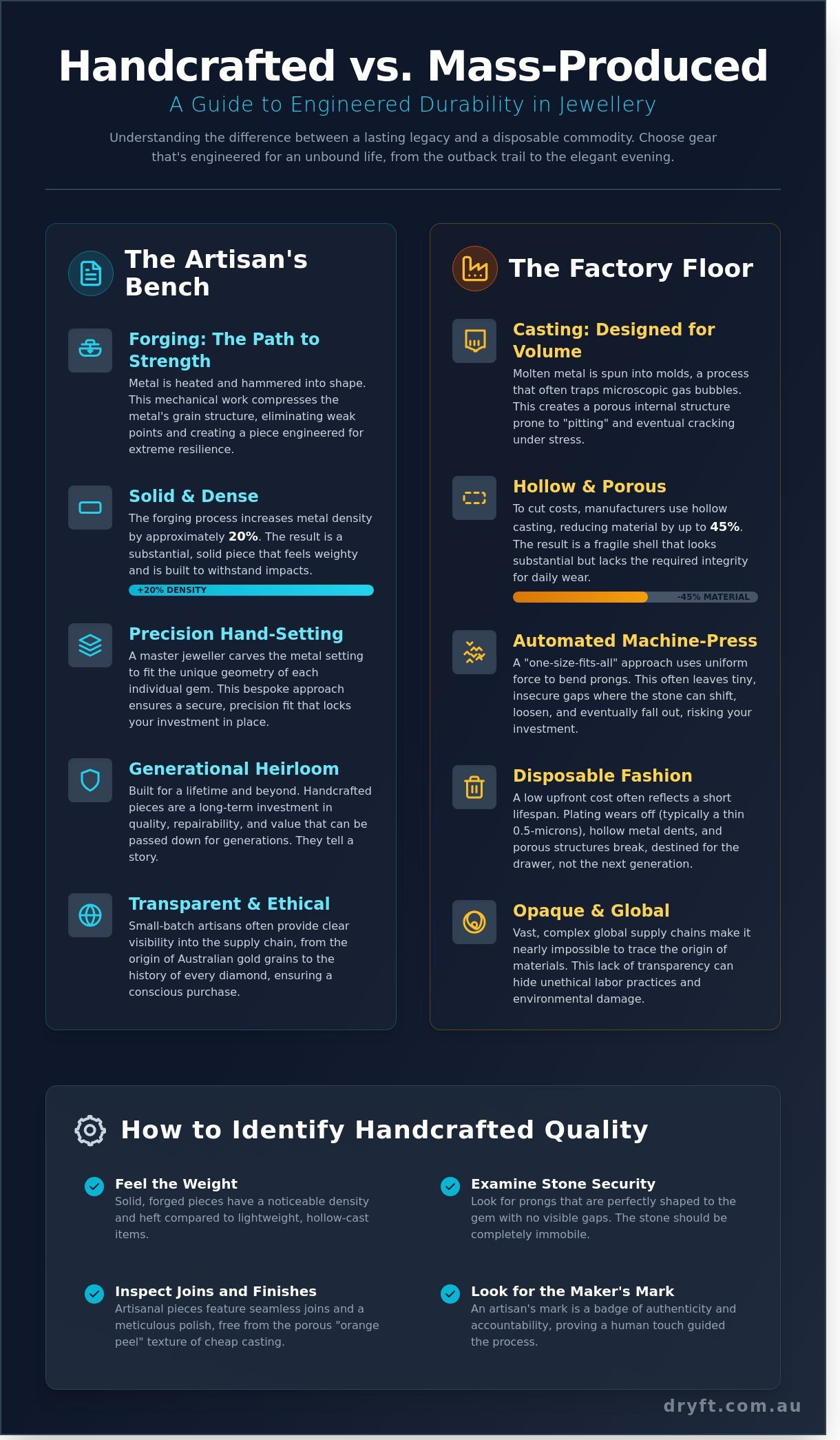
Most high-street retailers utilize the lost-wax casting process to create thousands of identical units. A single master mold might produce 3,000 to 5,000 pieces before it’s retired. To drive down costs, manufacturers often employ “hollow” designs. By removing the internal metal, they reduce material usage by up to 45%. This creates a piece that looks heavy but remains structurally fragile. It’s a shell that mimics substance but lacks the integrity required for an active life.
Speed governs the factory floor. When a machine cycles every 20 seconds, precision is sacrificed for volume. This rapid pace often results in porous metal, which is prone to cracking under the stresses of daily wear. In the high-street retail world, the goal is to move inventory, not to create a piece that lasts for decades. A ring that costs A$80 might look the part, but it’s rarely engineered for the long haul.
The Artisan’s Bench: The Handcrafted Philosophy
True craftsmanship relies on forging rather than simple casting. Forging involves heating and hammering metal into shape. This mechanical work increases the metal’s density by roughly 20%, ensuring it withstands the rigors of the Australian outback. The jeweler acts as a technical guide, selecting materials that won’t fail when the pavement ends. They understand the relationship between metal tension and stone security, ensuring every element is locked in place.
This dedication to durability is at the heart of Dryft’s commitment to handcrafted excellence. Every piece is treated as a sanctuary of design, built with the same precision as an independent suspension system. While a mass-produced ring might save you A$150 upfront, it lacks the “Outback-proven” toughness of a forged piece. Handcrafted jewelry isn’t just an accessory; it’s a piece of engineered luxury that provides a sense of quiet confidence, no matter how far you wander from the horizon.
Engineering for Durability: Why Handcrafted Wins on the Trail
The Australian outback doesn’t forgive weakness. Whether it’s the independent suspension on a hybrid camper or the gold band on your finger, structural integrity is the difference between a lifelong companion and a mid-trip failure. When we analyze handcrafted vs mass produced jewellery, we aren’t just talking about aesthetics; we’re talking about high-end engineering. Most commercial jewellery relies on centrifugal casting, a process where molten metal is spun into a mold. This often traps microscopic gas bubbles, creating a porous internal structure that’s prone to “pitting” and eventual snapping under pressure. In contrast, a handcrafted piece is forged from solid metal stock, compressed and hammered into a dense, resilient form that can withstand the vibrations of a corrugated track in the Kimberley.
Security is paramount when your lifestyle takes you off the grid. Machine-pressed stone settings use uniform, automated force to bend prongs over a diamond. This “one size fits all” approach often leaves tiny gaps where the stone can shift and eventually fall out. A master jeweller sets each stone by hand, carving the metal to fit the unique geometry of the individual gem. This ensures a precision fit that keeps your investment secure through every gear change and campsite setup. Understanding the technical side of production also requires a look at jewellery supply chain transparency, as the origin and purity of these metals dictate how they respond to manual stress. Work hardening is the process of making metal stronger through manual manipulation and compression rather than heat alone.
Material Density and Metal Fatigue
Mass-produced rings are frequently engineered to use the least amount of metal possible to maximize profit. You’ll often see “hollow” under-galleries or bands that taper to a fragile 1.2mm thickness. These pieces are highly susceptible to metal fatigue, a condition where repeated small stresses cause the metal to deform or crack. Hand-rolling and drawing wire for chains and bracelets creates a linear grain structure, much like the grain in timber, which provides superior tensile strength. This is why bespoke engagement rings are engineered for a lifetime of wear, utilizing a higher density of gold that won’t thin out or warp after a few years of active use. A handcrafted 18k gold band feels heavier and more substantial because it is physically more compact than its cast counterpart.
The Pearl Standard: Hand-Strung vs. Bulk-Assembled
In the world of coastal adventure, pearls are a staple, but their longevity depends entirely on how they’re assembled. Factory-made strands often use thin nylon thread and skip the vital step of individual knotting to save time. This creates two major risks. If the thread snaps, every pearl is lost to the sand. More importantly, without knots, the pearls rub against each other, grinding away the precious nacre. High-quality pearl string bracelets utilize silk or high-test polyester thread with hand-tied knots between every single bead. This keeps them secure and prevents friction damage.
- Hand-Selection: Artisans sort freshwater pearls by luster and surface quality, ensuring a 95% match across the strand.
- Friction Barriers: Individual knots act as shock absorbers, protecting the pearl’s surface from 100% of pearl-on-pearl contact.
- Custom Tension: Hand-stringing allows for a “break-in” period where the tension is calibrated for the wearer’s specific wrist movement.
Choosing a piece built with this level of technical precision ensures your jewellery remains a sanctuary of style, even when you’re miles from the nearest paved road. If you’re ready to upgrade your gear, consider how a custom design can match your pace.
The Ethical Gap: Conscious Sourcing vs. Global Supply Chains
True luxury isn’t found on a factory line. It’s found in the integrity of the source. The hidden cost of cheap jewellery often involves environmental degradation and opaque labor practices that remain hidden from the consumer. Mass-produced pieces frequently move through complex global hubs; this makes it nearly impossible to verify the conditions of the workers or the health of the land. When we weigh handcrafted vs mass produced jewelry, we’re looking at a choice between industrial waste and intentional creation.
Small-batch artisans maintain a level of visibility that global giants simply can’t match. They source gold and gemstones from suppliers who adhere to strict ethical standards. This transparency is the cornerstone of “Quiet Luxury.” It’s the confidence that comes from knowing your piece didn’t contribute to the millions of tonnes of toxic tailings produced by large-scale mining operations every year. For Dryft, ethical sourcing is a non-negotiable foundation. It’s about providing a sanctuary of quality in a world of disposable goods. We believe in movement and freedom, but never at the expense of the earth we explore.
Ethically Sourced Diamonds and Pearls
Finding an ethical diamond supplier in Australia starts with looking for the 2003 Kimberley Process certification and Responsible Jewellery Council (RJC) membership. These standards help ensure diamonds are conflict-free and mined under fair conditions. Freshwater pearls represent a sustainable alternative to intensive industrial mining; they require clean, thriving aquatic ecosystems to grow. The shift toward ethical jewellery Australia standards is transforming the market, as over 60 percent of modern Australian consumers now prioritize transparency over a lower price tag. It’s a commitment to the beauty of the natural world that feels both elite and grounded.
Reducing the Carbon Footprint of Your Wardrobe
Shipping mass-produced goods across global hubs creates a massive carbon footprint. A single ring might travel over 18,000 kilometres across multiple continents before reaching an Australian storefront. Buying once and buying well is the ultimate sustainable strategy. It reduces waste and ensures your investment lasts a lifetime rather than a season. Supporting local Australian talent is a form of conscious consumption that keeps the craft alive. It’s a pragmatic approach to luxury. You’re not just buying a piece; you’re supporting a legacy of Australian-made authenticity that respects the rugged landscape we call home. This focus on local testing and design is a badge of honour for those who value grit and glamour in equal measure.
Choosing handcrafted means you’re opting for a piece engineered with technical precision and a deep respect for the wild. It’s about the transition from a dusty trail to a premium interior without losing your soul along the way. Mass production offers a facade of luxury, but the handcrafted path offers a gateway to life-changing experiences rooted in truth. It’s the difference between a product that merely exists and one that tells a story of discovery and reliability. Your jewellery should be as unbound as your spirit.
The Investment Value: Heirlooms vs. Disposable Fashion
Mass-produced jewellery is often designed for the shelf, not the skin. It’s a consumable product, built to satisfy a fleeting trend before retreating into a jewellery box, tarnished and forgotten. These pieces possess zero resale value because they lack the intrinsic metal weight and gemstone quality required for the secondary market. They’re the “fast fashion” of the accessory world; once the thin gold plating wears away to reveal a base metal of brass or zinc, the item’s life is effectively over. In contrast, handcrafted pieces are engineered to endure. They’re built with a structural integrity that respects the materials, ensuring they don’t just survive the journey but improve with age.
The technical divide becomes most apparent when something goes wrong. Most high-street “fashion” jewellery cannot be repaired. Because these items use low-grade base metals with low melting points, a jeweller’s torch will often melt the entire piece before the solder even flows. They’re essentially unfixable. Handcrafted jewellery, however, is designed for a lifetime of maintenance. It can be resized, reset, and restored by a master smith. We define heirloom quality as the intersection of high-grade materials and technical repairability. It’s the assurance that a piece can be passed down through generations because its foundation is solid gold, platinum, and ethically sourced stones.
The Cost Per Wear Calculation
Smart investing requires looking past the initial price tag. Consider the math: a A$50 mass-produced ring might last six months before the plating peels or the shank snaps. That’s a cost of roughly A$8.33 per month for a temporary accessory. A A$500 handcrafted solid gold band, designed to last 50 years or more, costs less than A$0.85 per month over its lifespan. When weighing up handcrafted vs mass produced jewelry, the long-term economics favour the artisan every time.
- Material Retention: Handcrafted pieces retain the raw value of their gold and gemstones, providing a financial safety net.
- Structural Maintenance: Access to professional jewellery repair ensures that minor wear doesn’t lead to total loss.
- Durability: Thicker shanks and hand-set stones mean fewer lost diamonds and less frequent replacements.
Customisation and Personal Significance
There’s an emotional ROI that comes with a bespoke piece that mass-market items simply can’t replicate. A “one-of-a-kind” status protects the long-term value of the item, making it a unique asset rather than a generic commodity. When you work with a Melbourne artisan, you aren’t just buying a product; you’re commissioning a sanctuary for a specific memory or milestone. This fundamental difference in construction is why handcrafted vs mass produced jewelry represents two entirely different asset classes. One is a whisper of a trend; the other is an unbound expression of personal history. By consulting with a local craftsman, you ensure your investment is as rugged as the Australian landscape and as refined as a luxury interior.
Ready to invest in a piece that stands the test of time? Explore our collection of enduring craftsmanship and find your next heirloom today.
How to Identify Handcrafted Quality: A Buyer’s Checklist
Distinguishing between the two requires a discerning eye similar to inspecting a high-performance chassis. True quality reveals itself in the details that mass-market machines simply cannot replicate. When evaluating handcrafted vs mass produced jewelry, your first move should be to feel the piece. Handcrafted items generally possess a weight that feels substantial and purposeful. While a factory-cast ring might weigh 2.5 grams to save on material costs, an artisan-forged piece often hits 4 or 5 grams of solid metal. This density ensures the item won’t warp or bend during your daily adventures.
Examine the joints and connection points with a loupe or a steady eye. In a workshop, a jeweler uses high-heat soldering to create seamless transitions. You shouldn’t see dark lines, pits, or visible gaps where a setting meets a band. Factory joins often look clunky or “glued” together because they’re designed for speed rather than structural integrity. A well-engineered piece of jewelry should look like it grew from a single piece of gold or silver.
- Verify the hallmark: Authentic Australian-made fine jewellery must carry clear metal purity stamps. Look for “750” for 18ct gold or “375” for 9ct gold. These stamps should be crisp and deep, not faded or blurred.
- Ask for the provenance: A genuine maker can tell you exactly where the stone was sourced and the specific techniques used to set it. If the seller can’t name the individual behind the bench, you’re likely looking at a mass-produced item.
- Inspect the finish: Hand-polished surfaces have a deep, mirror-like lustre. Machine-polished pieces often show “orange peel” textures or microscopic ripples under light.
Signs of Mass Production to Avoid
Flip the piece over. If you see hollowed-out backs on rings or pendants, it’s a red flag. Manufacturers use this tactic to reduce gold volume by up to 45 percent, which traps dirt and irritates the skin. Avoid perfectly identical “pairs” of earrings that look clinical or plastic-like. Real stones and hand-worked metal have soul; they possess minute variations that prove a human hand was involved. Be wary of thin plating. A 0.5-micron gold “flash” will inevitably wear off within 3 months of regular wear, revealing base metals like brass underneath.
Final Verdict: Choosing Your Next Piece
The choice between handcrafted vs mass produced jewelry depends on your lifestyle and values. Choose mass-produced items only for ephemeral, one-season trends where longevity doesn’t matter. For everything else, the investment in a handcrafted piece pays dividends in durability and spirit. You’re buying more than an accessory; you’re securing a sanctuary of craftsmanship that withstands the test of time. There is a specific confidence that comes from wearing “Outback-proven luxury” that can survive a dusty trail and still shine at a five-star dinner.
Don’t settle for the fragility of the assembly line. Your jewelry should be as resilient and refined as the life you lead. It’s time to invest in pieces that mirror your own standard of excellence. Explore Dryft’s handcrafted collection and find your sanctuary today.
Invest in a Legacy of Rugged Elegance
Deciding between handcrafted vs mass produced jewelry is ultimately a choice about engineering and ethics. While mass-market items often feature thin 1.2mm bands that fail under the stress of an active lifestyle, handcrafted pieces are built with the structural integrity required for the modern adventurer. Every piece designed and handcrafted in Melbourne is built to endure the 40-degree heat and grit of the Australian outback. By prioritizing ethically sourced freshwater pearls and diamonds, you’re investing in a piece that carries a 100% transparency guarantee rather than contributing to opaque global supply chains. These heirlooms offer a lifetime of durability, proving that true luxury doesn’t have to be delicate. You shouldn’t have to choose between a sophisticated aesthetic and the mechanical strength needed for the trail. Your jewelry should be as resilient as your spirit, serving as a permanent sanctuary of style in the middle of nowhere. It’s time to demand more from your collection and choose quality that survives the journey.
Discover the Dryft difference: Handcrafted luxury for the modern adventurer.
Step out with confidence and find the piece that speaks to your next great discovery.
Frequently Asked Questions
Is handcrafted jewellery always more expensive than mass-produced?
Handcrafted pieces aren’t always more expensive, though they represent a higher investment in raw materials and expert labour. While a mass-produced ring might retail for A$250, it often carries a 400% markup on low-grade alloys. Handcrafted jewellery focuses on durability; you pay for the artisan’s 10,000 hours of expertise rather than a corporate marketing budget. It’s a pragmatic choice for those seeking a sanctuary of quality.
How can I tell if a ring is handmade or cast by a machine?
You can identify machine-cast items by their clinical perfection and lack of structural grain. Use a 10x jeweler’s loupe to inspect the inner band. Machine-made rings often show a faint parting line from the mold; handcrafted pieces show subtle tool marks or a denser metal structure. This technical precision ensures your piece survives the grit of daily life without failing at the seams.
Why does mass-produced jewellery turn my skin green?
Skin discoloration happens because mass-market brands use high-copper base metals plated with less than 0.5 microns of gold. When sweat reacts with these cheap alloys, it creates copper carbonate. This green residue is common in items costing under A$100. Handcrafted vs mass produced jewelry comparisons often highlight this failure of integrity. Artisans prefer solid 9ct or 18ct gold that resists the harsh realities of corrosion.
Can handcrafted jewellery be repaired if it breaks?
Handcrafted jewellery is highly repairable because it’s engineered from solid, high-quality components. Unlike hollow, machine-stamped pieces that collapse under heat, a handcrafted ring can be resized or soldered multiple times. Most Australian independent jewellers provide a lifetime guarantee on their structural welds. It’s about reliability; your jewellery should be as tough as the landscape you traverse. A well-crafted piece remains a sanctuary for generations.
What makes Australian handcrafted jewellery unique?
Australian handcrafted jewellery is defined by its connection to the land and use of local, ethically sourced gemstones. We produce 95% of the world’s precious opals and a significant portion of rare pink diamonds. Local artisans test their designs against the active Australian lifestyle. This creates a signature of outback-proven luxury that global mass-market competitors cannot replicate in a cold factory setting.
Is “handmade” the same thing as “handcrafted”?
The terms are often used interchangeably, but “handmade” specifically means the piece was forged from raw metal stock rather than cast. Handcrafted is a broader philosophy of movement and freedom in design. In the Australian market, a piece is handmade if it doesn’t use pre-cast components. Both paths prioritize the human touch over the cold efficiency of a factory line to achieve a refined finish.
Are lab-grown diamonds used in handcrafted jewellery?
Lab-grown diamonds are increasingly common in handcrafted commissions, making up 45% of new engagement ring sales in 2024. These stones offer the same chemical hardness as mined diamonds, rating a 10 on the Mohs scale. Artisans use them to balance the grit of high-end engineering with modern ethical standards. They provide a seamless transition into sustainable luxury for the modern adventurer.