What if the most enduring symbol of your commitment wasn’t pulled from a deep, industrial scar in the earth, but engineered with the same precision as a high-end off-road chassis? You appreciate the finer details of a well-crafted sanctuary, yet you demand a stone that survives the grit of the Kimberley or the salt of the Ningaloo coast. It’s understandable to feel overwhelmed by technical jargon or the lingering fear that choosing ethical alternatives to mined diamonds might result in a piece that looks underwhelming under the high-noon sun. You want a stone that reflects your values without sacrificing the uncompromising brilliance of a traditional gem.
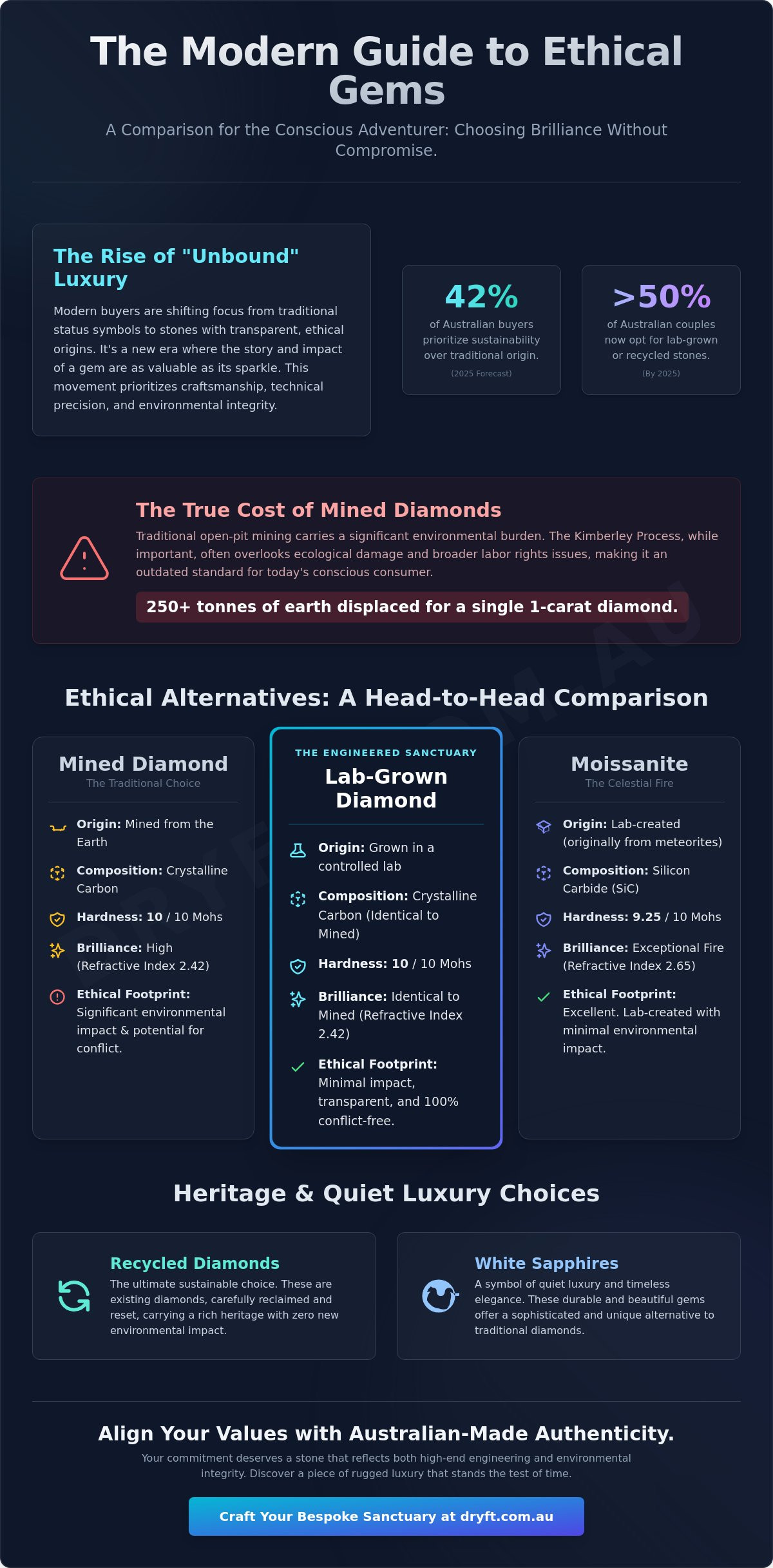
We believe that luxury should be as resilient as it is refined. According to 2025 industry forecasts, 42% of Australian fine jewelry buyers now prioritise sustainability over traditional origin. This guide will help you discover the most brilliant, sustainable, and sophisticated stones that align with your unbound lifestyle. We will decode the differences between lab-grown diamonds and moissanite, ensuring your purchase is truly conflict-free and physically identical to its mined counterparts. From long-term durability to handcrafted elegance, you’re about to find a piece of rugged luxury that stands the test of time.
Key Takeaways
- Understand the shift toward “unbound” luxury and how selecting sustainable stones protects the wild landscapes that inspire every modern adventurer.
- Uncover the engineered perfection of lab-grown stones, which provide a chemically identical sanctuary of brilliance without the dust of the traditional mining trail.
- Navigate the most sophisticated ethical alternatives to mined diamonds, including the celestial fire of moissanite and the quiet luxury of timeless white sapphires.
- Discover the heritage value of recycled diamonds and pearls, nature’s original sustainable gems that form the cornerstone of Dryft’s bespoke craftsmanship.
- Learn how to align your values with Australian-made authenticity, ensuring your choice of stone reflects a commitment to both high-end engineering and environmental integrity.
The Evolution of Brilliance: Why Ethical Alternatives Matter
Luxury is undergoing a radical transformation. The old guard once relied on scarcity and high-impact extraction to define value, but the horizon has shifted. In 2026, we’re seeing the rise of “unbound” luxury. This movement prioritizes the origin story of a stone as much as its refractive index. Modern adventurers are no longer satisfied with beauty that comes at a heavy cost to the earth. They want the grit of the journey without the ecological footprint. This shift is driving a massive surge in demand for ethical alternatives to mined diamonds. It represents a new era where a sanctuary of style doesn’t have to compromise the wild places we love to explore.
The emotional pull of a diamond has always been about discovery and permanence. However, the modern collector finds more resonance in a stone that reflects their personal values. Choosing a sustainable option isn’t just a trend; it’s a statement of intent. It shows a deep respect for the landscape and a commitment to high-end engineering. Whether you’re navigating the streets of Sydney or the red dust of the Kimberley, your jewelry should match your standard of reliability and integrity. It’s about time our symbols of love mirrored our respect for the planet.
The Problem with Traditional Mining
Traditional open-pit mining remains a significant burden on global ecosystems. To recover a single one-carat diamond, miners often displace over 250 tonnes of earth. This process creates massive voids in the landscape and disrupts local water tables. While the Kimberley Process was a vital step when it launched in 2003, it’s increasingly seen as the bare minimum in 2026. It focuses primarily on preventing “conflict diamonds” from entering the market but often overlooks broader environmental degradation and labor rights. Savvy Australian collectors now view these old standards as outdated. They’re looking for the deeper transparency found in ethical jewelry australia. True luxury shouldn’t leave a permanent scar on the terrain.
The Rise of the Conscious Trailblazer
The modern buyer is a different breed. They’re informed, quality-obsessed, and fiercely value-driven. They don’t need a flashy status symbol to prove their worth; they need a story that aligns with their own. This is the era of “quiet luxury” where the focus is on craftsmanship and technical precision. Many are turning toward the Synthetic diamond because it offers the same physical and chemical properties as a mined stone but with a cleaner history. By 2025, industry reports showed that over 50% of Australian couples were opting for lab-grown or recycled stones. These individuals seek ethical alternatives to mined diamonds because they’ve seen the world and want to protect its future. They appreciate the engineering required to create a perfect stone in a controlled environment, much like they appreciate a well-built off-road chassis.
Lab-Grown Diamonds: The Engineered Sanctuary
Lab-grown diamonds represent the apex of modern engineering. These stones aren’t imitations or synthetics in the traditional sense. They are chemically, physically, and optically identical to diamonds pulled from the earth. Think of them as a masterfully crafted sanctuary, born in a controlled environment rather than a dusty pit. This precision allows for a level of clarity and brilliance that mirrors the high-end engineering found in a premium off-road chassis. Choosing these gems is one of the most effective ethical alternatives to mined diamonds available to Australians in 2026. It’s about achieving perfection without the trail of environmental disruption.
Traceability is the heartbeat of conscious luxury. When you opt for a lab-grown stone, the supply chain is transparent from the moment the carbon seed is placed in the chamber. You know exactly where your diamond came from. There are no murky origins. This clarity provides a sense of quiet confidence, allowing the wearer to focus on the beauty of the piece rather than the ethics of its extraction. It’s a seamless transition from technical excellence to emotional resonance.
HPHT vs. CVD: Precision Engineering
Creating a diamond requires replicating the intense conditions of the earth’s mantle. Two primary methods dominate the industry: High Pressure High Temperature (HPHT) and Chemical Vapour Deposition (CVD). HPHT uses massive presses to subject a carbon seed to extreme heat and crushing weight. It’s a brute-force approach to beauty. CVD is more like a high-tech laboratory experiment, using a plasma cloud to layer carbon atoms onto a seed one by one. Both methods result in a stone that registers a 10/10 on the Mohs scale of hardness. The structural integrity is absolute. These gems are built to endure the harshest conditions, much like a vehicle designed for the Australian outback.
The Value Proposition of Modern Science
The financial logic of lab-grown diamonds is undeniable. In the current Australian market, buyers often find they receive up to 70% better value compared to mined stones of the same 4Cs. This means an A$10,000 budget can secure a significantly larger or higher-clarity gem. It’s a pragmatic choice for the modern explorer who values performance over prestige myths. While some argue about resale value, it’s vital to remember that diamonds are a lifestyle choice, not a speculative investment. They are meant to be worn and enjoyed, not tucked away in a safe.
Certification remains the gold standard for quality assurance. Even though these stones are engineered, they are still graded by the same experts. Always insist on GIA or IGI certification to verify the stone’s attributes. This commitment to transparency aligns with the UN Sustainable Development Goals by fostering responsible consumption and production patterns. It’s about making a sophisticated choice that respects both the planet and your personal standards. For those seeking a premium adventure in every aspect of life, lab-grown diamonds offer a path that refuses to compromise on quality or conscience.
Beyond the Diamond: Moissanite and Sapphires
True luxury doesn’t always require a carbon lattice. For those who value a blend of high-end engineering and natural wonder, exploring ethical alternatives to mined diamonds leads to stones as resilient as a reinforced chassis and as brilliant as a desert sunrise. Moissanite and white sapphires represent two distinct paths for the modern collector who demands both performance and prestige.
Moissanite: Exceptional Fire and Durability
Moissanite is a stone literally born from the stars. Originally discovered in a meteor crater in 1893, this silicon carbide gem is now engineered in labs to achieve a level of brilliance that outshines traditional stones. It boasts a refractive index of 2.65 to 2.69. This technical edge creates a “rainbow effect” or “fire” that captures light and disperses it with intense, multi-colored flashes. On the Mohs scale of mineral hardness, moissanite sits at a formidable 9.25. It’s second only to diamonds. This makes it a pragmatic choice for an active, adventurous lifestyle. Whether you’re navigating the dusty trails of the Kimberley or attending a gala in Melbourne, moissanite handles the grit of daily life without scratching or losing its luster.
- Refractive Index: 2.65 (Higher than diamond’s 2.42).
- Hardness: 9.25 Mohs (Highly scratch-resistant for outback conditions).
- Sustainability: 100% lab-created, ensuring zero land displacement.
White Sapphires: A Subtle, Classy Alternative
If moissanite is the high-performance spotlight, the white sapphire is the soft glow of a sanctuary. It offers a “quiet luxury” aesthetic that many Australians prefer for its understated confidence. While diamonds look icy and sharp, white sapphires possess a silvery, ethereal depth. They’ve been a staple of royal and bespoke jewellery for centuries, prized for their historical significance and timeless appeal. At 9 on the Mohs scale, they’re incredibly durable. However, they lack the same level of fire as moissanite, meaning they require consistent jewelry care to keep their facets from appearing cloudy over time. Choosing a sapphire is a nod to tradition and a commitment to ethical alternatives to mined diamonds that don’t scream for attention. It’s a choice for the explorer who appreciates the finer, quieter details of a well-crafted piece.
The visual contrast is striking when these stones meet the light. Moissanite is bold and unapologetic with its brilliance. The white sapphire remains composed and deep. Both stones offer the reliability needed for a life lived unbound by city limits. They provide the confidence of a premium build without the ethical compromise of traditional mining practices, proving that grit and glamour can coexist seamlessly in the wild.
The Heritage Choice: Recycled Diamonds and Pearls
True luxury doesn’t always require a fresh scar on the earth. It’s often found in the enduring quality of what already exists. In 2026, the circular economy has redefined high-end jewellery, placing a premium on stones with a history. Recycled diamonds represent a pragmatic, low-impact choice for the modern adventurer. They offer the same chemical brilliance as a newly mined stone but without the environmental cost of new excavation. This is the ultimate expression of conscious luxury; it’s about being a custodian of beauty rather than a consumer of resources. By opting for stones already in circulation, you eliminate the need for 100% of the energy and water typically required for diamond recovery.
Antique and Recycled Diamonds: A History Reimagined
There’s a specific, quiet confidence in wearing a stone that has survived a century. Antique cuts, such as “Old Mine” or “European” cuts, offer a bespoke aesthetic that modern, laser-cut diamonds can’t replicate. These gems feature larger facets and higher crowns, designed to catch the soft flicker of candlelight rather than the harsh glare of an office. At Dryft, we incorporate these heritage stones into rugged, architectural designs that mirror the durability of a custom off-road chassis. Choosing these ethical alternatives to mined diamonds means you’re investing in a piece with a soul. It’s a technical choice as much as an aesthetic one, ensuring that your jewellery is as resilient and unique as the Australian landscape itself.
- Reduced Carbon Footprint: Zero new mining means zero additional land displacement.
- Unique Character: Hand-cut antique stones possess individual “fingerprints” modern stones lack.
- Value Retention: High-quality recycled diamonds maintain their market position in the circular economy.
Pearls: The Sophisticated Alternative
If diamonds represent the fire of the earth, pearls represent the quiet strength of the water. They are nature’s original sustainable luxury. Unlike minerals that require deep-earth extraction, pearls are a renewable resource. High-quality freshwater pearls are cultivated through processes that often require pristine water conditions, incentivising the protection of local ecosystems. They offer a unique, organic texture that provides a sophisticated contrast to the sharp lines of modern engineering. This makes them one of the most compelling ethical alternatives to mined diamonds for those who prefer an understated, “quiet luxury” look.
Dryft designs are engineered to take pearls out of the ballroom and into the wild. We treat these gems as structural elements, creating pieces that transition seamlessly from a dusty trail to a premium interior. The focus is on Australian-made authenticity, ensuring every piece reflects a standard of excellence that handles the elements with ease. You can explore our specific range of handcrafted pearl jewelry australia to see how we’ve elevated this timeless resource for the 2026 collector.
Ready to find a piece that balances rugged durability with refined heritage? Discover the Dryft conscious collection today.
Crafting Your Bespoke Sanctuary: The Dryft Approach
True luxury isn’t found on a factory assembly line. It’s engineered at the intersection of grit and glamour. At Dryft, we view every piece as a personal sanctuary, designed to withstand the elements while maintaining an uncompromising aesthetic. This philosophy dictates how we select our materials. Choosing ethical alternatives to mined diamonds isn’t just a trend for 2026; it’s a commitment to a standard of excellence that respects the Australian landscape we love to explore. We build for those who demand performance without sacrificing the finer details.
Our Australian-made authenticity is a badge of honour. We don’t settle for mass-market imports that lack the soul of local craftsmanship. Every bespoke piece begins as a dusty trail vision, born from the desire for something that reflects the rugged beauty of the outback. We move from that initial spark to a premium jewellery sanctuary through a process of technical precision and artistic intuition. This journey ensures your choice is as resilient as the chassis of an off-road hybrid. It’s about quiet luxury that feels at home whether you’re at a black-tie event in Sydney or parked under a canopy of stars in the Kimberley.
Longevity is the ultimate mark of sustainability. To ensure your ethical choice lasts a lifetime, professional maintenance is non-negotiable. We recommend a technical inspection every 12 months to check settings and stone security. Just as you wouldn’t take a high-end rig across the Simpson Desert without a service, your fine jewellery requires expert care to remain unbound by time.
Handcrafted vs. Mass-Produced
A machine can’t feel the weight of a stone or the subtle balance of a precious metal band. Human hands bring a level of soul and character that factory settings simply cannot replicate. Bespoke design allows for the perfect, seamless integration of ethical alternatives to mined diamonds, tailored specifically to your lifestyle. This artisanal approach means your piece is a one-off original, not a carbon copy. For those who value the narrative behind their belongings, we invite you to explore our guide to gifting fine jewellery to discover how handcrafted elegance creates a lasting legacy.
A Philosophy of Movement and Freedom
The Dryft mission is centered on luxury that doesn’t hold you back from adventure. We create for the sophisticated trailblazer who seeks freedom above all else. Choosing an ethical alternative is a deliberate step toward a more unbound future, where our pursuit of beauty doesn’t come at the cost of the earth. It’s a pragmatic, powerful choice for the modern explorer. Ready to start your journey? Book a consultation with our designers or browse the collection to find a piece that matches your spirit of discovery.
Redefining Brilliance for the Modern Horizon
Choosing fine jewellery is no longer just about the sparkle; it’s about the story you carry with you. By 2026, the shift toward ethical alternatives to mined diamonds has become a permanent standard for the modern adventurer who demands both integrity and aesthetics. Whether you’re drawn to the engineered perfection of lab-grown stones or the heritage of recycled gems, you’re investing in a sanctuary of conscious luxury. These choices reflect a deep respect for the landscape we explore. Industry data from 2024 confirms that lab-grown diamond market share has surpassed 20% of global sales by volume, proving that sophisticated buyers are increasingly choosing innovation over tradition.
At Dryft, we bridge the gap between grit and glamour. Every piece is handcrafted in Australia with a focus on ethical sourcing and a rugged luxury aesthetic that’s built for the wild. We provide expert guidance on bespoke engagement rings and fine jewellery, ensuring your piece is engineered for a lifetime of discovery. You don’t have to compromise on durability or elegance when you’re forging your own path. Your journey deserves a mark of excellence that respects the horizon ahead.
Explore our collection of ethical, handcrafted jewellery
Frequently Asked Questions
Is a lab-grown diamond a “real” diamond?
Yes, lab-grown diamonds are chemically, physically, and optically identical to their mined counterparts. They consist of pure carbon arranged in a crystal structure, scoring a 10 on the Mohs scale of hardness. According to the Federal Trade Commission’s 2018 ruling, a diamond is a diamond regardless of whether it grew in the earth or a laboratory. This makes them one of the most popular ethical alternatives to mined diamonds for those seeking brilliance without the heavy environmental cost of traditional excavation.
Which diamond alternative is the most durable for an engagement ring?
Lab-grown diamonds are the most durable choice, matching the hardness of mined stones exactly. For those looking outside the diamond family, moissanite is the next best contender with a Mohs rating of 9.25. It resists scratching better than sapphires or rubies; it’s built to withstand the rigours of an active life. This durability is vital for the Australian lifestyle, ensuring your ring survives everything from a formal gala to a weekend trek through the rugged Kimberley region.
Will a moissanite stone look “fake” next to a diamond?
Moissanite possesses a higher refractive index than a diamond, meaning it emits more colorful flashes, often called the “disco ball” effect. While a diamond has a refractive index of 2.42, moissanite sits at 2.65. Side by side, a trained eye might notice this extra fire, but most people won’t spot the difference in daily lighting. It’s a high-performance choice for those who value brilliance and technical excellence in their jewelry without the diamond price tag.
Are recycled diamonds more ethical than lab-grown diamonds?
Recycled diamonds are often considered the most sustainable option because they require zero new mining or energy-intensive laboratory growth. They represent a circular economy, repurposing existing stones from vintage pieces. However, lab-grown diamonds offer a transparent, conflict-free supply chain from day one. A 2021 report by Frost & Sullivan noted that lab diamonds use significantly less water per carat, making both options valid paths for the conscious Australian consumer who demands a clean conscience.
How do I care for a white sapphire compared to a diamond?
White sapphires require more frequent cleaning than diamonds because they attract skin oils and dirt more readily, which can make them look cloudy. You should clean your sapphire every 2 to 3 weeks with warm soapy water and a soft brush. While they are hard stones with a Mohs rating of 9, they lack the “self-cleaning” brilliance that diamonds possess. Regular maintenance ensures your sanctuary of style remains bright and clear even after a dusty journey.
Can people tell the difference between a lab diamond and a mined diamond?
It’s impossible for the naked eye to distinguish between a lab-grown diamond and a mined one. Even professional gemologists require advanced spectroscopic equipment to identify the specific growth patterns within the stone. Both stones share the same refractive index and thermal conductivity. For the modern adventurer, this means you can enjoy the pinnacle of luxury and engineering without compromise, knowing your ethical alternatives to mined diamonds are indistinguishable from the traditional stones.
Why are pearls considered a sustainable alternative to diamonds?
Pearls are unique because they are the only gems grown within a living organism, and quality pearl farming actually improves the surrounding marine ecosystem. Oysters are filter feeders that clean the water; a single oyster can filter up to 190 litres of water daily. In regions like Western Australia, pearl farms act as protected sanctuaries for marine life. This biological partnership creates a luxury product that actively gives back to the wild and supports local biodiversity.
Do ethical diamond alternatives hold their value over time?
Ethical alternatives generally have lower resale values compared to high-grade mined diamonds, which have established secondary markets. A lab diamond might retain only 20% to 30% of its initial A$ price upon resale, whereas a mined stone might hold 50% or more. However, the initial cost of a lab stone is often 70% lower than a mined one. You’re investing in the experience and the ethics rather than a speculative financial asset, choosing quiet luxury over market hype.