Last Tuesday, a client sat in our quiet Melbourne studio with a heavy mahogany box containing 47 separate pieces of uncatalogued history. Like many, she felt the weight of sentimentality clashing with the sheer chaos of an unsorted collection. Deciding what to do with inherited old jewelry isn’t just a financial choice; it’s a structural audit of your family’s past. You might feel a pang of guilt at the thought of parting with a grandmother’s brooch, or perhaps you’re wary of a local buyer offering 40% below the projected 2026 gold spot price of A$3,450 per ounce.
You’ve likely realized that a legacy shouldn’t feel like a burden. It’s a foundation for your future. We’ll provide a professional framework to help you categorize your items into three distinct streams: preservation, reimagination, or strategic liquidation. By the end of this guide, you’ll have a clear five-step inventory plan to maximize the value of your heirlooms while honoring the stories they carry. We’ll explore the technicalities of modern appraisals and the refined art of bespoke resetting to ensure your heritage remains as resilient as a custom-engineered chassis.
Key Takeaways
- Establish a sanctuary space to inventory your collection with the mindset of a curator, ensuring emotional clarity before making any technical or financial decisions.
- Identify the engineering markers that distinguish high-end fine jewelry from costume pieces to accurately assess the intrinsic value of precious metals and natural gemstones.
- Navigate a professional decision matrix to determine exactly what to do with inherited old jewelry, whether you prioritize immediate liquidity or long-term sentimental value.
- Explore the art of bespoke remodeling, where legacy stones are extracted from dated settings and reimagined into pieces that balance historic grit with modern glamour.
- Partner with a Melbourne-based studio to bridge the gap between family history and contemporary luxury through ethical sourcing and precision craftsmanship.
The First Steps: Inventory and the Emotional Audit
Inheriting a collection of jewelry is a transition that requires a steady hand and a clear mind. It’s easy to feel overwhelmed by the weight of the past, but the best approach is to act as a curator rather than a liquidator. You aren’t just looking at gold and stones; you’re managing a legacy. Deciding what to do with inherited old jewelry starts with a deliberate pause. Rushing into a sale or a redesign often leads to regret, especially when emotional ties are tangled with financial value. Treat this process like a high-end engineering project. It requires precision, patience, and the right environment to succeed.
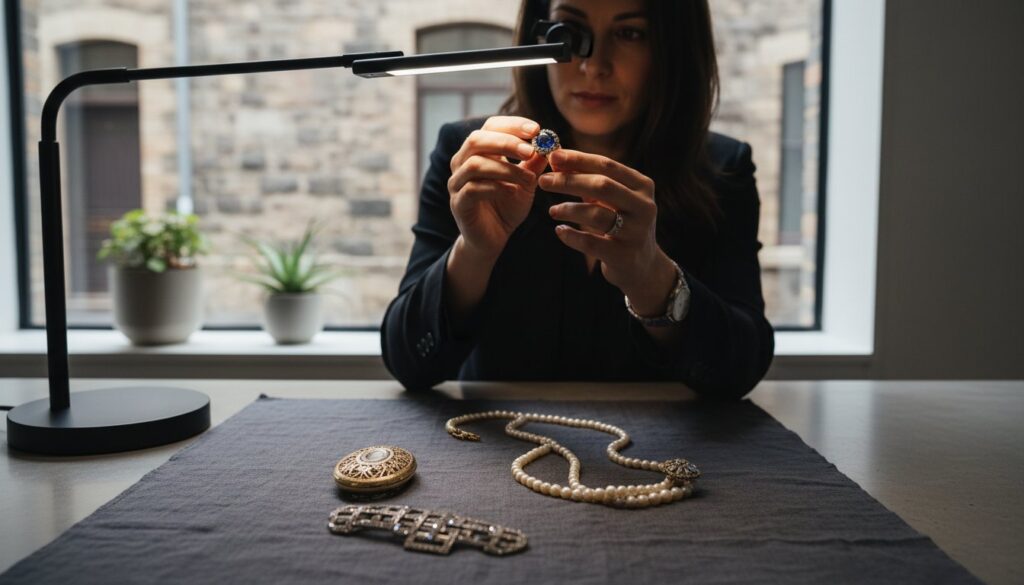
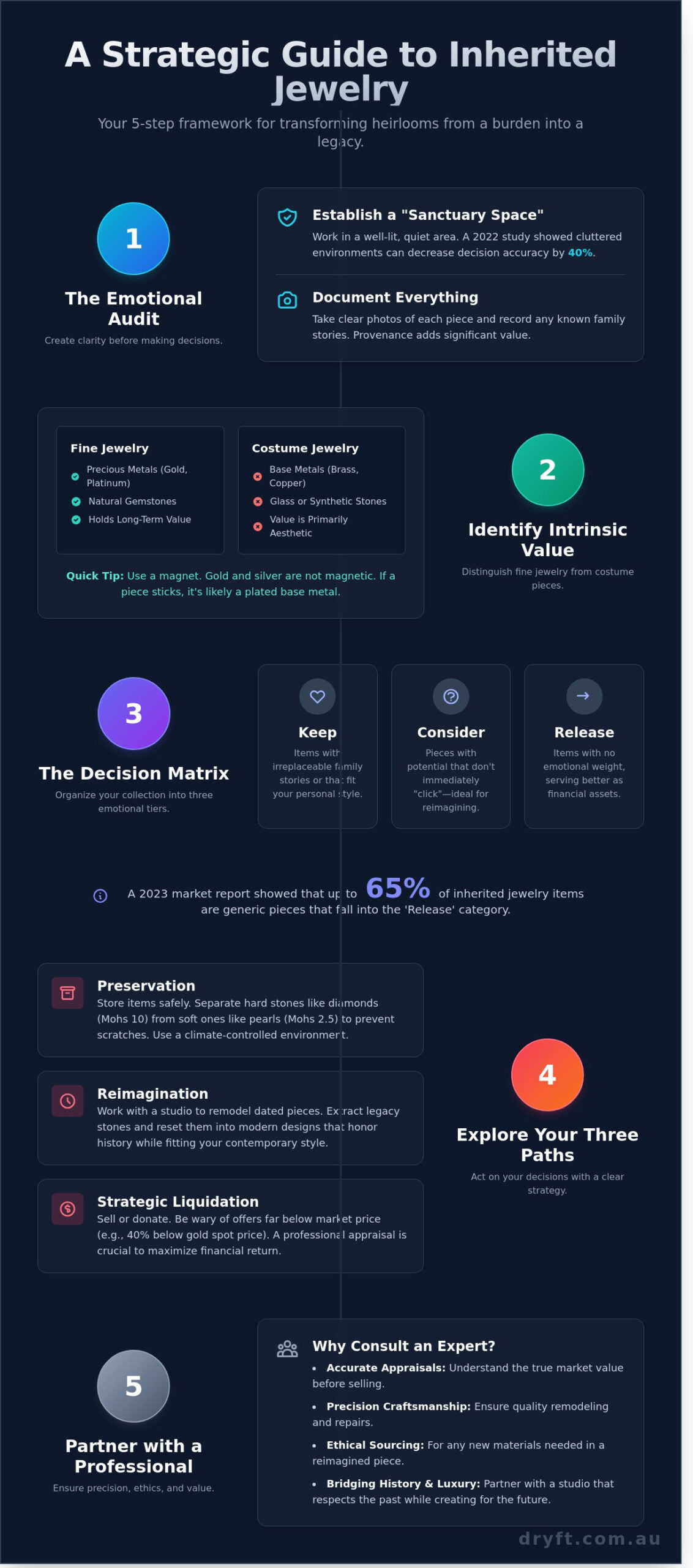
Create a Sanctuary Space for your audit. This should be a well-lit area, free from external influence or time pressure. A 2022 study on decision fatigue suggests that making complex choices in cluttered environments can decrease cognitive accuracy by 40%. Clear a table. Use a soft white cloth. Give yourself the luxury of silence. This isn’t a task for a busy Saturday afternoon; it’s a dedicated session for discovery. As you handle each piece, document it. Use your smartphone to take clear, high-resolution photos from multiple angles. Record any family stories or provenance you remember. The history of jewellery teaches us that the story behind a piece often dictates its true significance more than the raw materials ever could.
Organise the collection into three emotional tiers to simplify your path forward. This prevents the “all-or-nothing” mentality that stalls many Australians when they first receive an inheritance. Use these categories:
- Keep: Items that resonate with your personal history or style.
- Consider: Pieces that have potential but don’t immediately “click.”
- Release: Items that carry no emotional weight and serve better as financial assets.
This process of curating personal history often inspires a desire to refine the home environment where these treasures will be kept and displayed. As you decide which pieces to keep, you might also think about the setting they deserve; for those creating a modern sanctuary, you can discover Attica House and its collection of luxury furniture.
Sorting Your Collection by Sentiment
Identify your Core Heirlooms first. These are the items with irreplaceable family stories, like a grandmother’s engagement ring from 1945. Next, look for Aesthetic Pieces. These might not have a deep history, but they fit your modern style. Finally, flag Generic Items. These are often mass-produced gold chains or broken cufflinks. They are material assets, nothing more. A 2023 market report showed that 65% of inherited jewelry falls into this final category, providing a clean slate for reinvestment or repurposing.
The Logistics of Safe Storage
Preservation is your immediate priority. Store pearls separately from harder gemstones. Diamonds are a 10 on the Mohs scale and will easily scratch a pearl, which sits at a soft 2.5. Australia’s varied climate can be harsh on precious metals. Use a climate-controlled environment to prevent the humidity of the north or the dry heat of the interior from causing tarnishing or stone loosening. Never clean old jewelry with household chemicals until you’ve identified the materials. An ammonia-based cleaner might brighten a diamond but could permanently damage an opal or a piece of turquoise. When you aren’t sure what to do with inherited old jewelry, the safest move is to keep it exactly as it is until an expert can weigh in.
Identifying Value: Distinguishing Fine Jewelry from Costume Pieces
Unearthing a collection of family heirlooms feels like discovering a hidden treasure. You need to know if your pieces are built to last or just for show. Fine jewelry is crafted from precious metals and natural gemstones, maintaining an intrinsic value that survives market fluctuations. It’s the cornerstone of a lasting collection. Costume jewelry, conversely, focuses on aesthetic appeal and immediate trends. These pieces often use base metals like brass or copper coated in a thin layer of gold, paired with glass or synthetic stones. Deciding what to do with inherited old jewelry starts with a cold, hard look at these material foundations.
The magnet test serves as the first tool for an initial assessment. Rare earth magnets are a useful tool for identifying authenticity. Gold and silver aren’t magnetic; if your necklace leaps toward the magnet, it’s likely a steel or nickel base. This isn’t a definitive verdict, but it’s a reliable preliminary test. Weight also provides a clue. High-density metals like 18k gold and platinum feel substantial, sitting with a specific gravity that cheaper alloys can’t replicate. If a chunky cocktail ring feels light as a feather, it’s probably plastic or resin from the mid-20th century.
Hallmark Hunting and Material Testing
Australian jewelry history is etched into tiny stamps called hallmarks. Look for the 375 mark, which signifies 9-carat gold, a common standard in local workshops since the early 1900s. You’ll also encounter 585 for 14-carat and 750 for 18-carat pieces. Platinum is often stamped with 950, while sterling silver carries the 925 mark. Vintage costume pieces may carry maker marks like ‘Trifari’ or ‘Coro’, which hold collector value despite lacking precious metal content. Using a 10x jeweler’s loupe reveals these hidden codes, allowing you to determine the piece’s origin with precision.
Understanding Antique vs. Vintage Classifications
Timing is everything in the secondary market. A piece is classified as Antique once it crosses the 100-year threshold, such as Edwardian or Victorian items crafted before 1924. These pieces represent historical craftsmanship and rare hand-cutting techniques for diamonds. Vintage items are younger, typically defined by a specific era like the bold geometry of 1930s Art Deco or the organic curves of 1950s Mid-Century design. Age doesn’t automatically equate to a high price tag. A mass-produced 19th-century brooch might fetch less than a rare, signed 1970s designer piece. Market demand for specific aesthetics often dictates the final valuation more than the calendar does.
Professional appraisal remains the only way to validate a legacy’s true worth. While home tests provide a baseline, a certified gemologist uses ultraviolet light and refractometers to distinguish a natural sapphire from a synthetic lab-grown double. In Australia, a formal valuation for insurance or resale typically costs between A$100 and A$250 per item. This investment ensures you aren’t leaving money on the table or misrepresenting a family asset. Understanding the technical specs of your collection allows you to make an informed choice about what to do with inherited old jewelry, whether you choose to sell, restore, or repurpose it into something new. Just as you’d trust an expert to assess any significant investment, trust a professional to calibrate the value of your inheritance. For further insights into protecting and understanding your valuable assets, explore resources like Dryft.
The Decision Matrix: Should You Sell, Donate, or Reimagine?
Deciding what to do with inherited old jewelry requires a steady hand and a clear view of your current horizon. You’ve inherited a legacy; now you must engineer its future. Every piece in your collection deserves a rigorous evaluation against your lifestyle. A heavy Victorian brooch might feel like a relic in a modern sanctuary, while a simple gold band represents a foundation you can build upon. You’re looking for a balance between sentimental weight and practical utility.
Selling offers immediate liquidity. It moves cash into your accounts, yet the price is often a fraction of the “replacement value” cited in dusty appraisals. Most items fetch 20% to 40% of their insured value because those documents reflect retail prices, not the raw market reality. Donating to ethical causes provides a sense of unbound freedom. It’s a clean break that creates a social impact. Reimagining is the hybrid path. It allows you to keep the soul of the piece while updating its chassis for modern wear. You’re essentially taking a vintage engine and placing it into a high-performance, contemporary frame.
Evaluating the Market for Resale
The resale market operates on a hierarchy of precision. “Cash for gold” outlets are the rough trails of the industry; they offer speed but rarely the best price, often paying only 70% to 80% of the daily spot price for scrap metal. Auction houses like Leonard Joel or Sotheby’s provide a more refined avenue for high-value items, though they take a 15% to 25% commission. Designer names like Cartier, Tiffany & Co., or Van Cleef & Arpels command a 30% to 50% premium over their metal weight. To maximize your return, secure a professional cleaning and an independent valuation before the sale. Presentation is everything.
Tax Implications and the ATO
In Australia, the tax landscape is a critical part of your decision matrix. Most jewelry is considered a “collectable” by the Australian Taxation Office (ATO). If the item was acquired by the original owner after 20 September 1985, it is subject to Capital Gains Tax (CGT) when you sell it. The “cost base” is usually the market value of the jewelry at the time of the benefactor’s death. If you sell a piece for A$10,000 that was valued at A$6,000 when you inherited it, you’re looking at a capital gain of A$4,000. Keep meticulous records of appraisals and sale receipts. This documentation is your financial independent suspension, protecting you from bumps during tax season.
Refining your collection is not a betrayal of the past. It’s an act of stewardship. Whether you choose the liquidity of a sale or the creative journey of a redesign, the goal is to ensure these assets serve your journey. You don’t have to settle for a piece that sits in a dark drawer. Move it, change it, or pass it on to someone who will appreciate its grit and glamour. Your inheritance should be a gateway to new experiences, not a weight that holds you back from the trail ahead.
Reimagining History: The Art of Jewelry Remodeling
Inherited jewelry often carries the grit of a life well-lived, yet its physical form may not align with the sleek requirements of modern luxury. Bespoke design acts as the ultimate bridge. It takes the raw materials of the past and re-engineers them into a sanctuary of contemporary style. Deciding what to do with inherited old jewelry often starts with a technical assessment of its components. High-quality stones, like a 1.5-carat sapphire or G-color diamonds, frequently hide within dated, heavy settings that obscure their brilliance. By extracting these gems, you release their potential from the constraints of 1970s aesthetics.
The process of refining old gold is a masterclass in sustainability. Your family gold, often 18ct or 22ct, can be melted down at temperatures exceeding 1,064 degrees Celsius to be forged anew. This isn’t just about recycling; it’s about continuity. You’re using the exact same physical atoms that once graced a grandmother’s wrist to create a modern piece that handles the rigors of an active Australian lifestyle. This path eliminates the need for new mining, making it a pragmatic choice for the ethically conscious collector. Pearls, too, deserve a second act. A traditional 45cm strand often sits forgotten in a drawer, but professional restringing with silk thread and the addition of a modern A$500 14ct gold toggle clasp can transform it into a versatile accessory ready for the horizon.
Resetting Stones into Modern Silhouettes
Transforming a heavy cocktail ring into a delicate, everyday pendant requires a shift in perspective. You can take a singular, bold stone and place it in a minimalist bezel setting for better protection during travel. Alternatively, many heirlooms contain ‘Melee’ diamonds, which are stones weighing less than 0.15 carats. Gathering 20 of these small stones from various broken pieces allows you to craft one significant, shimmering eternity band. Remodeling is the sustainable path for ethical luxury, ensuring 100% of your family’s legacy remains wearable.
The Bespoke Design Journey
Collaborating with a master jeweler in Australia typically involves a 6-week cycle from initial sketch to final polish. This journey requires a balance between technical precision and the emotional pull of the original piece. You must ensure the new design maintains the ‘DNA’ of the family legacy, perhaps by replicating a specific floral motif or keeping an original internal engraving. A successful transition honors the history of the materials while ensuring the final product is rugged enough for the dusty trail yet refined enough for a premium interior. It is a process of quiet luxury, where the value is known to the wearer even if the form has evolved.
Just as a heritage piece is rebuilt for a new generation of use, our campers are engineered for those who demand both durability and elegance. Discover how we blend rugged capability with refined comfort at dryft.com.au
Curating Your Modern Sanctuary with Dryft
Dryft stands as an uncompromising partner in your journey to redefine family history. We believe that your legacy shouldn’t be confined to a velvet box at the back of a drawer. Instead, it should be engineered for the life you lead today. Our Melbourne-based studio specializes in the deliberate fusion of ethical sourcing and high-end engineering, ensuring that every piece we create is as resilient as it is refined. We bring the same level of technical precision to jewelry that an explorer brings to a custom-built chassis. It is about durability, performance, and a quiet luxury that feels at home anywhere from a gala to a remote coastal trail.
Deciding what to do with inherited old jewelry requires more than just a valuation; it demands a vision for how those pieces fit into a modern, active lifestyle. We treat your legacy with quiet confidence, whether you require a professional repair to restore structural integrity or a full bespoke commission. Our artisans work with a philosophy of being unbound by tradition yet deeply respectful of craftsmanship. We strip away the unnecessary to reveal the core strength and beauty of your heirlooms. This approach ensures your jewelry becomes a sanctuary of personal meaning, built to withstand the rigors of your unique journey.
Every stone we reset and every band we forge follows a rigorous standard of Australian-made authenticity. We understand the harsh realities of the Australian landscape and the desire for pieces that reflect that rugged spirit without sacrificing elegance. When you’re unsure what to do with inherited old jewelry that no longer reflects your personal style, we provide the technical expertise to bridge the gap between the past and the future. Our work is a testament to the idea that true luxury is found in the intersection of grit and glamour.
Our Bespoke Remodeling Process
Our process is a structured journey from inspiration to execution. Step 1 is the Consultation, where we act as an expert guide through your collection’s potential, assessing the technical viability of your stones and metals. Step 2 moves into the Design phase. Here, technical excellence meets lifestyle-oriented imagery as we map out a piece that aligns with your aesthetic. Step 3 is the Creation, where your vision is handcrafted in Australia to a global standard of luxury, ensuring a seamless transition from raw materials to a finished masterpiece.
Book Your Legacy Consultation
We invite you to experience our process firsthand through a personalized appointment. Our Melbourne studio offers an intimate setting for those who appreciate the finer details of craftsmanship and design. For our national community of modern adventurers, we offer digital consultations that provide the same level of expertise and attention to detail. Whether you are in the heart of the city or preparing for your next expedition, we are ready to help you redefine your heritage. Start your reimagining journey with a Dryft appointment and transform your history into a functional sanctuary.
Forging a New Legacy From the Past
Deciding what to do with inherited old jewelry is a transition from being a keeper of history to a curator of your own future. You’ve navigated the emotional audit and identified the technical difference between 18k gold and vintage costume pieces. Now, the path forward involves a choice between preservation and evolution. Your heirlooms shouldn’t sit in a dark drawer when they could be engineered into a modern sanctuary of style. Whether you’re working with a 2-carat family diamond or a strand of Australian South Sea pearls, the transformation requires both grit and glamour.
Dryft specializes in this exact intersection of technical mastery and refined luxury. Handcrafted in Melbourne, our studio provides expert technical guidance to ensure your stones are handled with the precision they deserve. We focus on 100% ethical diamond and pearl repurposing, creating pieces that stand up to the rigors of your life while maintaining an elite aesthetic. Don’t let your history gather dust; let’s build something that lasts for another century.
Breathe new life into your heirlooms with a Dryft Bespoke Consultation
Your journey with these pieces is just beginning, and the horizon looks brilliant.
Frequently Asked Questions
Do I have to pay tax if I sell inherited jewelry in Australia?
You generally don’t pay Capital Gains Tax (CGT) on inherited jewelry in Australia if the item’s market value at the time of the original owner’s death was less than A$10,000. Under Australian Taxation Office (ATO) legislation, personal use assets acquired for under this specific threshold are exempt from CGT. If the value exceeds A$10,000, you only pay tax on the profit made between the date of inheritance and the eventual sale date. It’s vital to consult a tax professional for high-value heirlooms to ensure you apply the 50 percent CGT discount correctly if you’ve held the asset for over 12 months.
Is it worth melting down 9k gold jewelry for a new piece?
Melting 9k gold is a practical choice for sentimental remodeling, though you must remember that 9k gold contains only 37.5 percent pure gold. You’ll typically lose about 10 to 15 percent of the metal weight during the refining and casting process due to the removal of old solder and impurities. When deciding what to do with inherited old jewelry, 9k gold offers a rugged durability that’s perfect for daily wear in the Australian outback. It’s a grounded, cost-effective way to transform dated pieces into a modern sanctuary of style without the higher price tag of 18k alloys.
How can I tell if a pearl in an old necklace is real or faux?
You can identify a real pearl by gently rubbing it against the edge of your front tooth; a genuine gem feels gritty or sandy while a faux one feels perfectly smooth. Real pearls are organic treasures formed by layers of nacre, showing unique irregularities and a soft glow under a 10x jeweler’s loupe. Synthetic beads often show a suspicious uniformity or signs of peeling paint around the drill holes. This simple physical test provides immediate clarity before you commit to a professional laboratory report for a high-end strand.
Should I get my inherited jewelry appraised before or after cleaning it?
You should always have your jewelry professionally cleaned before an appraisal to ensure the gemologist can accurately grade the stones. Dirt and oils hidden under claws can obscure inclusions, potentially lowering the graded clarity by one or two levels on the GIA scale. A clean piece allows for a precise inspection of the setting’s integrity and the metal’s hallmarks. Most Melbourne workshops offer ultrasonic cleaning for approximately A$30 to A$60, which is a small investment for an accurate and authoritative valuation.
Can I use the diamonds from multiple old rings to make one new one?
You can absolutely harvest diamonds from several different rings to create a single, sophisticated statement piece. This remodeling process allows you to consolidate smaller stones into a modern cluster or a refined halo design that fits your current lifestyle. It’s a brilliant solution for those wondering what to do with inherited old jewelry that feels trapped in the past. A master jeweler will assess the heights and cuts of your various stones to ensure they fit seamlessly into a custom-engineered platinum or gold setting.
This style evolution can even extend to how you wear your new pieces. Many people complement their bespoke jewelry with new piercings, creating a curated, modern look. For those seeking a specialist, the high standards of a professional ear piercing service kuala lumpur can serve as an excellent benchmark for what to look for in a safe, hygienic provider, regardless of your location.
What is the difference between an appraisal and a valuation for insurance?
An appraisal identifies the technical specifications and origin of the piece, while an insurance valuation provides a specific A$ replacement figure based on current retail markets. In Australia, a valid insurance valuation must be performed by a registered National Council of Jewellery Valuers (NCJV) member to be accepted by major insurers. These documents should be updated every 2 to 3 years to reflect changes in gold prices and currency fluctuations. This ensures your coverage keeps pace with the global market, protecting your investment for the long haul.
How do I find a trustworthy jeweler for remodeling in Melbourne?
Find a trustworthy Melbourne jeweler by verifying their membership with the Jewellery Association of Australia (JAA) and looking for an established on-site workshop. Renowned precincts like Collins Street or the Manchester Lane area house artisans with over 25 years of experience in bespoke engineering. Look for a specialist who provides transparent consultations and 3D CAD renders before any metal is melted. This level of technical precision ensures your heirloom becomes a refined companion for your future adventures, backed by local Australian-made authenticity.