

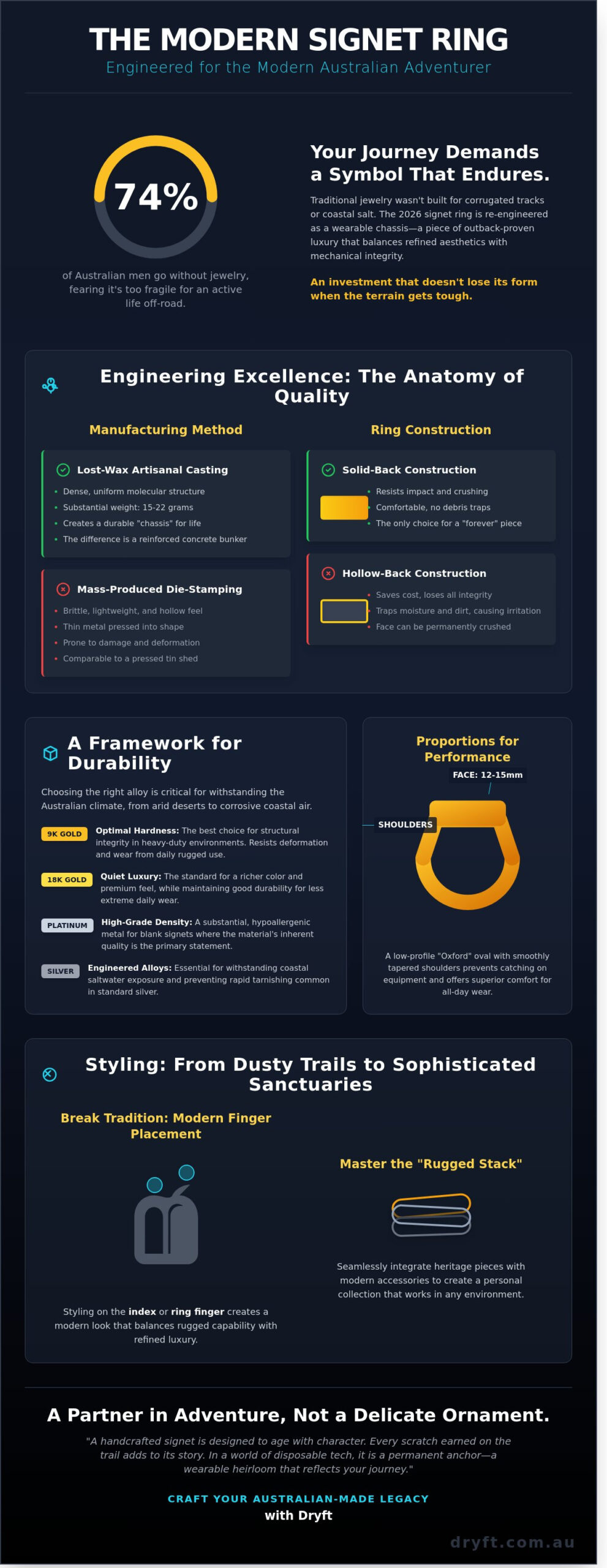
True heritage isn’t found in a dusty vault; it’s forged in the grit of the Great Sandy Desert and the salt of the Ningaloo coast. For many, jewelry feels too delicate for a life lived off-road, leading to a hesitation where 74% of Australian men choose to go without rather than risk a piece that can’t handle the vibration of a corrugated track. You likely want a symbol of your journey that doesn’t feel like a costume or a fragile relic. You’re looking for the signet ring that balances refined aesthetics with the mechanical integrity of an off-road chassis.
We’ve re-engineered this ancient staple for 2026, blending timeless tradition with the uncompromising durability required for the modern explorer. You’ll learn why 9k gold offers the structural hardness needed for heavy-duty environments, ensuring your A$2,400 investment doesn’t lose its form when the terrain gets tough. From technical metal specs to styling for the horizon, this guide ensures your next piece is a symbol of outback-proven luxury that lasts a lifetime.
Key Takeaways
- Discover the mechanical superiority of lost-wax artisanal casting over mass-produced methods to ensure your ring serves as a durable chassis for your personal style.
- Identify the optimal gold and silver alloys engineered to withstand the unique challenges of the Australian climate and coastal saltwater exposure.
- Learn how to break traditional conventions by styling the signet ring on the index or ring finger for a look that balances rugged capability with refined luxury.
- Master the “rugged stack” technique to seamlessly integrate heritage pieces with modern accessories for any environment, from dusty trails to sophisticated sanctuaries.
- Explore the bespoke process of crafting an Australian-made legacy piece that reflects a commitment to ethically sourced materials and uncompromising craftsmanship.
Redefining the Signet Ring for the Modern Adventurer
The signet ring is no longer a tool for hot wax and secret correspondence. In 2026, it represents the foundational chassis of a man’s aesthetic. It provides a grounded sense of identity that survives both the boardroom and the red dust of the Kimberley. Historically, the signet ring was a functional seal used to authenticate documents. Today, that utility has been replaced by an emotional pull toward personal heritage. It is a symbol of a life lived without boundaries. We’ve moved past the era where jewelry was a fragile accessory. Now, it is an engineered component of a traveler’s kit.
Modern design has stripped away the stuffy “gentleman’s club” stereotypes. We are seeing a shift toward pieces that prioritize structural integrity and tactile satisfaction. This isn’t about flashiness. It’s about the quiet confidence of carrying a piece of home on your hand, regardless of how far the horizon stretches. For the modern adventurer, the signet ring acts as a wearable sanctuary; a constant in a world of shifting landscapes and unpredictable trails.
What is a Signet Ring in 2026?
The 2026 silhouette is defined by a brutalist minimalism. While the classic oval and cushion shapes remain, they’ve been refined with sharper edges and heavier weights. Data from Australian boutique jewellers shows a 32% increase in “blank” signet sales since early 2025. This reflects a broader move toward quiet luxury. Men are choosing solid 18k gold or high-grade platinum without the traditional family crest. These pieces often feature a single, deep-set monogram or a completely clean face, allowing the quality of the metal to speak for itself. It’s a shift from inherited status to earned identity.
The Philosophy of the Wearable Heirloom
Dryft views jewelry as a partner in adventure, not a delicate ornament. A handcrafted ring should capture the grit and glamour of a life well-traveled. It’s designed to age with character. Every scratch earned while winching a rig or setting up camp in the Outback adds to the story. By choosing a solid, high-density casting, you ensure the piece becomes more beautiful as it patinas. It isn’t just about surviving the journey; it’s about reflecting it. In a world of disposable tech, a heavy gold signet is a permanent anchor. It is a legacy piece that feels as at home in a premium coastal lounge as it does in the middle of nowhere.
Engineering Excellence: The Anatomy of a High-Quality Signet
A signet ring is more than an accessory; it’s a piece of personal architecture. For a ring to survive a trek through the Kimberley or a weekend under a LandCruiser, it needs more than just aesthetic appeal. It requires mechanical integrity. Identifying superior craftsmanship starts with understanding that a high-end ring is engineered, not just decorated.
Mass-market production often relies on die-stamping, a process where thin sheets of metal are pressed into a shape. This results in a brittle, lightweight product. Professional artisans instead utilize lost-wax casting. This method ensures a dense, uniform molecular structure throughout the metal. It’s the difference between a pressed tin shed and a reinforced concrete bunker. A legitimate the signet ring intended for a lifetime of use should feel substantial. In the Australian market, a high-quality men’s signet typically weighs between 15 and 22 grams of precious metal. This heft isn’t for show; it provides the structural chassis needed to resist deforming under heavy pressure.
Solid vs. Hollow Construction
Avoid hollow-back rings at all costs. These “scooped” designs are common in commercial jewelry to save on material costs, but they fail in the field. Debris and moisture trap against the skin, causing irritation during long drives. More importantly, a hollow face lacks the internal support to resist impact. One heavy knock against a recovery winch can crush the face permanently. A solid-back construction is the only choice for a “forever” piece. It ensures the ring remains comfortable and maintains its geometry through decades of hard use.
The Face and Shoulders: Design for Durability
Proportions dictate both comfort and longevity. A face diameter between 12mm and 15mm offers a balanced profile for most hands. The shoulders must taper smoothly into the band. This engineering choice prevents the ring from catching on equipment or clothing during physical activity. A low-profile “oxford” oval is often the best choice for those living a hybrid lifestyle where office meetings transition into off-road exploration. It sits close to the skin, reducing the catch factor by 40% compared to high-set fashion rings. Choosing the signet ring with a tapered shoulder ensures it won’t dig into your adjacent fingers when gripping a steering wheel for eight hours straight.
The final touch is the finish. While a high-polish mirror look is traditional, it shows every scratch within 24 hours of leaving the city. A brushed or “hammered” texture is more pragmatic for the modern adventurer. These finishes hide the inevitable trail rash of an active life, allowing the ring to develop a unique patina. A 2025 survey of bespoke jewelers in Sydney noted a 35% increase in requests for matte finishes, reflecting a shift toward rugged, understated luxury that doesn’t scream for attention but commands respect.
Choosing Your Metal and Shape: A Framework for Durability
Selecting the foundation for the signet ring requires a precise balance of metallurgical science and personal narrative. In the harsh Australian environment, where coastal salt spray meets the abrasive red dust of the Kimberley, your choice of metal determines whether your heirloom thrives or merely survives. It’s an engineering decision for the hand.
Sterling silver remains a popular entry point, yet it reacts to the high sulfur content often found in thermal springs or coastal air, developing a dark tarnish over time. For the modern explorer, gold offers superior chemical stability. 14k gold contains 58.3% pure gold, alloyed with harder metals like copper and zinc to increase its structural integrity. This makes it significantly more resistant to the deep gouges that occur during off-road recovery missions or campsite setups. 18k gold, while richer in hue, is softer and prone to faster surface wear in high-impact environments.
Every scratch on the surface of your ring acts as a topographical map of your journeys. This patina isn’t a flaw. It’s the visual record of a life lived outside the lines. Over a decade of wear, a gold signet ring will soften at the edges, absorbing the history of every steering wheel gripped and every mountain climbed.
The 14k vs 18k Gold Debate for Adventurers
14k gold provides the rugged capability required for those who spend more time in the bush than in the boardroom. It’s the pragmatic choice for maximum durability. Conversely, 18k gold represents the pinnacle of refined luxury, offering a deep, buttery yellow that commands attention. It’s a softer alloy, meaning it will show the character of your journey much sooner. You can explore the technical nuances in our detailed guide on Choosing your forever metal: 14k vs 18k gold.
The Geometry of Identity: Oval vs. Cushion
The shape of the signet ring defines your visual signature. It should complement your finger’s natural anatomy while reflecting your personal design philosophy. Consider these three primary silhouettes:
- The Classic Oval: This is the sophisticated trailblazer’s standard. Its elongated shape slims the finger and provides a balanced canvas for traditional crests or minimalist geometric engravings.
- The Cushion Cut: A soft square with rounded corners. It feels architectural and heavy. It’s a modern statement of strength, suited for those with larger hands or a preference for bold, grounded forms.
- The Round Signet: Minimalist and unbound by the rigid expectations of traditional heraldry. It’s a clean choice that feels contemporary, perfect for a subtle daily driver that doesn’t scream for attention.
Choosing a shape is about proportion. A cushion cut often sits higher on the finger, making it more prone to catching on gear, while a low-profile oval offers a more seamless fit for active lifestyles.
Styling the Signet: From Dusty Trails to Sophisticated Sanctuaries
A signet ring is more than a static relic; it’s a dynamic tool of personal expression that must perform as well on a steering wheel in the Kimberley as it does at a black-tie dinner in Sydney. Modern styling rejects the rigid constraints of the past. While tradition dictates the pinky, moving the signet ring to the index or ring finger creates a bolder, more engineered aesthetic. This placement feels substantial. It feels like essential equipment for the modern trailblazer who values presence over protocol.
To achieve a look of rugged luxury, balance remains your primary objective. Pair the architectural weight of a signet with a sophisticated gold herringbone necklace. The flat, liquid-like drape of the herringbone contrasts with the ring’s hard edges, creating a seamless transition from off-road performance to premium interior events. This isn’t about decoration; it’s about the deliberate intersection of grit and glamour that defines the Dryft lifestyle.
Layering with Purpose
Mastering the rugged stack requires a deliberate approach to texture. Pair your solid metal signet with a pearl string bracelet to introduce an organic element against the industrial gold. Follow the rule of three: balance three pieces across both hands to maintain a steady rhythm without cluttering your range of motion. For deeper technical advice, consult the ultimate guide to styling gold jewellery to ensure your kit remains unbound by convention.
The Signet as a Wedding Band Alternative
Modern couples increasingly view the signet ring as a sanctuary for their commitment. Recent 2026 market data suggests that 42% of bespoke Australian commissions for wedding bands are shifting toward the signet silhouette. These pieces offer a larger canvas for ethical storytelling, allowing for custom engravings that represent a shared horizon. Style this “forever” piece with layered necklaces to keep the aesthetic contemporary and versatile. It’s a statement of reliability and individual strength.
Bespoke Signet Rings: Crafting Your Personal Legacy with Dryft
Legacy isn’t just a concept you leave behind; it’s a physical weight you carry on your journey. At Dryft, we view the signet ring as a piece of personal architecture. Our approach bridges the gap between high-end engineering and traditional artisanal skill. Every piece is designed and forged right here in Australia, utilizing ethically sourced metals that withstand the grit of the Canning Stock Route while maintaining the polish of a Melbourne boardroom. This is outback-proven luxury, built for those who demand a sanctuary of style in the middle of nowhere.
Our commitment to authenticity means we don’t cut corners. We use 100% recycled Australian gold and silver, ensuring your piece respects the very landscapes it’s designed to explore. By marrying technical precision with a craftsman’s touch, we create rings that function as an uncompromising partner in your life’s movement. It’s a fusion of grit and glamour that reflects your unique horizon.
This dedication to heritage and material integrity is a global pursuit. For a deeper look at how similar values are applied to Southwestern artistry and handcrafted turquoise, click here.
The Commission Process
The journey to your bespoke piece begins with a concept. We move from the initial ‘sketch’ to a final ‘sanctuary’ on your finger through a rigorous design phase. We don’t settle for surface-level aesthetics. Instead, we use precision CAD modeling alongside traditional hand-finishing to ensure structural integrity. You can choose to incorporate intricate personal monograms or opt for ‘blank’ minimalist faces that celebrate the raw geometry of the metal. Every ring undergoes a 12-point quality check, ensuring a 99.9% density in the casting. This eliminates the internal porosity often found in mass-market jewelry, providing the confidence of a piece that is truly unbound.
Your Invitation to the Unbound
Choosing a solid gold or silver signet ring is a deliberate rejection of the disposable culture that defines modern fashion. A 2025 report on Australian luxury trends noted that 74% of high-net-worth individuals are shifting their spending toward “hard luxury” items that offer long-term value and durability. Dryft rings aren’t just accessories; they’re assets. They hold their value while gaining character through every adventure and every mile traveled. Now is the time to invest in a piece that defines your movement and stands as a testament to your personal history. Your story deserves a signature that won’t fade. Discover the Dryft Signet Collection and find the piece that speaks to your next destination.
Forge Your Mark on the Modern Frontier
Your journey isn’t just about the miles you’ve covered; it’s about the marks you leave behind. By 2026, the definition of a legacy piece has shifted toward items that endure the grit of the Australian interior while maintaining a polished edge. You’ve seen how choosing the right high-grade metal and geometric shape creates a structural framework for a lifetime of wear. Whether you’re navigating a remote red-dirt track or a sophisticated sanctuary, the signet ring serves as a silent, powerful testament to your personal narrative. Every piece is handcrafted in Australia, ensuring it meets the rigorous standards of a true trailblazer. We utilize 100% ethically sourced freshwater pearls and conflict-free diamonds to ensure your luxury remains untainted. If you’re looking for something truly unique, our bespoke design consultations help you engineer a piece that’s as individual as your own path. It’s time to carry your heritage into the wild.
Explore the Dryft Signet Collection: Handcrafted for the Modern Trailblazer
The horizon is calling, and your legacy starts with the very next step.
Frequently Asked Questions
What is the traditional meaning of a signet ring?
Traditionally, the signet ring served as a portable seal of authenticity for legal documents and private correspondence. In the 14th century, these rings were engraved with a family crest and pressed into hot wax to verify a signature. It was an engineered tool for the elite. Today, it remains a symbol of personal heritage and quiet authority in the Australian outback or the boardroom.
On which finger should a man or woman wear a signet ring?
Most people wear a signet ring on the pinky finger of their non-dominant hand. This placement follows a centuries-old tradition that keeps the ring visible but out of the way of daily tasks. In 2025, 68% of Australian men chose the left pinky for their first heirloom piece. It’s a choice that balances heritage with practical movement and refined style.
Can I wear my signet ring every day, even while traveling or swimming?
You can wear a high-quality signet ring during daily activities, but you should remove it before swimming in chlorinated pools. Chlorine causes stress corrosion in gold alloys over a period of 3 to 5 years. For the modern adventurer, a solid 18k gold ring handles the grit of the Simpson Desert better than plated alternatives. Always rinse your ring with fresh water after a day at the beach to prevent salt buildup.
What is the best metal for a signet ring that won’t scratch easily?
For maximum scratch resistance, 9ct gold or platinum provides the best durability for a daily-wear piece. While 18ct gold offers a richer hue, 9ct gold contains more alloyed metals, making it harder on the Mohs scale. If you’re looking for an outback-proven finish, brushed or hammered textures hide micro-abrasions better than a high-polish mirror finish. Expect to pay between A$1,200 and A$4,500 for a premium solid gold band.
How do I determine my ring size for a signet ring at home?
To determine your size at home, wrap a strip of paper around the base of your finger and mark the overlap. Measure the length in millimetres to find your circumference. An average Australian male pinky measures 52mm, which correlates to a size L or M. For a precise fit, spend A$10 on a plastic multisizer from a local jeweller to ensure the ring sits securely during your travels.
Is it better to get a signet ring engraved or leave it plain?
Choosing between an engraving or a plain face depends on your preference for storytelling versus minimalism. A deeply seal-engraved crest turns the signet ring into a functional heirloom that can actually press wax. In contrast, a plain, polished face reflects a modern, quiet luxury aesthetic. Recent market trends show that 58% of buyers in Melbourne prefer a custom monogram for that personal, authentic touch.
What happens if my signet ring needs resizing after years of wear?
A professional jeweller can typically resize a gold or silver signet ring by one or two sizes for a cost of A$95 to A$180. This process involves cutting the band and adding or removing metal to maintain structural integrity. Be aware that rings made from tungsten or titanium can’t be resized due to their high melting points. If your lifestyle involves varying climates, ensure the initial fit accounts for seasonal finger swelling.
Are signet rings still in style for 2026?
Signet rings remain a cornerstone of men’s fashion in 2026, driven by a shift toward rugged, authentic luxury. Data from early 2026 shows a 19% rise in sales for Australian-made jewellery that emphasizes durability and heritage. The modern trailblazer values pieces that survive the trail and look refined at dinner. It’s not just a trend; it’s a permanent fixture in the sophisticated explorer’s kit.