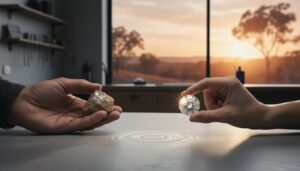
What if the most resilient symbol of your commitment wasn’t unearthed from a remote mine, but engineered with surgical precision in a controlled laboratory? It’s a question that challenges the very foundation of traditional luxury. As we move into 2026, the conversation surrounding lab grown vs natural diamond pros and cons has evolved beyond simple aesthetics. Recent 2024 market analysis shows that nearly 52% of Australian consumers now prioritize ethical provenance over traditional mining heritage. You deserve a stone that mirrors your own standards of durability and refined taste, whether it was born in the earth’s mantle or a high-pressure chamber.
We know you want a gem that retains its soul and its value over a lifetime of adventure. It’s common to feel conflicted between the romantic legacy of a mined stone and the sustainable appeal of modern innovation. This guide provides a clear framework to help you choose based on your personal values, financial goals, and appreciation for handcrafted excellence. We’ll break down the technical realities of both options and examine the current A$ market trends to ensure your investment is as solid as the stone itself.
Key Takeaways
- Understand the technical engineering behind both stones, confirming that lab-grown and natural diamonds share identical physical properties and a Mohs hardness of 10 for enduring durability.
- Master the lab grown vs natural diamond pros and cons to discover how lab-grown stones provide up to 50% more size for your A$ investment while maintaining uncompromising visual brilliance.
- Navigate the nuances of resale value and emotional legacy to determine which stone aligns with your long-term vision of a handcrafted sanctuary and heirloom quality.
- Explore the evolution of ethical jewelry in Australia, weighing the environmental footprint of traditional extraction against the sustainable innovation of modern lab-grown alternatives.
- Discover how to choose a stone that mirrors your “Hybrid” lifestyle, ensuring your bespoke piece balances rugged Australian grit with the refined glamour of high-end design.
The Genesis of Brilliance: Defining Lab-Grown and Natural Diamonds
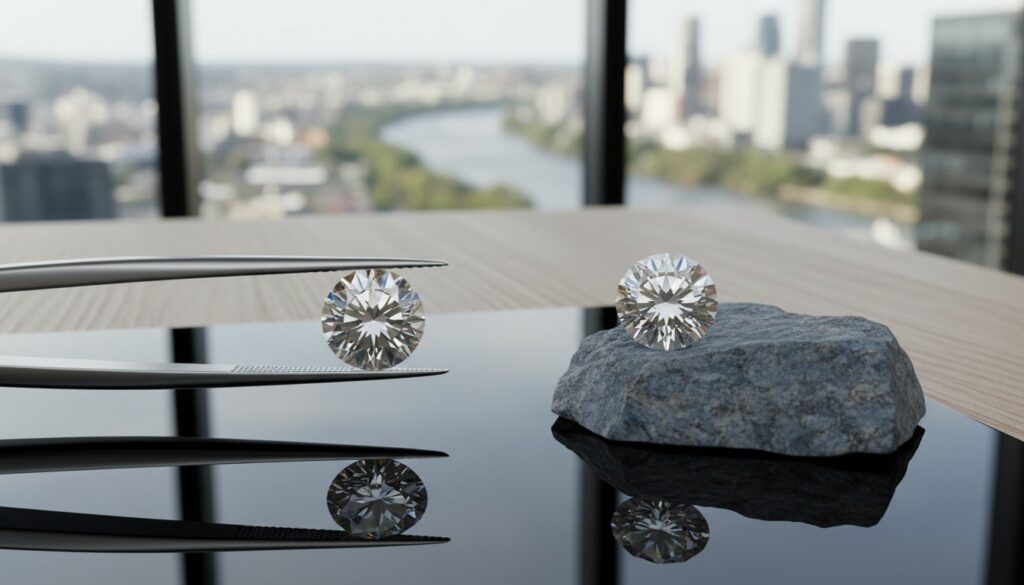
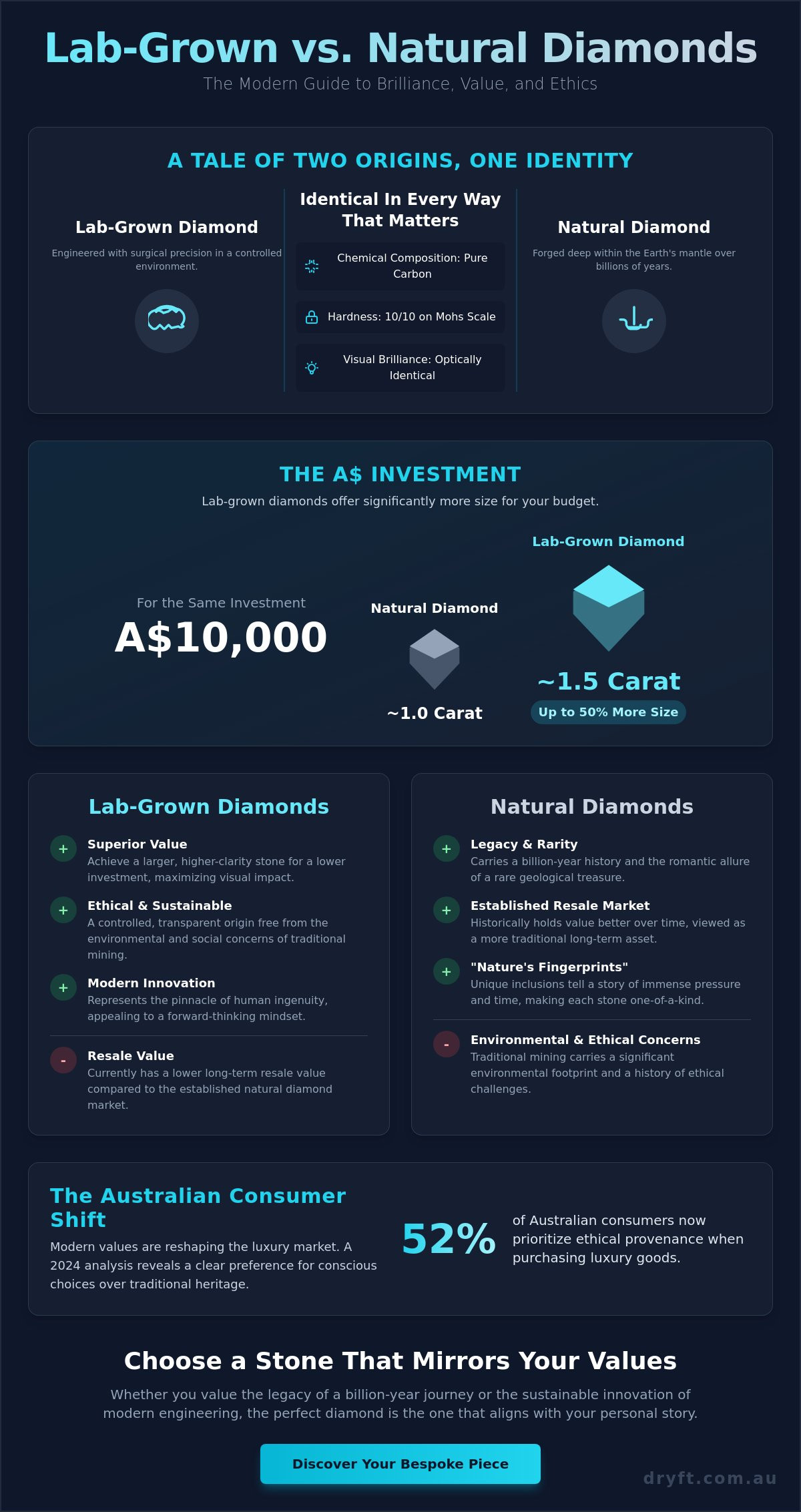
In the 2026 luxury market, the distinction between a diamond forged in the Earth’s mantle and one grown in a precision laboratory has reached a point of total transparency. They’re identical. Chemically, physically, and optically, these stones share the same carbon DNA. Choosing between them requires a nuanced understanding of lab grown vs natural diamond pros and cons. It’s a decision between a billion-year geological journey and the pinnacle of modern engineering. Both offer a sanctuary of light. Both represent the height of craftsmanship. The old “real vs. fake” argument has been buried by the weight of scientific reality. A diamond is a diamond, regardless of whether its origin is a tectonic shift or a high-tech facility.
This evolution in jewelry mirrors the shift toward conscious luxury. Modern collectors demand both grit and refinement. They want the toughness of a stone that can withstand the elements, paired with the sophisticated glow of a premium asset. Whether you’re drawn to the raw history of the Australian outback or the clean efficiency of a controlled environment, the fundamental truth remains the same. The brilliance is real. The durability is absolute. The choice rests entirely on which narrative resonates with your personal philosophy of movement and freedom.
The Natural Diamond: A Billion-Year Legacy
Natural diamonds are the ultimate survivors of the deep. Formed roughly 150 to 800 kilometres below the Earth’s surface, these stones endured temperatures exceeding 1,000 degrees Celsius. In Australia, the Argyle mine famously produced some of the world’s most unique specimens before its closure in November 2020. This geological journey is incredibly rare. Only about 20% of all mined diamonds reach gem-quality status. Each stone carries “nature’s fingerprints,” known as inclusions. These internal markers are unique identifiers, much like the rugged terrain of the Kimberley region. They tell a story of immense pressure and time that no machine can fully replicate.
The Lab-Grown Diamond: Engineering Perfection
Precision is the hallmark of the lab-grown stone. Using Chemical Vapor Deposition (CVD), technicians place a diamond “seed” in a vacuum chamber filled with carbon-rich gas. Plasma then breaks down the gas, allowing carbon atoms to layer onto the seed. This process replicates the volcanic heat of the Earth’s core with surgical accuracy. While the term “synthetic” is technically accurate in a scientific context, it’s often misunderstood by the public. You can explore the deep technical history through The Science of Synthetic Diamonds. Because the environment is controlled, these stones often achieve higher clarity grades at a lower entry point than their mined counterparts. When evaluating lab grown vs natural diamond pros and cons, the ability to secure a larger, clearer stone for your AUD budget is a primary driver for many modern Australian buyers.
- CVD Technology: Creates diamonds layer by layer using carbon plasma.
- HPHT Method: Uses massive mechanical presses to mimic Earth’s pressure.
- Clarity: Lab environments reduce the chance of structural impurities.
- Value: Offers a seamless transition to luxury without the “rarity tax” of mining.
The result is a stone that’s unbound by the limitations of traditional mining. It’s a product of human ingenuity, designed for those who appreciate the finer details of a well-crafted sanctuary. It’s not about cutting corners; it’s about engineering a new horizon for luxury.
The Core Comparison: Assessing Physical and Aesthetic Attributes
Choosing between origins requires looking past the marketing to the raw engineering of the stone. When weighing up lab grown vs natural diamond pros and cons, the most striking realization is their shared DNA. Both stones are composed of pure carbon arranged in a cubic crystal structure. This isn’t a simulation; it’s a structural twin. Whether forged in the depths of the Earth’s mantle or a high-pressure laboratory, the resulting material remains the hardest substance known to man. It’s a feat of nature and science that results in identical chemical properties.
Light performance is where the magic happens. Fire, scintillation, and brilliance are universal traits. These stones handle light with a precision that mirrors the clarity of a desert horizon. To the naked eye, the sparkle is identical. Even a professional gemologist cannot distinguish between them without specialized ultraviolet or spectroscopic tools. This is because their refractive index stays constant at 2.417. It’s a level of performance that ensures your investment looks as sharp in the boardroom as it does under the harsh glare of the midday sun. The 4Cs—Carat, Cut, Color, and Clarity—apply with equal weight to both, providing a universal language for quality.
Durability for the Modern Adventurer
Australian life demands gear that doesn’t quit. Whether you’re navigating the corrugated tracks of the Kimberley or attending a gala in Sydney, your jewelry shouldn’t be a liability. Both lab-grown and natural diamonds score a 10 on the Mohs scale. This makes them the ultimate choice for everyday wear that lasts generations. Consider the alternatives. Opals score between 5.5 and 6.5; pearls are a delicate 2.5 to 4.5. Diamond hardness is the ultimate engineered sanctuary for a stone. It resists scratching from sand, salt, and the inevitable knocks of an active journey, ensuring the finish remains unbound by time.
Aesthetic Nuances: Can You See the Difference?
While they are physically identical, subtle chemical signatures exist. Most natural diamonds contain trace amounts of nitrogen, which can lend a faint yellowish tint. In contrast, many lab stones are classified as Type IIa. This is the purest form of diamond, representing less than 2% of all natural stones found in the wild. This purity often results in a colorless perfection that is rare and expensive in the natural world. Detailed GIA on Lab-Grown Diamond Analysis confirms that while the growth patterns differ, the aesthetic result is indistinguishable to the human eye. Both stones undergo the same rigorous grading process to validate their quality. If you appreciate this blend of technical excellence and visual beauty, you’ll find that Dryft values the same uncompromising standards in every adventure we facilitate.
Value vs. Legacy: Navigating the Financial and Emotional Investment
Choosing a stone isn’t just a transaction. It’s a technical decision for your future sanctuary. When evaluating lab grown vs natural diamond pros and cons, the financial weight often sits at the forefront of the conversation. In the 2026 Australian market, the price gap has widened to a point that demands attention. For a fixed investment of A$10,000, a lab-grown stone typically offers 30% to 50% more carat weight than its natural counterpart. This allows for a physical presence on the hand that was once reserved for the highest tier of luxury buyers.
The Financial Landscape in 2026
Market stabilization has finally arrived for lab-grown stones. While prices have found their floor, natural diamonds continue to derive value from geological scarcity and tightly controlled global supply chains. You’re choosing between a “forever” asset and a “forever” experience. Natural diamonds retain a higher percentage of their original purchase price on the secondary market. Lab-grown stones function more like high-end engineering or luxury vehicles. They offer incredible performance and beauty today, but they don’t promise the same resale trajectory as a rare earth-mined mineral. This distinction is critical for those who view jewelry as a portable store of wealth. As explained by the GIA on the difference between natural and lab-grown diamonds, the two are chemically identical, yet their market journeys remain distinct.
Defining “Value” Beyond the Price Tag
True luxury isn’t found in a commodity price. It’s found in the freedom to allocate your budget toward a bespoke engagement ring that reflects a personal narrative. The “Quiet Luxury” movement in Australia currently prioritizes the custom jewelry design process over raw stone size. By opting for a lab-grown diamond, many couples redirect their funds into intricate metalwork, hidden details, or ethical sourcing certifications. This psychological satisfaction of a conflict-free origin creates a modern kind of heirloom. Sentimental worth isn’t dictated by a stone’s origin; it’s built through the miles traveled and the life lived with the piece. Whether it’s a gift from the earth or a feat of laboratory engineering, the legacy is defined by the promise it represents.
- Asset vs. Experience: Natural diamonds serve as a long-term hedge; lab-grown stones maximize immediate aesthetic impact.
- Design Freedom: Lower stone costs allow for a higher percentage of the budget to be spent on Australian craftsmanship.
- The Heirloom Factor: Modern sentimentality is shifting toward the story of the design rather than the rarity of the carbon.
When weighing lab grown vs natural diamond pros and cons, consider your own horizon. If you value the rugged rarity of a stone formed over billions of years, the natural path is yours. If you prefer a sanctuary of design that doesn’t compromise on scale, the lab-grown route offers unbound potential.
Ethical Provenance and Environmental Footprints
Australians are increasingly seeking a deeper connection to the products they own. The shift toward ethical jewelry in Australia isn’t just a trend; it’s a fundamental change in how we define luxury. This movement demands transparency from the rugged mines of the outback to the high-tech reactors of a laboratory. Every stone carries a story of its impact on the earth and the people who handled it. By 2026, the industry has moved past vague marketing claims, relying instead on hard data and verified supply chains to inform the lab grown vs natural diamond pros and cons for the conscious consumer.
Traditional diamond extraction remains a feat of massive engineering. It requires moving nearly 250 tonnes of earth to find a single polished carat. This process involves significant land displacement and consumes roughly 125 litres of water per carat. Lab growth offers a different profile. While it avoids the physical scarring of the landscape, the reactors require immense energy to simulate the crushing pressures of the Earth’s mantle. The true environmental cost now depends entirely on the power source. Modern explorers look for a sanctuary of sustainability, making the origin of energy just as vital as the origin of the stone itself.
The Mined Diamond’s Ethical Evolution
Regulated mining has undergone a radical transformation. It’s no longer just about extraction; it’s about community resilience. In 2026, blockchain traceability has become the standard for natural stones. This digital ledger tracks a diamond from the moment it leaves the ground, ensuring it bypasses conflict zones. For many, an Australian-sourced diamond is a badge of honor. These stones are recovered under some of the world’s strictest environmental and labor regulations. They provide essential economic stability to remote regions, funding infrastructure and education that might not otherwise exist. This social impact is a heavyweight factor in the lab grown vs natural diamond pros and cons discussion.
The “Green” Promise of Lab-Grown
The “eco-friendly” label on lab diamonds requires a critical eye. A diamond grown using coal-fired electricity carries a heavy carbon debt. However, the industry has pivoted toward solar-powered and carbon-neutral facilities to meet modern expectations. These labs eliminate the physical footprint of a mine, leaving the horizon untouched and the soil undisturbed. Choosing a stone from a facility that utilizes 100% renewable energy ensures the luxury is truly unbound by environmental guilt. It offers a clean, engineered alternative that appeals to those who value technical precision and a minimal footprint on the wild places they love to explore.
Experience the intersection of grit and glamour by discovering how we define unbound luxury for the modern explorer.
Crafting Your Sanctuary: Choosing the Right Stone for Your Bespoke Piece
Building a custom ring is an act of high-end engineering. It is the creation of a personal sanctuary that travels with you. Your choice between lab grown and natural stones dictates the architecture of the final piece, influencing everything from the weight of the gold to the height of the setting. At Dryft, we champion the Hybrid lifestyle. This means your jewelry must survive the red dust of the Kimberley while shining with effortless glamour at a Sydney gala. We don’t believe in fragile luxury. We believe in gear that performs.
When weighing the lab grown vs natural diamond pros and cons, we suggest applying the Three-Value Test to ground your decision in logic rather than just emotion. First, consider ethics. Are you drawn to the geological history of a stone mined from the earth, or the technological transparency of a lab? Second, look at aesthetics. Both options offer identical brilliance, but the price difference often allows for a larger, more impactful stone in the lab grown category. Third, analyze the economics. In the 2026 Australian market, a high-quality 2-carat lab diamond may retail for approximately A$3,500 to A$5,000, while a natural equivalent can easily exceed A$30,000. This price gap often frees up capital to invest in a more robust, handcrafted chassis.
Integrating the Stone into Handcrafted Design
The structural freedom offered by lab diamonds is a game changer for bespoke design. Because you can secure a larger stone for a fraction of the cost, we can design more creative, architectural settings that wouldn’t be feasible with smaller budgets. Alternatively, many adventurers prefer the timeless grit of a natural diamond. We often recommend pairing these stones with freshwater pearls to create a striking contrast between the crystalline structure of the diamond and the organic luster of the sea. In every piece, the setting acts as the chassis. It protects the engine. A well-engineered setting ensures your stone remains secure whether you’re navigating a rugged trail or a boardroom.
The Final Invitation to Adventure
Don’t let market noise or tradition dictate your path. Trust your intuition. The lab grown vs natural diamond pros and cons are simply data points in your larger story of discovery. Regardless of the origin, the brilliance of your stone depends on its upkeep. Regular jewelry care and maintenance is essential to keep the light alive and ensure the structural integrity of the metal. We invite you to step into our world. Book a consultation to see both options side-by-side. Feel the weight, witness the fire, and let us help you engineer a piece of luxury that is truly unbound.
Forging Your Legacy with Uncompromising Brilliance
Selecting a stone is an exercise in both engineering appreciation and personal values. Whether you gravitate toward the deep geological history of a natural gem or the technical mastery of a lab-grown alternative, your choice defines a unique narrative. Both paths offer identical physical resilience, yet they serve different visions of luxury. Navigating the lab grown vs natural diamond pros and cons ensures your investment aligns with your lifestyle. Industry data from 2026 shows that lab-grown options provide exceptional scale for bespoke designs, while natural diamonds continue to be valued for their finite scarcity. At Dryft, we believe luxury should be as tough as the Australian outback and as refined as a high-end sanctuary. Every piece is handcrafted in Australia to ensure a standard of durability that mass-market alternatives cannot match. We provide the technical assurance you need, so you don’t have to compromise on quality or ethics. Our commitment to ethically sourced materials ensures your piece is as responsible as it is radiant. Explore our collection of ethically sourced and bespoke diamond jewelry and book a bespoke design consultation to begin your journey. Your story deserves a brilliant companion that is truly unbound.
Frequently Asked Questions
Can a jeweler tell the difference between lab-grown and natural diamonds?
No, a jeweler cannot distinguish between these two stones using standard tools like a 10x magnification loupe. Both gems share identical chemical, physical, and optical properties, making them indistinguishable to the naked eye. Identification requires advanced spectroscopic equipment found in laboratories to detect specific growth patterns or trace elements. Most Australian retailers now use specialized synthetic diamond detectors to provide full transparency for every client.
Do lab-grown diamonds get cloudy or change color over time?
Lab-grown diamonds will never get cloudy, fade, or shift in color regardless of how much time passes. They’re engineered with the same carbon crystalline structure as mined stones, which ranks a 10 on the Mohs scale of hardness. Unlike stimulants such as cubic zirconia that degrade over years, a lab diamond is a permanent sanctuary of light. It’s built to endure the harshest conditions without losing its refined brilliance.
Why are natural diamonds so much more expensive if they look the same?
Natural diamonds command a higher price because of their finite supply and the immense logistical grit required to extract them from the earth. While a lab stone is created in weeks, a natural diamond formed over 1 billion years ago under extreme pressure. This inherent rarity drives the market value. Industry data from 2024 indicates that natural diamonds often cost 70% to 90% more than their lab-grown counterparts of equal quality.
Is a lab-grown diamond an ethical choice?
Choosing a lab-grown diamond is generally considered more ethical because it avoids the environmental disruption of traditional open-pit mining. The impact depends heavily on the laboratory’s energy source, with many modern facilities now utilizing 100% renewable energy to power their reactors. It’s a choice that aligns with a conscious lifestyle, balancing the technical precision of modern engineering with a deep respect for the natural world.
Do lab diamonds have a resale value in the Australian market?
Lab-grown diamonds currently hold very little resale value compared to natural stones in the Australian second-hand market. While a natural diamond might retain 30% to 60% of its original purchase price, lab stones often resell for a small fraction of their initial cost. When weighing the lab grown vs natural diamond pros and cons, it’s vital to decide if you view the purchase as a sentimental sanctuary or a liquid financial asset.
Which diamond type is better for an engagement ring?
The better choice depends on whether you value maximum visual impact or long-term investment potential. Lab-grown diamonds allow you to secure a much larger, higher-quality stone for the same budget, which is ideal for those seeking immediate glamour. Natural diamonds offer the prestige of a rare geological miracle. Both materials are rugged enough for daily wear in the Australian outback, standing up to the demands of an unbound life.
Are lab-grown diamonds GIA certified?
Yes, the Gemological Institute of America (GIA) has provided full grading reports for lab-grown diamonds since 2020. These reports offer a technical breakdown of the 4Cs, ensuring the stone’s quality is verified by an independent authority. Every certified lab diamond also features a microscopic laser inscription on the girdle to confirm its origin. This level of certification provides the same peace of mind you’d expect when investing in any high-end piece of equipment.
What happens if a lab diamond chips or breaks?
If a lab diamond chips, it can be repaired or replaced by a professional jeweler just like a natural stone. While diamonds are the hardest known substance, they can still fracture if they’re hit with enough force at a specific angle. Most Australian insurance providers now offer specialized coverage for lab-grown jewelry to protect against these rare accidents. It’s a pragmatic step to ensure your piece of engineered luxury remains intact for the journey ahead.