

A diamond’s brilliance is meant to be absolute. Yet, the path to finding one is often clouded by ambiguity. Vague terms like ‘conflict-free’ and ‘sustainable’ can feel like navigating an unmarked trail, leaving you to question the true story behind the sparkle. You’re not just buying a stone; you’re investing in a symbol, and its provenance matters. This is where understanding the genuine ethically sourced diamonds meaning becomes your compass, guiding you past surface-level claims and the fear of being misled.
This guide is engineered to provide that clarity. We will cut through the marketing noise to build a practical framework for your decision, equipping you with the right questions for your jeweller and the confidence to choose a diamond whose journey is as beautiful as its destination. It’s about finding a stone that truly reflects your values, a symbol of commitment chosen without compromise.
Key Takeaways
- Move beyond the baseline ‘conflict-free’ label and discover why the Kimberley Process is just the first step on the path to a truly conscious choice.
- Understanding the true ethically sourced diamonds meaning involves looking beyond a single certificate to evaluate its impact on people and the planet.
- Uncover the clear pathways to verify a diamond’s origin, from blockchain traceability to specific mine-of-origin documentation that provides undeniable proof.
- Arm yourself with a practical checklist of non-negotiable questions to confidently vet any jeweller and ensure their claims stand up to scrutiny.
The Baseline: Why ‘Conflict-Free’ Is Just the Starting Point
In the world of fine jewellery, the term ‘conflict-free’ has long been the standard-bearer for ethical assurance. It’s a term that offers a sense of security, a promise of a clean origin. But like the first marker on a long outback track, it only tells you where the journey begins, not where it ends. To truly understand the ethically sourced diamonds meaning, we must first look past this baseline and examine what it promises-and, more importantly, what it leaves uncharted.
A ‘conflict-free’ diamond is, in simple terms, a diamond that has not been used to finance a rebel war against a recognised government. This definition is the entire foundation of the international certification scheme designed to prevent the trade of so-called ‘blood diamonds’.
What is the Kimberley Process?
Established in 2003, the Kimberley Process Certification Scheme (KPCS) was a landmark global effort to clean up the diamond supply chain. Its goal was to stop rough diamonds from being used by rebel movements to fund brutal conflicts. The system works by requiring member governments to certify that shipments of rough diamonds are free from the influence of these groups. While noble in its intent, its scope is intentionally narrow. The Kimberley Process was engineered to stop diamonds from funding rebel wars, but its narrow focus leaves vast ethical landscapes completely unexplored.
The Gaps in the ‘Conflict-Free’ Guarantee
The stark reality is that the ‘conflict-free’ label provides a very limited guarantee. Its definition of ‘conflict’ is surgically precise, ignoring a host of other critical ethical issues that define a diamond’s true story. A KPCS-certified stone can still be linked to significant harm, a fact that complicates the search for a truly ethical diamond.
The system’s primary weaknesses include:
- A Narrow Definition: The KPCS does not address violence or human rights abuses committed by government forces themselves, only by rebel groups.
- Labour Practices: It offers no protection against child labour, unsafe working conditions, or unfair wages for miners.
- Environmental Impact: The devastating environmental degradation caused by irresponsible mining practices is completely outside its mandate.
Recent events have further exposed these limitations. For instance, the KPCS has been unable to reach a consensus on how to treat diamonds from Russia following the invasion of Ukraine, demonstrating how geopolitical realities can paralyse its effectiveness. This highlights that a ‘conflict-free’ stamp is not a comprehensive seal of ethical approval. It’s simply the first, crucial step. The complete ethically sourced diamonds meaning demands we look deeper into the entire journey of the stone, from the earth to its final, brilliant form.
Defining ‘Ethically Sourced’: A More Holistic Standard
While the term ‘conflict-free’ is a crucial starting point, it is no longer the final destination for conscious consumers. The true ethically sourced diamonds meaning represents a far more holistic and uncompromising standard. Think of it like the difference between standard coffee and certified Fair Trade coffee; one simply avoids a specific negative, while the other actively champions positive outcomes for both people and the planet.
The baseline for ‘conflict-free’ is set by frameworks like the Kimberley Process Certification Scheme, which aims to prevent diamonds from financing civil wars. An ethically sourced diamond, however, must satisfy three core pillars that go much deeper, ensuring its journey from the earth is one of integrity.
Pillar 1: Human Rights & Fair Labour
This is the human element. It moves beyond politics to people, a shift in perspective also seen in human-centred journalism from platforms like the Gulf–ASEAN Exchange. A truly ethical diamond is mined under conditions that uphold human dignity-guaranteeing safe working environments, fair wages, and the absolute prohibition of child labour. Critically, it also means the local communities see tangible benefits from the mine’s presence, sharing in the prosperity drawn from their land.
Pillar 2: Environmental Responsibility
A diamond forged by nature should not come at the cost of destroying it. This pillar demands a deep respect for the wild, focusing on minimising the ecological footprint of mining operations. It includes responsible water usage, proactive land rehabilitation to restore landscapes post-mining, and the protection of local biodiversity. This stands in stark contrast to destructive, unregulated practices that leave irreparable scars on the earth.
Pillar 3: Transparent & Verifiable Origin
This is the ultimate assurance. Transparency is the bedrock that guarantees the other two pillars are upheld. It means a diamond’s complete journey can be meticulously tracked from its origin mine to the final market. For the discerning buyer, this verifiable provenance isn’t just a detail; it’s the non-negotiable proof that their choice is a genuine reflection of their values.
The Paths to an Ethical Diamond: How to Verify the Source
Understanding the definition of an ethical diamond is the first step. The next is navigating the terrain to find one. The journey from a raw stone to a refined jewel is complex, but transparency is the key. For those who value integrity as much as beauty, there are three distinct and proven paths to acquiring a diamond with a story you can be proud of. Discerning the true ethically sourced diamonds meaning requires knowing how to verify that story.
Traceable Natural Diamonds
The gold standard for a mined diamond is a guaranteed chain of custody. This isn’t just a vague promise; it’s backed by mine-of-origin documentation that traces the stone from its specific point of extraction to the final cut. While broad initiatives like the Kimberley Process Certification Scheme were engineered to prevent the trade of conflict diamonds, true ethical assurance goes further. Nations like Canada and Botswana are renowned for their stringent regulations and positive community impact. Here in Australia, the now-closed Argyle mine was a benchmark for responsible sourcing, producing its famous pink diamonds with unwavering ethical and environmental oversight.
Lab-Grown Diamonds: The Scientific Alternative
Engineered in highly controlled environments, lab-grown diamonds offer absolute certainty. They are not imitations; they are chemically, physically, and optically identical to their mined counterparts, forged from a pure carbon seed. Their primary ethical advantage is an unbreachable chain of custody. A guaranteed origin. No exceptions. This modern marvel of science sidesteps the complexities of mining entirely, often resulting in a significantly smaller environmental footprint and a clear conscience.
Recycled & Antique Diamonds: The Sustainable Choice
The most sustainable diamond is one that already exists. Recycled or antique diamonds are stones that have been carefully reclaimed from previous settings and reintroduced to the market. This path honours the past while demanding nothing new from the earth. While their original mining history from decades or centuries ago may be lost to time, their current impact is zero. It’s a choice that champions conservation and legacy, giving a brilliant stone a new chapter in a new story.
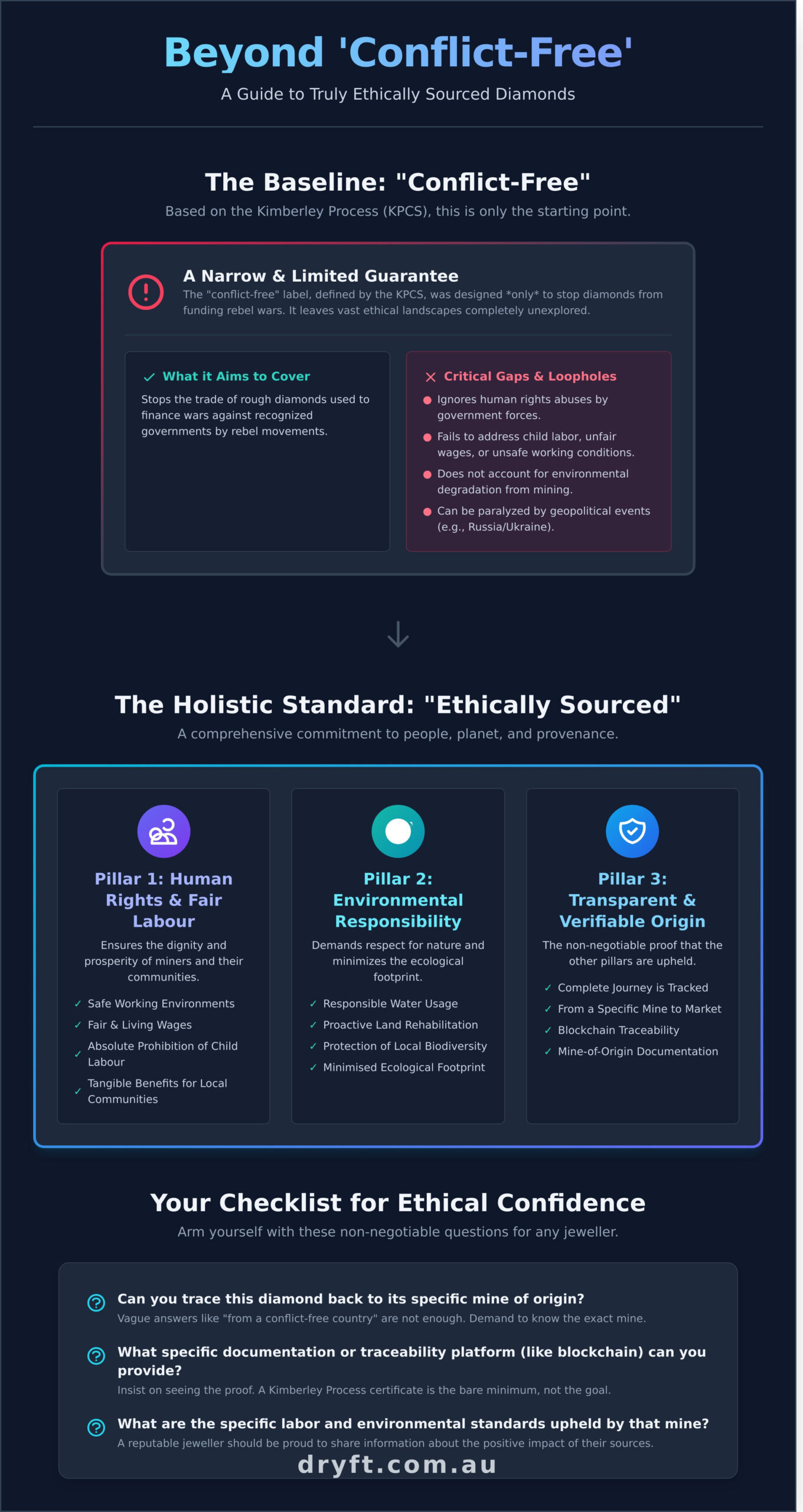
Your Checklist for Ethical Confidence: Questions to Ask Any Jeweler
Navigating the world of diamonds requires a clear map. True confidence isn’t just about finding a beautiful stone; it’s about understanding its journey. A reputable jeweler will not only welcome your questions but will respect you for asking them. This checklist is your guide-a tool to help you vet any diamond and ensure its story aligns with your values.
Think of this as due diligence for one of life’s most significant purchases. The answers you receive will illuminate a business’s true commitment to the real ethically sourced diamonds meaning.
Questions About Origin & Traceability
The foundation of an ethical diamond is a transparent and verifiable path from the earth to you. Vague assurances are no longer enough. Demand specifics.
- ‘Can you tell me the country or specific mine this diamond came from?’
A strong answer: They can name a specific country known for responsible mining, such as Canada, Botswana, or Australia. An exceptional answer will identify the specific mine of origin.
A red flag: A generic reply like, “It’s conflict-free.” This avoids the question and suggests a lack of detailed tracking. - ‘What documentation do you provide to verify its origin?’
A strong answer: They can provide a grading report (e.g., GIA) that lists the country of origin, a specific certificate of origin, or a unique serial number laser-inscribed on the diamond that traces it back to its source.
A red flag: Relying solely on a verbal promise or a standard Kimberley Process warranty statement on a receipt. This offers minimal proof for an individual stone. - ‘Do you subscribe to standards beyond the Kimberley Process?’
A strong answer: They mention memberships or adherence to stricter protocols, like the Responsible Jewellery Council (RJC), or direct relationships with mines that have proven social and environmental programs.
A red flag: Confusion about the question or stating that the Kimberley Process is all that’s required. This indicates a surface-level commitment to ethics.
Questions About the Business’s Philosophy
A company’s policies reveal its core principles. This is where you move beyond a single diamond to understand the integrity of the entire operation.
- ‘What is your policy on ethical sourcing?’
A strong answer: They have a clear, well-articulated policy they can share with you, often published on their website. They should speak confidently about their supplier relationships and vetting process.
A red flag: A non-committal or generic response that lacks substance. If ethics isn’t a core part of their business language, it likely isn’t a core part of their practice. - ‘Do you offer lab-grown or recycled diamond options?’
A strong answer: A simple “yes” and a willingness to discuss the merits of each. Even a considered “no” backed by a clear philosophy on natural diamonds is a sign of a thoughtful business. The goal is transparency and choice.
A red flag: Dismissing these alternatives as inferior or “fake” without a nuanced discussion. This suggests an outdated, sales-driven approach rather than a client-focused one.
This level of inquiry is standard practice for us. See how we answer these questions and explore our commitment to transparency in our bespoke engagement ring process.
The Dryft Commitment: Handcrafted with Integrity in Australia
The journey to understand the true ethically sourced diamonds meaning can be as complex as navigating a remote landscape. It’s a path that demands clarity, honesty, and an unwavering compass. At Dryft, we don’t just navigate this path; we define it. We see ourselves not merely as jewellers, but as curators of conscious luxury-offering you a clear and confident choice in a world of complexity.
Our Sourcing Philosophy
Our commitment is built on an uncompromising foundation of integrity. It’s a philosophy that sees a piece of jewellery not just as an object of beauty, but as a story that begins with respect for the earth and its people. This belief is engineered into every piece we create through three core pillars:
- Uncompromising Traceability: We prioritise fully traceable natural diamonds and select only the highest-quality lab-grown stones. This dual approach offers you freedom of choice, ensuring every option meets our stringent ethical standards.
- Sustainable Foundations: Our dedication extends to the settings themselves. We exclusively use recycled precious metals, minimising our environmental footprint and honouring the finite resources of our planet.
- Beauty in Integrity: We believe the most profound beauty is born from a clear conscience. The brilliance of a Dryft piece is inseparable from the integrity of its creation story.
Why Handcrafted in Melbourne Matters
Our commitment to ethical practice doesn’t end at the source. It’s brought to life right here, in our Melbourne workshop. Choosing local, handcrafted creation is a deliberate act of assurance. It means we can guarantee ethical labour practices, providing fair, safe conditions for the artisans who pour their skill into your piece. This is where the true ethically sourced diamonds meaning finds its final, tangible form.
This approach moves beyond the anonymity of mass production, fostering a direct relationship between creator and client. It ensures every angle is perfected, every setting is secured with precision, and every piece carries a personal touch that can only come from human hands. It’s the final, vital step in a chain of custody built on trust.
Your journey deserves a symbol crafted with the same integrity you live by. Explore the Dryft collection and discover a new standard of outback-proven luxury, forged with purpose.
Beyond Brilliance: A Legacy of Integrity
Choosing a diamond is more than an aesthetic decision; it’s a statement of your values. As we’ve explored, the true ethically sourced diamonds meaning extends far beyond a simple conflict-free label, encompassing the well-being of communities and the health of our planet. It demands a new standard of transparency-one that empowers you to seek a stone with a story you are proud to wear.
At Dryft, this is our foundation. We believe in a personal, transparent design process, where every bespoke piece is handcrafted with integrity in our Melbourne studio. By pairing fully traceable diamonds with recycled precious metals, we ensure your symbol of love is also a testament to conscious craftsmanship. Explore our collection of consciously crafted jewelry and discover the difference that unwavering integrity makes.
Your journey deserves a symbol as genuine as your commitment. Choose brilliance that endures, both in its fire and its ethics.
Frequently Asked Questions
Are ethically sourced diamonds more expensive than other diamonds?
Ethically sourced diamonds can carry a premium, often reflecting the rigorous standards behind them. This isn’t an arbitrary markup; it’s the tangible cost of ensuring fair wages, safe working conditions, and community investment at the source. Think of it as an investment in a transparent and honourable legacy. It is the price of profound assurance that your symbol of commitment was born from a place of respect, not exploitation, a value that far outweighs the A$ figure.
Is a lab-grown diamond a ‘real’ diamond?
Absolutely. A lab-grown diamond is not a replica; it is the genuine article, engineered to perfection. It shares the exact same chemical, physical, and optical properties as a mined diamond-a testament to human ingenuity. Forged under immense pressure and heat in a controlled sanctuary, it offers the same enduring brilliance and hardness. The only difference is its origin story, one of innovation rather than excavation. It is, in every measurable way, a real diamond.
How can I be sure a diamond is truly conflict-free if the Kimberley Process is flawed?
The Kimberley Process was a starting point, but the modern path to assurance demands greater rigour. True confidence comes from looking beyond this baseline. Seek out jewellers who offer complete traceability with a documented chain of custody from a specific mine or region. Advanced tracking systems, including blockchain, provide an unalterable record of a diamond’s journey. In short, you should demand a transparent story, not just a basic certificate.
What’s the difference between an ethical diamond and a sustainable diamond?
While interconnected, these terms address different facets of a diamond’s journey. ‘Ethical’ primarily focuses on the human element: conflict-free origins, fair labour practices, and safe working conditions for miners and their communities. ‘Sustainable’ broadens the horizon to include environmental stewardship-minimising ecological impact, managing water usage, and land rehabilitation. An ideal diamond is both, embodying a deep respect for both the people and the planet it came from.
Are Canadian diamonds always ethically sourced?
Canadian diamonds are mined under some of the world’s most stringent environmental and labour laws, making them a benchmark for ethical sourcing. Mines in the Northwest Territories are known for their commitment to community benefit agreements and responsible practices. However, a diamond’s origin is only guaranteed by its certification. Always look for a laser inscription and an official certificate of origin, like the CanadaMark™, for irrefutable proof of its provenance.
Does a GIA certificate tell me if a diamond is ethical?
A GIA certificate is the undisputed authority on a diamond’s physical characteristics-its cut, colour, clarity, and carat weight. It is a technical blueprint of the stone’s quality and identity. However, it does not trace the diamond’s journey or certify its ethical origins. For that, you need separate documentation, such as a System of Warranties statement from your jeweller or a certificate from the mine of origin. The GIA report validates the gem; provenance documents validate its history.
What are recycled diamonds and are they a good option?
Recycled diamonds, also known as reclaimed or antique diamonds, are stones that have been previously set in jewellery and are reintroduced to the market. They are an exceptional choice. Their brilliance is timeless, and their environmental and social impact is minimal, as they require no new mining. Choosing a recycled diamond honours the Earth’s finite resources and gives an exquisite piece of history a new chapter. It is the ultimate expression of enduring, sustainable luxury.
Why should I choose an ethical diamond for an engagement ring?
An engagement ring is more than a jewel; it is a foundational promise. Choosing an ethical diamond ensures this symbol of your future is built on a foundation of integrity, not harm. Understanding the ethically sourced diamonds meaning is about aligning your commitment to each other with a commitment to a better world. It transforms a beautiful object into a powerful statement-a testament to a love that is conscious, compassionate, and uncompromising in its values.
This commitment to conscious, meaningful choices often extends to all aspects of a special occasion. From the ring on a finger to the personal fragrance worn, selecting items from trusted curators—whether it’s an ethical jeweler or a specialized perfume boutique like Maison Ephyr—ensures every detail reflects those same uncompromising values.