
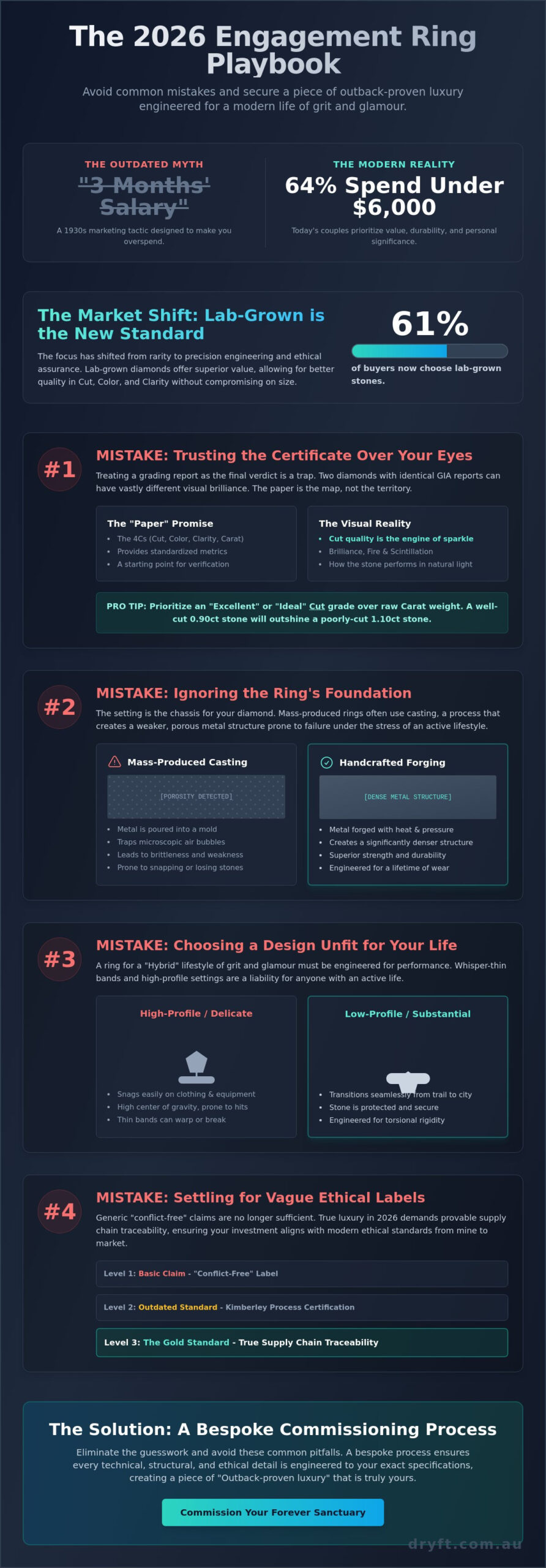
What if the most famous rule in diamond jewelry was actually a 1930s marketing tactic designed to make you overspend? The outdated “three months’ salary” guideline doesn’t account for a modern world where 64% of couples now spend under $6,000 on a ring. You want a piece that reflects a “Hybrid” lifestyle of grit and glamour, yet you likely worry about overpaying for a stone that won’t hold its value or a setting that won’t survive a weekend in the outback. It’s easy to fall for common mistakes when buying an engagement ring when you’re caught between conflicting grading reports and the pressure of a major investment.
You deserve a sanctuary of quality that aligns with your technical standards and ethical values. This guide ensures you secure a durable, beautiful piece by mastering the structural and ethical realities of the 2026 market. We’ll break down why 61% of buyers now choose lab-grown stones, how to interpret the latest Kimberley Process reforms under India’s 2026 chairmanship, and why substantial, low-profile bands are the elite choice for those who refuse to sacrifice performance for luxury.
Key Takeaways
- Look beyond the 4Cs to understand why diamonds with identical grading reports can display vastly different levels of visual brilliance and fire.
- Avoid common mistakes when buying an engagement ring by prioritizing handcrafted construction over mass-produced castings that often suffer from structural porosity.
- Ensure your ring is engineered for an active lifestyle by selecting low-profile, durable settings that transition seamlessly from the trail to a refined sanctuary.
- Demand true supply chain traceability rather than settling for generic “conflict-free” labels to ensure your luxury aligns with modern ethical standards.
- Discover how a bespoke commissioning process eliminates technical guesswork and creates a piece of “Outback-proven luxury” tailored to your specific journey.
Navigating the Technical Trap: Why the 4Cs Are Only the Beginning
Technical specs are the foundation of any high-end build. In the world of fine jewelry, the 4Cs (Cut, Colour, Clarity, and Carat) serve as the basic engineering blueprint. They provide a standardized language for quality, yet they often lead buyers into a false sense of security. One of the most common mistakes when buying an engagement ring is treating a grading report as a final verdict on beauty. A certificate is a map, not the territory. It documents the physical properties of a stone but fails to capture its soul, its fire, or how it interacts with the light of a sunset over the horizon.
True value lies in visual performance, not just a list of metrics. You wouldn’t buy an off-road vehicle based solely on a torque chart without testing its suspension on a corrugated track. Similarly, a diamond requires a physical inspection to ensure its light performance matches its technical pedigree. High-end engineering in jewelry means looking for a stone that feels alive, regardless of what the paperwork says.
The Illusion of the Paper Certificate
A grading report from the GIA or IGI is a vital tool for verification. It ensures you aren’t overpaying for a stone that doesn’t meet its claimed specs. However, “buying for the paper” is a trap. Two diamonds can share identical GIA grades; for instance, a 1-carat natural diamond with G colour and VS2 clarity, which typically costs between $3,694 and $4,313 in 2026. Despite identical stats, one might appear dull due to internal graining, while the other radiates brilliance. Understanding the history of engagement rings reveals that while our ancestors valued the symbol, modern explorers must value the technical reality. Always view a stone in natural light. Showroom spotlights are engineered to make even poor-quality stones sparkle; they hide the “milkiness” that often plagues lower-tier lab-grown and natural diamonds alike.
Prioritising Sparkle Over Substance
The “Cut” grade is the most critical factor in a diamond’s brilliance. It’s the engine that drives light return. Many buyers make the mistake of chasing Carat weight at the expense of Cut quality. A larger diamond with a “Fair” or “Good” cut will often look smaller and darker than a slightly smaller stone with an “Excellent” or “Ideal” cut. This is because a well-cut stone reflects light back through the top, whereas a poorly cut stone allows light to leak out the bottom like a faulty chassis. In 2026, where lab-grown diamonds account for 61% of engagement ring center stones, the focus has shifted toward precision. A 0.90-carat stone with superior light performance offers far more “quiet luxury” than a 1.10-carat stone that lacks life. Precision engineering ensures that every facet works in harmony to hide inclusions and maximize the stone’s natural fire.
Structural Oversights: Avoiding the Pitfalls of Mass-Produced Settings
High-end engineering shouldn’t end at your vehicle’s independent suspension; it must extend to the sanctuary you wear on your finger. One of the most overlooked common mistakes when buying an engagement ring is prioritizing the stone’s statistics while ignoring the structural integrity of the setting. If the diamond is the cargo, the setting is the chassis. A poorly engineered chassis will fail long before the journey is over. Most mass-market retailers rely on high-volume casting, a process that often compromises the metal’s density and long-term reliability.
Handcrafted pieces are forged through heat and pressure, resulting in a metal structure that is significantly denser than its cast counterparts. In contrast, mass-produced “cast” rings are created by pouring molten metal into a mold. This often traps microscopic air bubbles, a condition known as porosity. Porosity leads to metal brittleness, making the ring prone to snapping or losing stones under the stresses of an active lifestyle. While understanding the 4Cs provides a baseline for the stone, only a focus on structural engineering ensures the ring survives the rugged reality of the Australian outback.
The Hidden Costs of Off-the-Shelf Casting
Mass-market retailers often cut costs by reducing the amount of metal used in the shank. This creates the popular “whisper-thin” aesthetic, but it is a strategic mistake for a ring intended for daily wear. A thin band lacks the torsional rigidity to resist warping. Over time, a thin ring will “spin” on the finger or even ovalize, which puts immense pressure on the stone’s setting. This structural failure often leads to expensive jewellery repair and maintenance that could have been avoided with a more robust initial design. For those who value durability, a substantial band is a hallmark of “quiet luxury” that performs as well as it looks.
Metal Integrity and Prong Security
True luxury requires a balance of grit and glamour. Choosing 18k gold or Platinum is essential for its superior density and workability. Platinum is particularly favored for its “memory,” as it tends to bend rather than snap when struck. This is vital for prong security. Aesthetic prongs that are too delicate lack the structural depth to hold a diamond safely during a weekend of exploration. Ensuring your ring has a solid foundation is the only way to achieve a truly unbound adventure without the anxiety of losing a precious heirloom. A well-built ring should feel like a sanctuary, engineered to withstand the elements while maintaining its premium finish.
The Lifestyle Mismatch: Designing for the Rugged and the Refined
Adventure doesn’t pause for a delicate setting. Whether you’re navigating a dusty trail in the Kimberley or attending a gala in the city, your ring must function as a seamless extension of your movement. One of the most frequent common mistakes when buying an engagement ring is failing to account for the wearer’s actual environment. A ring is a sanctuary of sentiment, but it is also a piece of hardware. If the design isn’t engineered for the “Hybrid” lifestyle, it will eventually succumb to the harsh realities of daily wear. True “Quiet Luxury” isn’t just about the shimmer; it’s about a piece that feels at home anywhere, projecting a sense of quiet confidence through high-end engineering.
For the modern explorer, a low-profile setting is often the superior choice. High-set stones act like a lever, catching on gear, clothing, or even vehicle interiors. This puts unnecessary stress on the prongs and increases the risk of stone loss. As consumers pivot toward ethically sourced engagement rings, they’re also demanding products that survive the transition from the outback to the office without compromise. Balancing a desire for “The Baroque”—those intricate, sculptural details—with mechanical reliability is the hallmark of a sophisticated trailblazer.
When Aesthetic Fragility Fails Daily Life
Aesthetic fragility is a liability. While certain “trendy” stones like Opals or Emeralds offer vivid colors, they lack the hardness required for a lifetime of adventure. Opals, for instance, are porous and prone to cracking under temperature shifts. Choosing bespoke engagement rings allows for this level of technical customization, ensuring the piece is a gateway for life-changing experiences rather than a source of constant anxiety. By selecting stones like diamonds or sapphires, which rank 9 or 10 on the Mohs scale, you ensure the “chassis” of your jewelry remains unbound by the limitations of softer materials.
Sizing and Comfort for the Long Haul
Comfort is a technical requirement, not a luxury. A well-engineered band distributes weight evenly to prevent irritation during physical activity. Many buyers make the mistake of not accounting for seasonal finger swelling, which is particularly relevant in the Australian climate where temperatures can swing 20 degrees in a single afternoon. A “comfort fit” interior finish—where the inside of the band is slightly domed—ensures the ring remains a wearable sanctuary even during the most demanding legs of your journey. This pragmatic emphasis on reliability ensures your ring remains as tough as it is beautiful, built to last as long as the memories you’re creating.
The Ethical Blind Spot: Moving Beyond Surface-Level Sourcing
Technical integrity ensures your ring survives the trail, but ethical integrity ensures it aligns with your internal values. Assuming that a “conflict-free” label covers the entire supply chain is one of the most frequent common mistakes when buying an engagement ring. While the Kimberley Process, chaired by India in 2026, aims to eliminate diamonds that fund rebel movements, it largely ignores broader human rights and environmental concerns. A stone can be legally “conflict-free” yet still leave a trail of ecological destruction or unfair labor practices. True luxury requires a deeper audit of the journey from the mine to the jeweler’s bench. It’s about more than just avoiding war; it’s about actively supporting a positive legacy.
Traceable stones represent the new gold standard for the modern explorer. Generic “ethical” claims are often just noise in a crowded market, designed to soothe the conscience without providing data. You need a transparent path. This is why ethical jewellery in Australia is gaining momentum; it focuses on localized accountability that mass-market competitors simply can’t match. When you choose a traceable stone, you are investing in the safety and prosperity of the specific communities that brought that stone to light. It is the difference between a generic commodity and a story worth telling around a campfire.
Identifying Genuine Ethical Provenance
A sophisticated buyer asks about specific sourcing protocols. Don’t settle for vague assurances. Ask if the diamonds are tracked via blockchain or digital passports, which provide an immutable record of a stone’s origin. Genuine provenance also includes the use of recycled 18k gold or platinum. Using recycled metals significantly reduces the environmental footprint compared to traditional mining. Handcrafted production naturally fosters a smaller, more transparent supply chain where every artisan is known by name. This avoids the “greenwashing” trap where large corporations use slick marketing imagery to hide opaque, industrial processes. You want a piece that is as clean and unbound as the horizon you’re chasing.
The Value of Australian-Made Authenticity
Local craftsmanship is a badge of honor. It means your piece was designed and tested by artisans who understand the unique challenges of the Australian landscape. This isn’t just about aesthetics; it’s about a shared philosophy of movement and freedom. The Dryft story reflects this commitment to “Outback-proven luxury,” where every detail is scrutinized for both beauty and impact. Local testing ensures that the structural chassis of your jewelry can handle the vibrations of a corrugated track and the intense heat of the northern sun. By supporting local design, you ensure your sanctuary is built with a deep respect for the wild. It is a commitment to quality that transcends the superficial trends of mass-produced fashion.
Discover the intersection of grit and glamour with our Australian-made ethical jewelry.
The Commissioning Solution: Building Your Forever Sanctuary
Choosing a ring from a display case is often where the first errors occur. To bypass the common mistakes when buying an engagement ring, you must move from a passive consumer to an active commissioner. Bespoke design isn’t a luxury reserved for the elite; it is a strategic engineering choice for anyone who values durability and ethical clarity. By commissioning a piece, you ensure the chassis is built for your specific journey, eliminating the risks of mass-market porosity and opaque supply chains. It is the ultimate way to create a sanctuary that reflects both your grit and your glamour. You’re no longer buying a product; you’re engineering a legacy.
The transition from a dusty trail concept to a premium finish requires a partner who understands the harsh realities of the wild. While 64% of couples in 2026 spend under $6,000 on their rings, the true value lies in how that investment is structured. A commissioned piece allows you to allocate your budget toward technical excellence rather than retail overhead. This collaborative process ensures that the final result is a gateway for life-changing experiences, not just a fragile accessory that requires constant babying. It is about building a piece of Outback-proven luxury that stands as an uncompromising partner in your adventure.
The Collaborative Design Journey
- Step 1: Translating the Vision. We begin by translating your inspiration into a technical blueprint. This phase considers your physical activity level, ensuring the setting height and metal density are optimized for a life lived unbound.
- Step 2: Selecting the Soul. We source stones that possess “quiet luxury.” This means looking beyond the 4Cs to find a diamond or sapphire with unique character and verified ethical provenance, avoiding the paper certificate trap.
- Step 3: Engineering for Adventure. Our artisans hand-forge the setting for a lifetime of movement. Every prong is worked for maximum security, and every edge is polished to a premium finish, ensuring the piece is as reliable as a high-end off-road chassis.
Investing in Handcrafted Legacy
The long-term ROI of a handcrafted ring far outweighs the initial convenience of an off-the-shelf purchase. A handcrafted piece maintains its structural integrity decades longer than a cast ring because the metal is worked and compressed, not just poured into a mold. This creates a denser, tougher finish that survives the corrugated tracks and intense heat of the Australian landscape. It is a piece engineered specifically for you, providing a sense of quiet confidence that stems from high-end craftsmanship. Your engagement ring should be a testament to your shared history. It should be as tough as the outback and as refined as the sanctuary you’ve built together, remaining seamless and beautiful through every horizon you cross.
Secure Your Forever Sanctuary
Your journey doesn’t end at the showroom; it begins with a commitment to quality that survives the trail. By prioritizing structural engineering over mass-market convenience, you ensure your ring remains a wearable sanctuary. You now understand that visual performance transcends a paper certificate and that a low-profile, handcrafted setting is essential for the modern explorer. Avoiding common mistakes when buying an engagement ring means looking beyond the 4Cs and demanding true supply chain traceability. This is the essence of quiet luxury: a piece that is as resilient as it is refined.
Dryft stands at the intersection of grit and glamour. We specialize in Australian-made handcrafted luxury that is engineered for a lifetime of adventure. By utilizing ethically sourced diamonds and pearls, we create pieces that align with your values and your movement. Whether you’re navigating the city or the desert, your jewelry should remain unbound by technical or ethical compromise. It’s time to build a legacy that is as tough as the outback and as sophisticated as your destination. Confidence comes from knowing your ring is built to last.
Explore our bespoke engagement ring gallery and start your journey
Frequently Asked Questions
What is the #1 mistake people make when buying an engagement ring?
The most frequent error is treating a diamond certificate as a final verdict on beauty while ignoring the structural integrity of the setting. You might secure a stone with perfect technical specs, but if it’s housed in a porous, mass-produced chassis, the ring won’t survive the vibrations of an active life. Focus on light performance and handcrafted density to ensure your sanctuary remains intact through every adventure.
Is a bigger diamond always better for an engagement ring?
No, a larger carat weight often sacrifices the precision of the cut, which is the engine of a diamond’s brilliance. A 0.90-carat stone with an “Excellent” cut will radiate more fire and appear larger than a 1.10-carat stone with a “Poor” cut. In 2026, sophisticated trailblazers prioritize the quiet luxury of light performance over mere bulk, ensuring the stone has genuine character.
How can I tell if an engagement ring is actually ethically sourced?
Look for digital traceability and blockchain verification rather than relying on the baseline Kimberley Process. While India chairs the Kimberley Process in 2026, the scheme still doesn’t cover broader human rights or environmental impacts. Genuine ethical provenance requires a transparent supply chain where you can identify the specific mine and the artisans who crafted the piece, ensuring your luxury is truly unbound.
Why do stones fall out of engagement rings so often?
Stones typically fall out due to microscopic air bubbles in cast settings or bands that are engineered to be too thin for daily wear. This porosity makes the metal brittle and prone to snapping. Mass-market “whisper-thin” bands lack the torsional rigidity to hold prongs in place when the ring is knocked against a hard surface, leading to inevitable structural failure and stone loss.
Is it better to buy a ready-made ring or go bespoke?
Bespoke is the superior choice because it allows you to engineer the ring for your specific lifestyle requirements. Going bespoke helps you avoid common mistakes when buying an engagement ring, such as selecting a setting height that catches on equipment. It ensures a denser metal structure and a design that functions as a seamless extension of your movement from the trail to the city.
How much should I really spend on an engagement ring in 2026?
Most couples in 2026 are spending between $5,200 and $6,500 on an engagement ring. Verified data shows that 64% of buyers now spend under $6,000, moving away from outdated marketing rules from the 1930s. Your focus should be on technical assurance and ethical value rather than hitting an arbitrary price point. Investing in quality engineering provides a better long-term return than mass-market convenience.
What is the most durable metal for an engagement ring?
Platinum is the most durable choice for the modern adventurer because of its extreme density and metal memory. Unlike gold, platinum doesn’t lose material when scratched; the metal is simply displaced. This makes it an uncompromising partner for securing precious stones, as the prongs are more likely to bend than snap under the pressure of a rugged Australian lifestyle.
Can I use freshwater pearls in an engagement ring?
Freshwater pearls are not recommended for engagement rings because they lack the hardness to survive decades of daily wear. With a Mohs scale rating between 2.5 and 4.5, pearls are easily scratched or damaged by everyday chemicals. While they are perfect for a Baroque Pearl Drop Earring or a Pearl String Bracelet, the chassis of an engagement ring requires the grit of a diamond or sapphire.