
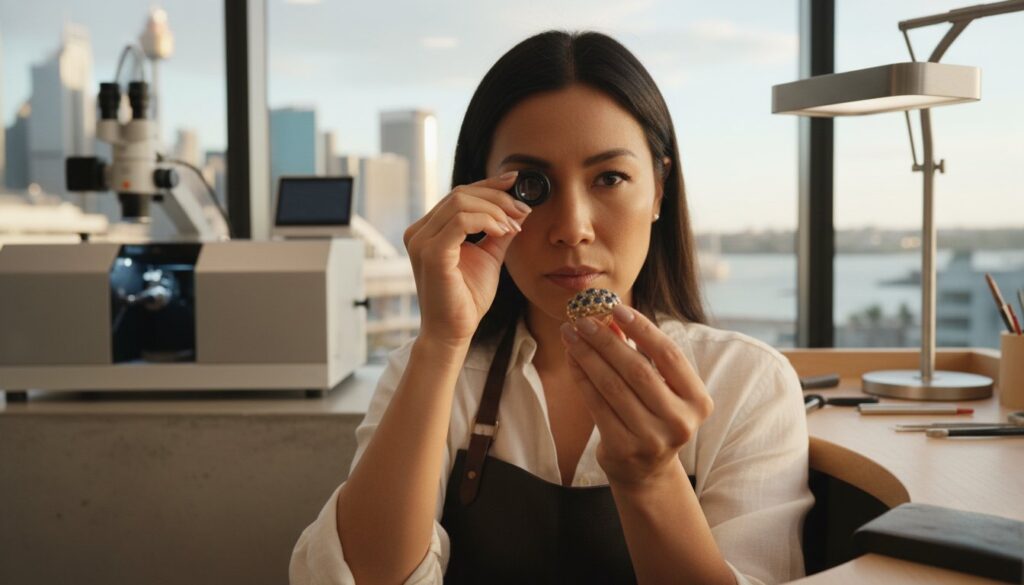
Imagine returning from a rugged trek through the Kimberley only to find a loose prong on your most cherished heirloom. With gold prices reaching $4,715.24 per ounce on May 9, 2026, a single mistake during restoration is a costly risk you cannot afford. Knowing what to look for in a jewelry repair shop is the difference between a seamless fix and a permanent loss of value. You require a sanctuary of technical precision that treats your jewelry with the same engineering rigor used to build an off-road chassis.
You likely feel a knot of anxiety when considering leaving a bespoke piece in the hands of a stranger. It is common to feel confused by technical terms like laser welding versus soldering; or to fear that your investment will be met with poor craftsmanship. This guide empowers you to master the art of vetting a repairer to ensure your pieces receive the ethical care they deserve. We provide a clear checklist for workshop selection and explain the technical requirements needed for a high-quality restoration that stands the test of time.
Key Takeaways
- Distinguish between a temporary “fast-fix” retail counter and a true engineering sanctuary to prevent structural damage to your handcrafted heirlooms.
- Identify what to look for in a jewelry repair shop, focusing on the specialized tools and on-site expertise required for a professional restoration.
- Master the professional intake protocols, including stone plotting and high-resolution photography, that provide a transparent security audit for your jewelry.
- Learn how to evaluate a workshop’s ability to match complex gold alloys and source ethical materials, ensuring your repair remains seamless and responsible.
Why Choosing the Right Jewelry Repair Shop is a Critical Investment
Fine jewellery is an engineered asset, a sophisticated blend of metallurgical science and sculptural art. It’s built to endure, yet even the most robust pieces face the slow erosion of time and wear. When you seek a repair, you aren’t just buying a service; you’re protecting a significant financial and emotional ROI. With gold trading at approximately $4,715.24 per ounce on May 9, 2026, the stakes for your high-end pieces are higher than ever before. A single technical error can devalue an heirloom or lead to the loss of a rare gemstone.
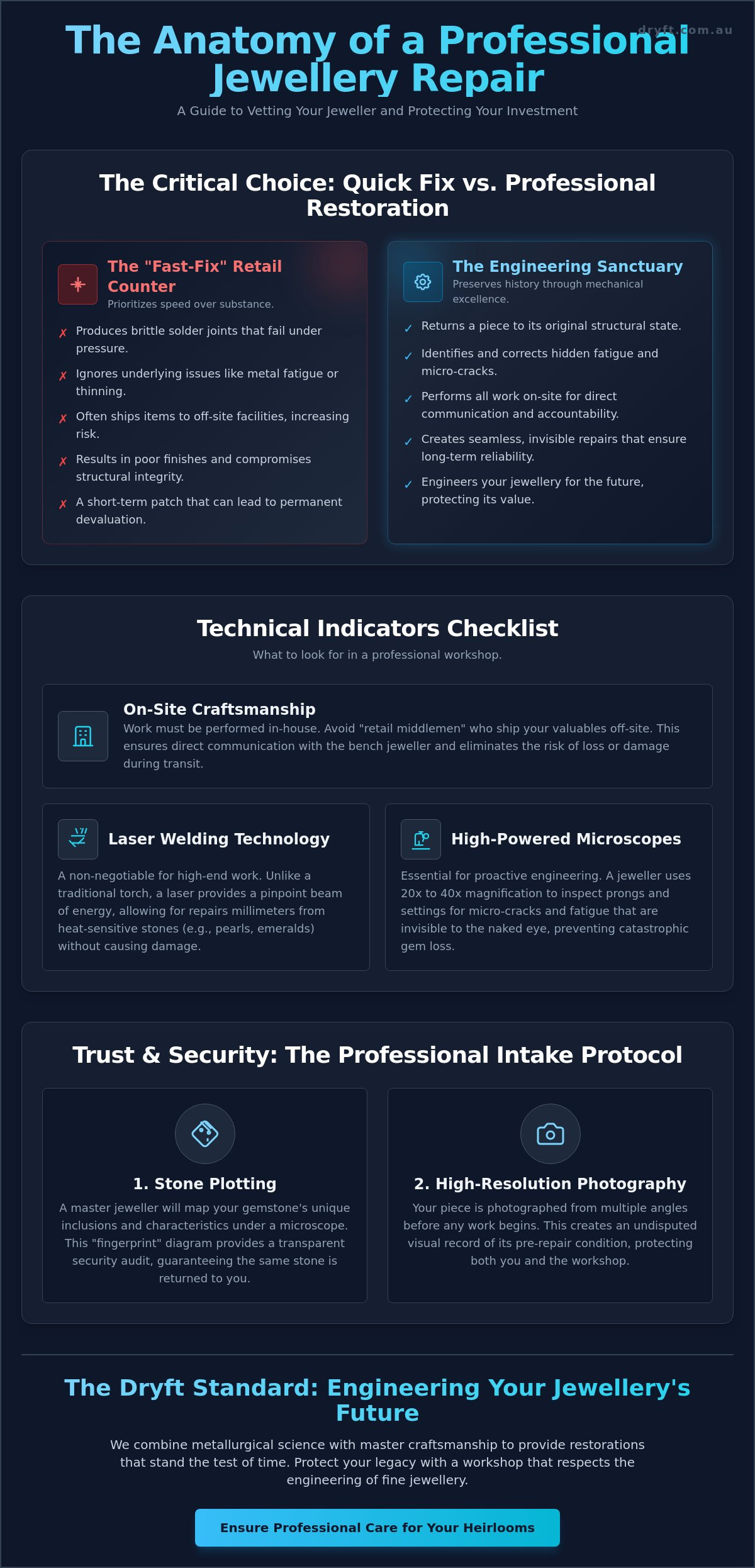
Knowing exactly what to look for in a jewelry repair shop starts with recognizing that Jewellery stores provide many services, but only a dedicated workshop offers the technical rigor needed for professional restoration. Many “fast-fix” outlets in shopping centres prioritize speed over substance. These shops often produce brittle solder joints and poor finishes that compromise the structural integrity of your piece. You need a sanctuary where history is preserved through mechanical excellence and a deep respect for the craft. Vetting your workshop is the only way to ensure your investment receives the quiet luxury of a job done right.
The Difference Between Restoration and a Quick Fix
True restoration is the process of returning a piece to its original structural state. It is not a temporary patch-up. While a simple solder might hold for a few months, it often ignores the underlying thinning of a band or the microscopic fatigue in a setting. Bespoke and handcrafted items, such as the Baroque Pearl Drop Earrings, require a specialized touch that respects the original maker’s intent. A professional workshop ensures the repair is seamless and invisible. They focus on long-term reliability rather than a cosmetic surface fix that will eventually fail under the pressure of daily wear.
Understanding the Value of Expertise
A master jeweller acts as a sophisticated trailblazer, identifying hidden structural fatigue before it leads to a catastrophic failure. They possess the expert eye to spot micro-cracks in a prong that are invisible to the untrained owner. This proactive engineering prevents the loss of a natural diamond, which in 2026 can cost well over $20,000 for a single high-quality carat. Structural integrity in a 50-year-old heirloom is the state where every solder joint and gallery wall remains robust enough to withstand daily friction without compromising the security of the gemstones or the original design intent. Choosing an expert means your jewellery is engineered for the future, not just patched for the moment.
Technical Indicators: What to Look for in a Professional Workshop
Beyond the polished glass of the showroom lies the true engine room of any reputable establishment. When evaluating what to look for in a jewelry repair shop, the most telling sign of quality is the presence of a visible, active workshop. You aren’t just looking for a salesperson; you’re looking for an engineer who understands the structural complexities of precious metals. A professional workshop should feel like a sanctuary of precision, where tools are organized with the same care an explorer gives their gear before a cross-continental trek.
On-Site Craftsmanship vs. Retail Middlemen
A significant number of retail stores operate as mere middlemen. They accept your repair only to package it and ship it to an off-site facility. This creates a dangerous lack of accountability. Every time a piece is shipped, the risk of loss or damage increases. Direct communication with the bench jeweler ensures your specific requirements are understood without being lost in translation. Always ask if the work is performed in-house by their own employees. A workshop that maintains the highest standards of ethical conduct will be transparent about their process and who is handling your investment.
The Toolset of a Master Jeweller
Modern restoration requires more than a simple torch. Laser welding technology is a non-negotiable requirement for high-end work. Unlike traditional soldering, which heats the entire piece, a laser welder provides a concentrated beam of energy. This allows a jeweler to work millimeters away from heat-sensitive stones. It is the only safe way to repair the settings on delicate items like the Pearl String Bracelet without risking the integrity of the pearls. These technical refinements separate a master’s workshop from a standard retail counter.
High-powered microscopes are equally essential. They allow the jeweler to inspect prongs and stone seats at 20x or 40x magnification. This level of scrutiny reveals micro-fractures that a standard jeweler’s loupe might miss. Combine this with GIA-standard lighting for accurate color matching, and you have a workshop capable of true professional restoration. A clean, organized bench reflects a mindset of precision. It shows that the jeweler respects the technical requirements of the craft as much as the aesthetic beauty of the final piece.
Trust and Security: The Professional Intake Protocol
Handing over a handcrafted heirloom for restoration requires more than a casual handshake. It demands a rigorous security protocol that mirrors the pre-departure checks of an off-road expedition. When determining what to look for in a jewelry repair shop, the intake process is your first line of defense. A professional workshop treats your jewelry as a high-value asset, documenting its condition with forensic precision before it ever reaches the jeweler’s bench. This sanctuary of accountability ensures that your piece is protected from the moment it leaves your hand.
Mapping Your Stones: The Security Check
A master jeweler will invite you to look through a microscope or a 10x loupe during the intake session. This collaborative mapping of your diamond’s unique “birthmarks” is essential for absolute trust. These inclusions and feathers are the geological fingerprint of your stone. By plotting these features on a diagram, you create a permanent record of the stone’s identity. A professional shop uses the unique laser inscription or inclusion map on a GIA certificate to verify the stone’s identity upon its return, ensuring the gem you receive is the exact one you entrusted to their care. This transparent mapping process eliminates the common fear of stone swapping and confirms the shop’s commitment to technical honesty.
Documentation and Accountability
Vague receipts are a red flag in professional restoration. A formal intake must include high-resolution photography of the piece from multiple angles, capturing every detail of its current state. Your documentation should itemize the metal type, the estimated stone weight, and a clear description of the damage. With gold prices at $4,715.24 per ounce as of May 9, 2026, and natural 1-carat diamonds often exceeding $20,000, precise documentation is a financial necessity. Ensure the receipt includes an estimated completion date and a full breakdown of costs.
Beyond the paperwork, verify that the workshop carries specialized “Care, Custody, and Control” insurance. This coverage is distinct from standard retail insurance; it specifically protects customer items during the repair process. Following GIA’s guide to caring for your jewelry, a reputable partner will also perform a “signed-in” and “signed-out” verification. This final audit confirms that every repair matches the original scope of work before you conclude the transaction. Never leave a high-value piece without a formal, legally binding receipt that reflects this level of engineering rigor.
Material Excellence: Matching Alloys and Ethical Sourcing
Metallurgy is the silent language of fine restoration. When evaluating what to look for in a jewelry repair shop, you must demand a mastery of alloy chemistry. Not all 18k yellow gold is identical. The specific ratio of silver to copper determines the warmth and hue of the metal. An expert workshop understands that Australian-sourced gold often carries a distinct saturation compared to European alloys. Using a generic solder or the wrong karat creates a visible “seam” and compromises structural integrity. With gold prices at $4,715.24 per ounce and platinum at $2,057.00 as of May 9, 2026, there is no room for material shortcuts.
The Art of the Invisible Repair
Master jewelers aim for the invisible repair. This requires blending solders that match the parent metal’s melting point and color exactly. A handcrafted ring has a specific “heft” and density that must be maintained during restoration. If a workshop suggests using 9k gold to reinforce an 18k band, walk away. This is a fundamental engineering error that devalues your asset. Transparency in sourcing is equally vital. Consult Dryft’s ethical jewellery guide to understand how high-end workshops ensure replacement stones and metals don’t compromise your values.
Restoring Handcrafted Pearls and Diamonds
Restoring organic forms like the Baroque Pearl Drop Earrings requires an eye for lustre and orient. If a pearl needs replacement, the new gem must match the existing strand’s skin quality and origin. For metalwork, prong retipping is a high-stakes procedure. As of March 2026, professional retipping typically costs between $25 and $75 per prong. This process demands technical exactness to secure the stone without exposing it to excessive heat. For white gold pieces, rhodium plating must be applied at the correct micron thickness to ensure a durable finish. Understanding what to look for in a jewelry repair shop means looking beyond the price tag to the quality of the raw materials used in the workshop. To ensure your collection remains in peak condition, explore our collection of handcrafted essentials.
The Dryft Standard: Engineering Your Jewellery’s Future
At Dryft, we believe that luxury isn’t just an aesthetic; it’s a standard of performance. Just as an off-road chassis must withstand the corrugated tracks of the Tanami, your fine jewellery requires a foundation of mechanical excellence to survive the rigors of daily life. Choosing a workshop is about more than finding a retail bench; it’s about finding a partner who understands the “Outback-proven” philosophy of reliability. When considering what to look for in a jewelry repair shop, you should seek a workshop that views restoration as a gateway to preserving your personal history. We treat every repair as a mission to return your piece to its status as a well-crafted sanctuary, ensuring it remains as resilient as the spirit of adventure itself.
Bespoke Maintenance for Handcrafted Pieces
Our deep expertise in bespoke engagement rings provides the technical blueprint for our repair standards. We apply a quiet luxury philosophy to every task, ensuring that the technical precision of our work never overshadows the piece’s original soul. Whether it’s a simple gold chain solder, which as of March 2026 typically costs between $20 and $50, or a complex structural rebuild, we maintain absolute ethical transparency. We believe that handcrafted authenticity is non-negotiable. Every resizing or restoration is engineered to meet a global standard of premium branding, ensuring your jewellery remains as unbound as the modern adventurer wearing it.
Next Steps for Your Jewellery Care
The transition from a damaged heirloom to a restored masterpiece should be seamless. Before you commit to a workshop, use this final checklist to confirm you’ve found the right partner:
- Verify on-site workshop capabilities and ensure direct access to the bench jeweller.
- Confirm the use of advanced technology like laser welders, essential for protecting heat-sensitive stones.
- Ensure a formal intake protocol with high-resolution photography and stone mapping is standard practice.
- Check for specialized “Care, Custody, and Control” insurance coverage to protect your investment.
Long-term preservation extends beyond the workshop bench. We encourage you to utilize our comprehensive jewellery care guide to manage daily maintenance and prevent future structural fatigue. With the global jewelry market projected to grow at a CAGR of 8.7% from 2026 to 2034, your collection is a growing asset that deserves elite protection. If you’re ready to ensure the longevity of your most cherished items, Book a repair consultation with the Dryft team today. Let’s engineer a future where your jewellery remains as resilient as the horizon you chase.
Preserving Your Legacy with Engineering Precision
Your jewellery is more than an accessory; it’s a testament to your journey and a repository of history. To protect its value in a market where gold has reached $4,715.24 per ounce as of May 2026, you must demand more than a superficial fix. You’ve learned that a true professional restoration requires a visible on-site workshop, advanced laser technology, and a forensic intake protocol that secures your gemstones through inclusion mapping.
Finding the right partner means prioritizing engineering rigor over retail convenience. Now that you understand what to look for in a jewelry repair shop, you can move forward with the quiet confidence of a seasoned explorer who knows the terrain. Dryft stands as a national Australian leader in this field. We are specialists in ethically sourced diamonds and pearls, utilizing a master-led handcrafted design process to ensure every restoration meets our global standard of excellence. Don’t leave your most cherished heirlooms to chance. Restore your handcrafted sanctuary with Dryft’s professional repair services and ensure your pieces are ready for the next horizon. Your collection is built for the wild; keep it resilient.
Frequently Asked Questions
How can I tell if a jewelry repair shop is trustworthy?
Trustworthy shops prioritize transparency through professional certifications and a visible, active workshop. You should look for a sanctuary of expertise that offers a collaborative intake process, including a microscopic inspection of your piece in your presence. A reputable partner will always provide a detailed security audit and carry specialized insurance to protect your financial ROI.
What happens if a jewelry repair shop loses my item?
Reputable workshops carry “Care, Custody, and Control” insurance which specifically covers the full replacement value of customer items. Before leaving your jewelry, verify that the shop’s policy accounts for the current market value of precious metals. With gold priced at $4,715.24 per ounce as of May 9, 2026, this coverage is essential for protecting your high-value assets.
Is it normal for a shop to send my jewelry elsewhere for repair?
Many mass-market retailers act as middlemen and ship items to off-site facilities, but this increases the risk of loss or damage. When determining what to look for in a jewelry repair shop, prioritize businesses that perform all work on-site. Direct access to the bench jeweler ensures your technical requirements are met without the lack of accountability found in outsourced services.
How do I know my diamond won’t be swapped during a repair?
Professional shops prevent stone swapping by performing a formal “plotting” session during the intake process. This involves mapping the unique inclusions and “birthmarks” of your diamond under 10x or 20x magnification. By documenting these geological fingerprints and cross-referencing any GIA laser inscriptions, the shop provides a technical guarantee that the stone you receive is your original gem.
What should be included on a jewelry repair receipt?
A professional repair receipt must serve as a forensic record of your item’s condition and the agreed scope of work. It should include high-resolution photography, metal type, estimated stone weights, and a clear description of the damage. Ensure the document also specifies a legally binding completion date and an itemized breakdown of all costs to avoid confusion upon collection.
Can any jeweler repair a handcrafted or bespoke piece?
Bespoke pieces require a master jeweler who understands the specific engineering and alloys used in handcrafted construction. Mass-produced repair shops often lack the laser welding technology needed to fix intricate items like the Pearl String Bracelet without damaging the organic materials. Professional restoration requires a sophisticated trailblazer who treats your jewelry with the same rigor used in high-end engineering.
How much should a professional jewelry repair cost?
Repair costs are heavily influenced by the daily market price of gold and platinum. As of April 2026, a simple gold ring resizing typically costs between $40 and $80, while prong retipping ranges from $25 to $75 per prong. Rhodium plating for white gold pieces generally falls between $79.99 and $99.99, reflecting the technical precision and material quality required for a professional finish.
What is the difference between a retail jeweler and a bench jeweler?
A retail jeweler manages the showroom and sales experience, while a bench jeweler is the engineer who performs the physical restoration. Knowing what to look for in a jewelry repair shop involves ensuring you have direct communication with the bench jeweler. They possess the mechanical expertise to operate laser welders and microscopes, providing the technical assurance that your piece is structurally sound.