

A flawless pearl is more than a gem; it’s a piece of biological engineering hardened by the ocean’s powerful tides. While mass-market retailers push confusing AAA or AAAA scales, true value lies in the organic grit that survives the elements. You deserve a sanctuary of style that withstands the journey, yet data shows that 65 percent of high-end jewelry buyers struggle to distinguish between over-processed freshwater pearls and genuine South Sea varieties. This pearl grading guide for buyers serves as your technical map through the complexities of lustre, surface quality, and structural depth. We believe that luxury should be as tough as the landscape it comes from.
You probably suspect that a high price tag doesn’t always guarantee a high-end soul. It’s frustrating to invest in jewelry only to realize it lacks the density of a genuine, investment-grade specimen. We’ll help you master the technical precision required to spot a rugged luxury aesthetic that matches an adventurous spirit. This guide explores the seven pillars of pearl evaluation and the ethical shifts defining the 2026 market. By the end, you’ll have the confidence to choose a handcrafted piece that’s unbound by trends and built for the long haul.
Key Takeaways
- Master the seven GIA-standard value factors to distinguish high-end, handcrafted investment pieces from mass-produced fashion jewelry.
- Identify why lustre acts as the “engine” of a pearl’s beauty, serving as the most critical metric in this pearl grading guide for buyers.
- Navigate the industry’s complex A-AAA scales with confidence by understanding the technical nuances behind Australian and global grading standards.
- Discover a practical framework for selecting pearls that match your lifestyle, proving that refined luxury can withstand the rigors of a modern journey.
- Learn the bespoke advantage of selecting individual pearls for their unique “grit and glamour” to ensure your jewelry is as resilient as it is refined.
The Silent Language of Pearls: Why Grading is Your Buyer’s Compass
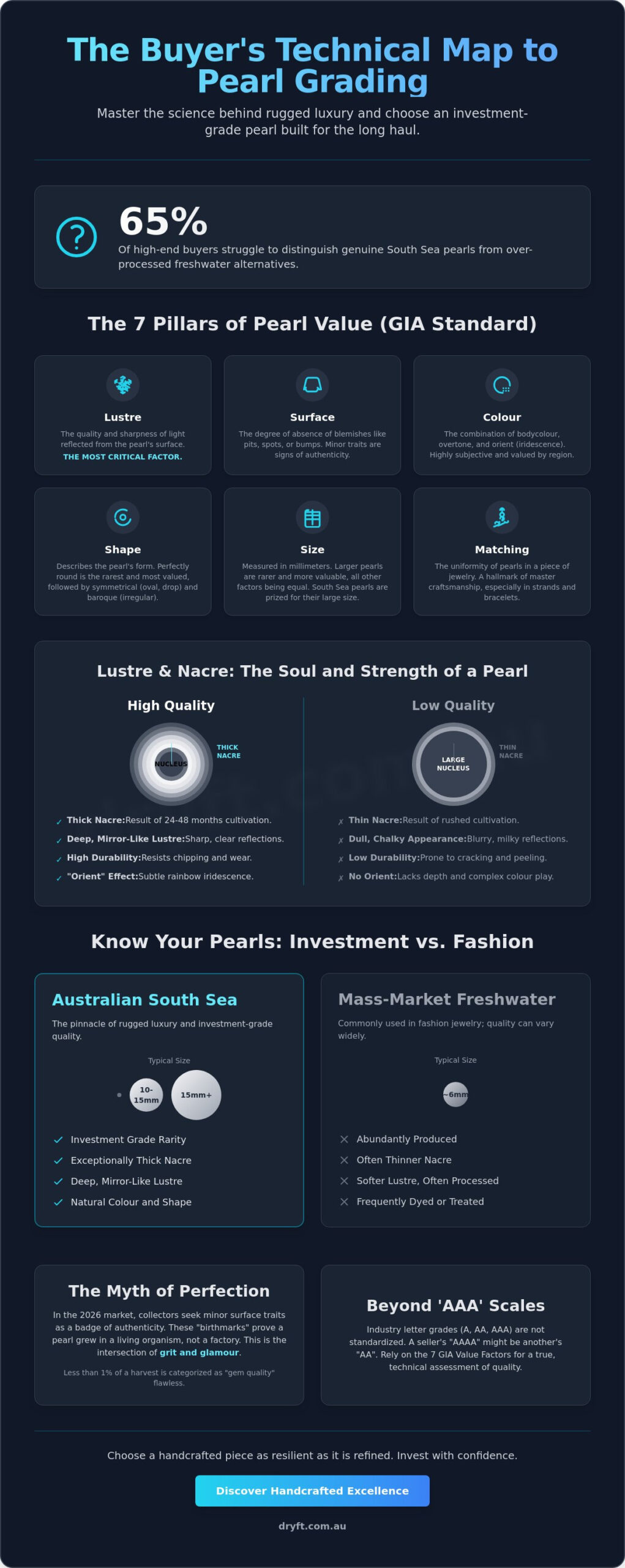
In the wild expanses of the Kimberley or the pristine coastal waters of Australia, beauty isn’t merely found; it’s forged through endurance. True luxury requires a metric for excellence. This pearl grading guide for buyers serves as that metric. It provides a systematic evaluation of seven key value factors: lustre, surface quality, shape, colour, size, nacre thickness, and matching. Understanding these pillars allows you to distinguish a handcrafted legacy piece from mass-produced fashion jewelry that lacks soul.
Grading isn’t just about aesthetics. It’s a technical audit of a biological miracle. For the sophisticated buyer in 2026, quiet confidence comes from knowing exactly why one strand commands A$5,000 while another costs a fraction of that price. We look beyond the surface to the nacre depth, which acts as the foundation of a pearl’s durability and inner glow. Without sufficient nacre, a pearl is a fleeting accessory; with it, it’s a sanctuary of light that lasts generations. This comprehensive overview of pearls highlights how these organic gems are unique in the world of jewellery, requiring specific standards to ensure their long-term value.
From Grit to Glamour: The Genesis of Lustre
Lustre is the heartbeat of the gem. It begins when a tiny irritant enters the oyster, triggering a defensive response that layers microscopic crystals of calcium carbonate over several years. High-quality Australian South Sea pearls often remain in the water for 24 to 48 months to develop a substantial coating. This extended cultivation time directly correlates to the thickness of the nacre, creating a deep, mirror-like reflection rather than a dull, chalky surface. Orient is the rainbow iridescence seen on the finest specimens. This optical phenomenon occurs when light scatters through the layers of nacre, proving the gem’s structural integrity and biological richness.
The Myth of Perfection in Natural Gems
True gems rarely reach a state of absolute flawlessness. In the 2026 market, discerning collectors actually seek out minor surface traits as a badge of authenticity. These small birthmarks prove the pearl grew inside a living organism rather than a factory mould. At Dryft, we embrace a philosophy of appreciating the rugged origins of a refined gem. We value the “lived-in” luxury that comes from nature’s unpredictable hand. This contrasts sharply with the plastic-perfect look of mass-market imitations that rely on synthetic coatings. While less than 1% of a harvest might be categorized as “gem quality,” the presence of subtle character marks ensures your piece is as unique as the landscape it came from. Using this pearl grading guide for buyers, you can identify which “flaws” are acceptable signs of nature and which are structural weaknesses to avoid.
- Lustre: The sharpness of reflections on the surface.
- Nacre Quality: The thickness and translucency of the layers.
- Surface Purity: The presence or absence of spots, pits, or cracks.
Choosing a pearl is an exercise in technical precision and emotional resonance. It’s about finding that exact intersection of grit and glamour. By mastering the language of grading, you step into the market not as a spectator, but as an expert guide of your own collection.
Decoding the Seven Virtues of Pearl Quality
True luxury isn’t accidental; it’s engineered by nature and refined by human hands. To navigate the market with confidence, this pearl grading guide for buyers focuses on the seven GIA-standard value factors: Size, Shape, Colour, Lustre, Surface, Nacre, and Matching. These pillars define a pearl’s rarity and its ability to withstand the test of time, much like a well-built sanctuary in the heart of the Kimberley.
Size is the most immediate indicator of rarity. While a standard Freshwater pearl might measure 6mm, South Sea varieties often reach 10mm to 15mm, with specimens exceeding 20mm commanding premium prices due to the years required for the oyster to produce such a gem. This growth period carries immense risk; the longer a pearl stays in the water, the more it’s exposed to the elements. Matching these individual gems into a cohesive piece is the ultimate hallmark of a master craftsman. You can see this precision in a high-end Pearl String Bracelet, where every stone must align in tone, size, and radiance to create a seamless aesthetic.
Lustre and Nacre: The Engine of Radiance
Lustre is the engine of a pearl’s beauty. It’s the way light travels through layers of nacre and reflects back to the observer. High-quality pearls exhibit a “metallic” lustre, showing sharp, mirror-like reflections. Lower grades appear “soft” or milky, lacking depth. To test this, look for the sharpness of your own reflection on the pearl’s surface. If you can see the features of your face clearly, the lustre is superior. This radiance depends entirely on nacre thickness. Thick nacre ensures the pearl remains a forever sanctuary rather than a fading accessory. While the GIA provides a framework, the official FTC jewelry guidelines define how these terms must be used to ensure transparency in the trade. A pearl with thin nacre will eventually “blink,” revealing the bead nucleus beneath and losing its value entirely.
Surface and Symmetry: Finding Beauty in the Baroque
Nature rarely produces perfection. Surface “blemishing” refers to the tiny pits or bumps on a pearl. Small natural birthmarks are acceptable and prove authenticity, but deep cracks are structural flaws that compromise durability. While perfectly round pearls are the traditional standard for formal elegance, there is a growing appreciation for the artistic “Baroque” and “Circled” forms. These irregular shapes capture a sense of unbound movement and raw Australian character. Choosing Baroque Pearl Drop Earrings allows you to embrace a unique silhouette that no one else can replicate. This shift toward symmetry over strict roundness reflects a modern desire for quiet luxury that feels both elite and accessible. Whether you prefer a classic sphere or a rugged baroque form, understanding these virtues is the first step toward a timeless investment. You can explore our curated collection to see these factors in action.
Navigating the Grading Scales: AAA, AAAA, and the Industry “Mess”
Unlike the diamond industry, where the GIA provides a rigid and universal framework, the pearl market operates without a central governing body. It’s a decentralized landscape. This lack of oversight creates a “mess” where one seller’s top-tier gem is another’s mid-range stock. For anyone using a pearl grading guide for buyers, understanding this inconsistency is the first step toward a secure investment. You aren’t just buying a stone; you’re buying the integrity of the person selling it.
The industry primarily splits between two scales. The A-AAA system is the standard for Freshwater and Akoya pearls, while the A-D scale (often called the Tahitian System) governs South Sea and Tahitian varieties. Because consumers find the A-AAA scale more intuitive, many Australian retailers translate A-D grades into the triple-A format. This translation is where things get murky. Be wary of “grade inflation.” Sellers using terms like “AAAAA” or “Top Gem” are usually employing marketing fluff to hide mediocre quality. These grades don’t exist in legitimate gemological circles; they’re designed to make a standard pearl look like a rare find.
The A-AAA System Demystified
The A-AAA scale is the most common metric you’ll encounter. A true AAA grade represents the pinnacle of the harvest. It requires at least 95% blemish-free surfaces, a sharp, mirror-like lustre, and a perfectly spherical shape. While AAA is the gold standard, the AA+ grade is often the “sweet spot” for those seeking rugged, everyday luxury. It offers 80% to 90% surface purity and exceptional shine at a more practical price point. Don’t just trust a letter on a screen. Ask for specific descriptions of lustre depth and surface texture to ensure the pearl meets your expectations.
Why Brand Integrity Outweighs Generic Labels
In 2026, a brand’s reputation is the true guarantee of quality. It’s about more than a generic chart; it’s about a commitment to ethical jewelry australia standards. A pearl grading guide for buyers is a useful tool, but it can’t replace the trust built through transparent sourcing and rigorous testing.
Dryft applies the same philosophy to pearls as we do to our off-road engineering. Every piece is Outback-proven. We ensure our pearls meet a standard of quiet luxury that survives the transition from a remote, dusty horizon to a refined sanctuary. We don’t hide behind inflated “AAAAA” labels. We rely on technical precision and a deep respect for the wild. Our pearls are selected for those who demand performance and elegance in equal measure, ensuring your investment is as enduring as the Australian landscape itself.
Selecting Your Sanctuary: A Practical Framework for the Modern Buyer
Technical theory finds its true value when it meets the reality of your lifestyle. You’ve mastered the basics of the pearl grading guide for buyers; now you must decide how these gems perform in the wild. A common objection suggests pearls are too delicate for the modern adventurer. This is a misconception. While they require respect, a high-quality pearl is built for the journey. It is an organic gem, forged in water and designed to endure, provided you choose the right grade for your specific horizon.
Matching the Pearl to the Occasion
Every journey has its tempo. For formal sanctuary moments, such as weddings or milestone celebrations in the city, high-lustre round pearls are the gold standard. Their symmetry projects a quiet confidence, reflecting light with the precision of a polished chassis. If your life is more unbound, characterized by daily travel and rugged spontaneity, consider baroque shapes. These organic, irregular forms are inherently unique. Their uneven surfaces excel at masking the minor wear of an active life, making them the perfect companion for the Australian coast or the red dust of the interior. Choose overtones that complement your skin tone; rose hues often suit fairer complexions, while cream and gold overtones thrive against warmer, sun-kissed skin.
Durability and Care for the Unbound Lifestyle
Nacre thickness is the primary indicator of a pearl’s resilience. It acts as the gem’s armour. Thick nacre, often exceeding 0.4mm in high-grade South Sea pearls, provides a robust barrier against the acidity of perfumes, hairsprays, and natural skin oils. This structural integrity ensures the lustre remains vivid after years of wear. Adhering to the “last on, first off” rule is essential. Put your pearls on after your fragrance has dried; remove them before you begin your evening routine. Professional restringing is your preventative maintenance. It secures the investment, ensuring the silk thread remains strong and the pearls don’t rub against one another. To keep your collection in peak condition, refer to this jewelry care guide for expert preservation techniques.
The Buyer’s Inspection Checklist
- Lustre Sharpness: When viewing in person or via high-resolution photography, check if your reflection is crisp or blurred.
- The Blink Test: Rotate the pearl under light. If you see a dark “blink” through the surface, the nacre is likely too thin.
- Surface Integrity: Ensure any natural inclusions don’t compromise the drill hole, as this can lead to cracking.
- Colour Consistency: In a strand, ensure the overtones match across every gem for a seamless aesthetic.
This pearl grading guide for buyers serves as your technical map, but your intuition provides the final direction. Quality is never an accident; it is the result of high-end engineering and nature’s own craftsmanship. When you find the piece that balances grit with glamour, you’ve found your sanctuary.
Ready to find a piece that matches your spirit of discovery? Explore the Dryft collection today.
Handcrafted Excellence: Why Dryft Pearls Define Rugged Luxury
Dryft represents a philosophy of movement and freedom. We don’t believe luxury should be fragile or confined to a velvet box. Our commitment to the “grit and glamour” lifestyle means every piece is engineered to withstand the elements without losing its refined edge. While this pearl grading guide for buyers provides the technical foundation for your purchase, the Dryft difference lies in the individual selection of every gem. We treat pearls like individuals; each one has a unique personality and a story to tell. Our bespoke approach involves hand-picking stones that possess a specific luster and character that defies mass-market standards.
The Ethical Pursuit: Sourcing with Soul
We source our pearls from ethical farms that respect the delicate balance of the marine ecosystem. These locations are chosen for their dedication to sustainable practices, ensuring that the waters remain pristine for future generations. This commitment to provenance creates a “hidden grade” of value that goes beyond surface aesthetics. When you wear a Dryft piece, you’re wearing a commitment to the ocean. If you’re searching for a meaningful present for a conscious loved one, our gifting guide offers deeper insights into choosing handcrafted elegance with purpose.
Engineering Timelessness in Every Strand
Our design process is rooted in Australian-made authenticity. We don’t just assemble jewelry; we engineer it for the modern adventurer. The hand-knotting technique used in our Pearl String Bracelet is a prime example of this mechanical precision. Each knot acts as a safety buffer, protecting the pearls from friction and ensuring the strand remains intact during your most rugged adventures. This craftsmanship bridges the gap between dusty trails and premium interiors, allowing you to transition from the outback to a sanctuary without needing to change your look. It’s about reliability and toughness wrapped in a high-end finish.
Choosing the right pearl is a personal journey that requires both data and intuition. Whether you’re navigating the technical details of a pearl grading guide for buyers or looking for a piece that speaks to your sense of adventure, we’re here to guide you. Our collection is built for the sophisticated trailblazer who demands excellence in every detail and refuses to sacrifice performance for style. Explore the Dryft Pearl Collection to find your next heirloom, or book a consultation with our experts to design a piece that is uniquely yours.
Mastering the Art of Rugged Elegance
True luxury requires more than a glance; it demands the technical precision of a seasoned explorer. This pearl grading guide for buyers simplifies the industry’s complex AAA to AAAA scales, giving you the authority to choose gems that endure. By focusing on the Seven Virtues of quality, you ensure your investment survives the transition from the city to the untamed coast. It’s about finding that rare balance between aesthetic brilliance and mechanical resilience. We’ve refined this process at Dryft, focusing on ethically sourced freshwater and baroque pearls that meet the highest 2026 standards for transparency. Each piece is hand-strung in Australia for maximum durability, engineered to be a quiet luxury sanctuary for the modern adventurer. You don’t have to choose between grit and glamour. Take the next step toward a piece that reflects your unbound spirit and uncompromising standards.
Discover the intersection of grit and glamour in our Handcrafted Pearl Collection
The horizon is waiting. Your journey deserves a companion as resilient as the path you choose.
Frequently Asked Questions
What is the difference between AAA and AAAA pearl grading?
AAA is the traditional ceiling for pearl quality in the standard A-AAA system, while AAAA is a premium tier used by elite boutiques to denote the top 0.1% of a harvest. In the Australian market, a AAA grade requires a 95% blemish-free surface and high luster. A AAAA pearl represents a near-flawless specimen with mirror-like reflection and exceptional nacre depth. This distinction is vital for any pearl grading guide for buyers seeking investment-grade Australian South Sea gems.
Is a round pearl always more valuable than a baroque pearl?
Perfectly spherical pearls usually command higher prices due to their extreme rarity, but high-quality baroque pearls can exceed them in value if they possess superior luster or unique shapes. A 12mm round South Sea pearl is a classic luxury staple. However, a “teardrop” baroque with intense orient often fetches a 25% premium among collectors who value individual character over traditional symmetry. It’s a choice between engineered perfection and the raw, organic artistry of the ocean.
How can I tell if a pearl is real or imitation using a grading guide?
You can identify a real pearl by performing the “tooth test” or examining the drill hole under 10x magnification. Genuine pearls feel slightly gritty against your teeth because of their crystalline nacre structure, whereas imitations feel unnaturally smooth. Look for a sharp, clean edge at the drill hole. Real pearls show distinct layers of nacre growth, while fakes often display peeling paint or a visible glass core at the entry point.
Does the colour of a pearl affect its grade or price?
Colour significantly impacts the market price but is considered secondary to luster and surface quality within the technical grading process. Rare naturally golden South Sea pearls or deep “peacock” Tahitians can cost 50% more than standard white varieties of the same grade. While a grade measures the physical perfection of the gem, the final price shifts based on the global rarity of the specific hue. Choose a shade that serves as a personal sanctuary for your style.
What does “nacre thickness” mean and why should a buyer care?
Nacre thickness refers to the depth of the iridescent layers surrounding the internal nucleus, and it determines the pearl’s long-term durability. For Australian South Sea pearls, a minimum thickness of 2.0mm is often required for export to ensure the gem doesn’t peel or dull over time. Thicker nacre provides the mechanical foundation for a pearl’s glow. It’s the most critical factor for buyers who want a piece of jewellery that survives the rigours of an adventurous lifestyle.
Can I wear high-graded pearls every day, or are they too delicate?
You can wear high-graded pearls every day if you follow the “last on, first off” rule to protect them from harsh chemicals and perfumes. Pearls rank between 2.5 and 4.5 on the Mohs hardness scale, making them softer than diamonds but resilient enough for daily life. High-grade pearls with thick nacre are surprisingly tough. They act as a sophisticated partner in your daily journey, provided you wipe them with a soft cloth after each wear to remove acidic skin oils.
What is the “orient” of a pearl and how is it graded?
Orient is the shimmering, rainbow-like play of colour that appears to dance just beneath the pearl’s surface. It’s graded by the intensity and complexity of light refraction within the microscopic nacre plates. This optical phenomenon is most common in baroque shapes or pearls with exceptionally thick nacre layers. A pearl with strong orient is considered a “living” gem, offering a level of sophisticated depth that flat, low-grade alternatives simply cannot match.
Why do different jewelers use different grading systems for the same type of pearl?
Jewelers use different systems like the A-AAA scale or the Tahitian A-D scale because there’s no single global regulatory body for pearl grading. This lack of a universal standard means a “AAA” at one boutique might only be a “AA” at another more stringent establishment. Using a comprehensive pearl grading guide for buyers helps you look past the labels. Focus on the five physical virtues: luster, surface quality, shape, colour, and size to ensure you’re getting true Australian-made quality.