
Imagine the sinking feeling of looking down at your hand only to find a vacant setting where an A$15,000 heirloom diamond once sat. It is a scenario that played out for 14% of fine jewellery owners last year, often triggered by a single compromised prong that went unnoticed during daily wear. You understand that your pieces are more than mere adornments. They are engineered milestones of your journey, designed to withstand the elements while maintaining a refined, quiet luxury. Yet, the grit of daily life can slowly erode the structural integrity of even the most robust platinum or gold settings.
You likely already suspect that a quick soak in warm water at home isn’t enough to safeguard your investment. Knowing exactly when to service jewelry is the only way to ensure your collection remains as resilient as it is beautiful. This guide provides a clear, professional maintenance schedule tailored for the modern Australian lifestyle. We will show you how to spot early warning signs of metal fatigue and explain why a professional 6-month inspection is the ultimate insurance for your most precious treasures. Your journey deserves a sanctuary that lasts; let’s ensure your jewellery does too.
Key Takeaways
- Understand why professional servicing is a structural necessity, protecting the precision engineering of your fine jewellery from the rigours of an active Australian lifestyle.
- Establish a reliable maintenance rhythm, with six-month safety checks for daily-wear rings and annual recalibrations for your most treasured statement pieces.
- Learn how to perform the ‘Tap Test’ and identify visual red flags to determine exactly when to service jewelry before a gemstone is lost.
- Discover the multi-point inspection process, where high-power magnification and ultrasonic cleaning restore your piece to its original, unbound brilliance.
- Realise the value of returning to the original maker for a bespoke service that treats your jewellery as a high-performance sanctuary of quiet luxury.
Beyond the Sparkle: Why Professional Jewellery Servicing is Essential
Fine jewellery is a marvel of precision engineering. It’s a sanctuary for rare stones. Yet, even the most robust 18ct gold settings face the relentless reality of friction. Knowing when to service jewelry isn’t just about aesthetics; it’s about structural survival in a world of hard surfaces and chemical exposure. While many owners mistake a bright shine for a healthy piece, the truth lies beneath the surface. Professional servicing is a technical calibration, not a cosmetic touch-up. It’s the difference between a secure heirloom and a catastrophic loss on a Saturday night.
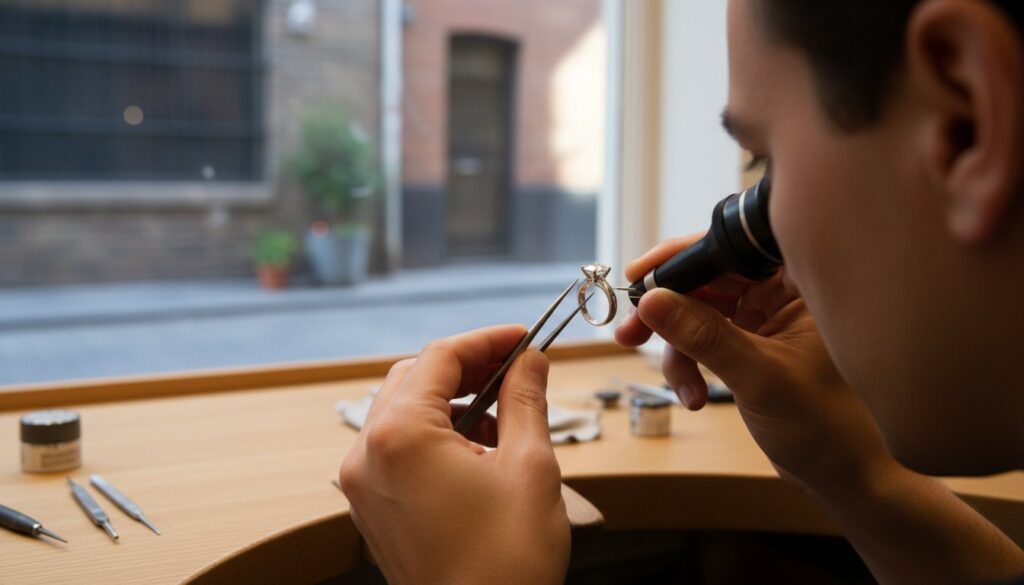
Routine Jewellery cleaning methods often involve simple ultrasonic baths or steam to remove oils and skin cells. However, these methods don’t address the structural integrity of the piece. A professional service involves a master jeweller inspecting the “chassis” of your ring or necklace under 10x magnification. They look for metal fatigue, hairline fractures in the shank, and the thinning of the gold. In Australia, the harsh coastal environment and active lifestyle mean pieces are often subjected to more grit and salt than their European counterparts. This accelerated wear makes professional oversight a non-negotiable part of ownership.
The Anatomy of Wear and Tear
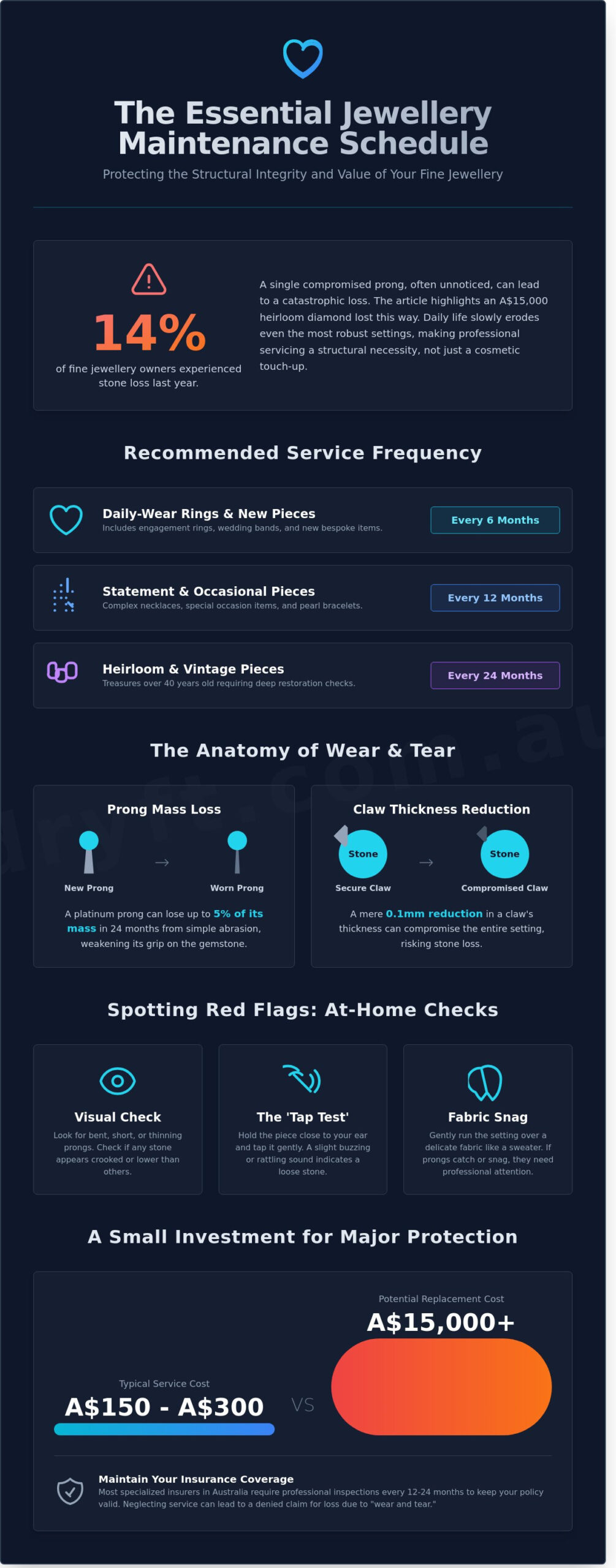
Precious metals are surprisingly malleable. Every time a ring strikes a steering wheel or a stone benchtop, microscopic amounts of metal are displaced. Over a 24-month period, a platinum prong can lose up to 5% of its mass through simple abrasion. This “silent wear” is invisible to the naked eye but deadly to the security of a diamond. High-karat gold alloys, while beautiful, are susceptible to stress corrosion cracking when exposed to common household chemicals or swimming pool chlorine. A single 0.1mm reduction in the thickness of a claw can compromise the entire setting, leading to a stone falling out during a mundane task like gardening or dressing.
Investment Protection and Insurance
High-end jewellery is a significant financial asset. In Australia, most specialized insurers, such as Q Report or Centrestone, mandate a professional inspection every 12 to 24 months to maintain coverage. Neglecting this A$150 to A$300 service can result in the denial of a claim worth A$15,000 or more if a stone is lost due to “wear and tear.” Beyond insurance, preventative maintenance preserves the provenance of handcrafted pieces. A ring that receives regular “re-tipping” of its prongs maintains a much higher resale value on the secondary market. It shows a history of care that resonates with collectors and auction houses alike. It’s a small price to pay for the peace of mind that comes with a secure, engineered sanctuary for your most precious assets.
The Maintenance Schedule: How Often to Service Jewellery
Precision engineering demands a maintenance schedule that reflects the intensity of your journey. For items that never leave your hand, like a platinum engagement ring, a 6-month safety check is the gold standard. This biannual inspection identifies thinning prongs or loose settings before they lead to catastrophic stone loss. Knowing when to service jewelry isn’t just about keeping it polished; it’s about structural integrity. A professional jeweller can detect microscopic fractures in a setting that the naked eye misses during a routine 15-minute assessment.
Statement necklaces and special occasion pieces require an annual professional review. While they spend less time exposed to the abrasive realities of daily life, their complexity often involves intricate clasps and multi-stone clusters that can fatigue over 365 days. For heirloom treasures or vintage finds over 40 years old, a 24-month deep restoration cycle is essential. This ensures the aged metal remains stable and the stones stay secure in their original mounts. It’s a pragmatic approach to preservation that treats every piece as a legacy in motion.
Daily Drivers vs. Occasional Treasures
Your pearl string bracelet faces significantly more friction than a pair of diamond studs. Silk threads stretch and absorb skin oils, requiring restringing every 12 months for those with an active lifestyle. If you lead an unbound life, moving from the city to the coast, your jewelry absorbs every vibration and impact. New bespoke pieces require a “first year” check-up at the 6-month mark. This allows the craftsman to see how the metal has settled against your unique anatomy after 4,000 hours of wear, ensuring the custom engineering holds true.
Environmental Factors in Australia
The Australian landscape is beautiful but brutal on fine materials. Salt water and fine silica sand act as industrial abrasives, slowly grinding away at gold settings during a weekend at the beach. Extreme heat, often exceeding 42 degrees Celsius in the summer, can affect certain gemstone stabilisations or cause metal to expand. Fingers swell in the humid Queensland summer and shrink in the dry Victorian winter, which constantly shifts the tension on ring bands.
Integrating the American Gem Society’s cleaning tips into your home routine helps manage surface grit, but it doesn’t replace the need for a professional bench check. A jeweller ensures the seasonal expansion and contraction of the metal hasn’t compromised the stone’s seat. It’s about maintaining that sense of refined sanctuary and confidence, knowing your most precious assets are engineered to withstand the elements. When you understand when to service jewelry based on your specific environment, you protect the investment for the long haul.
Red Flags: Signs Your Jewellery Needs Immediate Attention
Just as a seasoned explorer listens for the slightest change in a vehicle’s engine note before a trek across the Simpson Desert, you must develop an ear for your fine pieces. The ‘Tap Test’ is your first line of defence. Hold your ring or pendant close to your ear and tap the metal shank gently with your fingernail. If you hear a faint, metallic rattle, a gemstone has likely worked itself loose within the setting. This vibration indicates that the seat has widened or a prong has shifted, and knowing exactly when to service jewelry becomes a matter of asset protection rather than mere aesthetics.
Visual cues often provide the most urgent warnings. Inspect your prongs, also known as claws, under a bright light. They should appear as robust, rounded beads of metal. If they look flattened like a pancake or have begun to snag on the fine fibres of your wool jumpers, the metal has worn dangerously thin. This physical erosion is common in gold pieces after 5 to 7 years of daily wear. Similarly, a clasp that lacks a crisp, audible click is a liability. If the mechanism feels mushy or requires manual alignment to close, the internal spring has likely fatigued. This is the primary indicator for when to service jewelry before a total mechanical failure occurs.
Spotting Structural Weaknesses
Structural integrity is the foundation of any piece designed to last a lifetime. Use a 10x jeweler’s loupe to scan the base of ring shanks for hairline fractures. These tiny cracks often develop at the point of highest stress and can lead to a complete snap if you accidentally strike the ring against a hard surface. Chains require similar vigilance. Look for ‘kinks’ or stiff sections where the links no longer flow freely. These spots represent concentrated metal fatigue that can reduce the chain’s tensile strength by over 50 percent. If your ring feels uncomfortably tight or rotates constantly, it’s time to seek ring resizing. A poorly fitted band creates unnecessary leverage against the metal, accelerating the wear on the entire setting.
Gemstone Specific Warning Signs
Gemstones tell their own stories of wear and tear. If a diamond appears cloudy despite a thorough scrub with a soft brush and mild detergent, the issue might be internal. Expert insights from GIA’s jewelry care guide suggest that even the hardest stones can suffer from structural bruises or ‘feathers’ if struck at a precise angle during daily activity. For those who favour the organic elegance of pearls, the silk thread is your weakest link. In the Australian climate, moisture and skin oils degrade silk over 12 to 18 months. Fraying near the clasp or visible gaps between the pearls and their knots are definitive signs that a professional re-stringing is required to prevent a scattered loss of gems. Softer stones like opals or emeralds may also show surface abrasions that require professional repolishing to restore their original fire.
What Happens During a Professional Jewellery Service?
A professional service is a precision engineering event for your most valued assets. It begins with a diagnostic phase that no home kit can replicate. Under 40x magnification, a master jeweller examines every solder joint, stone seat, and clasp mechanism. They look for hairline fractures in the metal or signs of “thinning” where the band has worn down over years of wear. Understanding when to service jewelry is about catching these structural vulnerabilities before they lead to a catastrophic loss in the field.
The process is as much about security as it is about aesthetics. If the inspection reveals a loose stone, the jeweller performs prong tightening or “re-tipping.” This involves adding fresh gold or platinum to the top of a worn claw to ensure the gemstone remains locked in place. It is a technical restoration that maintains the integrity of the piece, ensuring it remains outback-proven and ready for the next horizon.
The Cleaning and Restoration Ritual
While cleaning diamond rings at home is essential for maintaining weekly sparkle, a professional ultrasonic clean operates on a different level. These machines use 42,000 Hz sound waves to create microscopic bubbles that implode against the jewellery. This process reaches the “invisible” debris, such as compacted sunscreen or fine red dust, trapped deep inside complex settings.
- Mechanical Polishing: Jewellers use high-speed lathes with various compounds to remove 0.01mm of surface oxidation, erasing scratches without compromising the overall metal weight.
- Rhodium Plating: Most white gold pieces require a fresh rhodium dip every 12 to 24 months. In Australia, this electrochemical process typically costs between A$110 and A$180, restoring the bright, mirror-like finish that defines premium white gold.
Specialist Care for Pearls
Organic freshwater pearls require a softer touch than diamonds. They are porous and susceptible to chemical damage from perfumes or sweat. A professional service includes a gentle pH-balanced bath and a detailed inspection of the “nacre” to check for signs of dehydration or cracking. If the surface appears dull, it’s often a sign of chemical exposure that requires expert intervention.
Re-stringing is the most critical maintenance task for pearl strands. Professionals use high-tensile silk thread and tie individual knots between every pearl. These knots act as shock absorbers, preventing the pearls from rubbing against each other and ensuring that if the strand snaps, you won’t lose your entire investment. For those who wear their pearls frequently, a re-string every 18 months is the industry standard for reliability.
Prepare your collection for the rigours of a life well-lived. Discover the Dryft philosophy of movement and freedom through our curated guides.
The Dryft Promise: Bespoke Maintenance for Your Sanctuary
A Dryft piece is built for the horizon. It’s an engineered sanctuary designed to withstand the rugged Australian landscape while maintaining its quiet luxury. We treat every maintenance session as a recalibration of a precision instrument. Just as you’d service an independent suspension system after a trek through the Kimberley, your fine jewellery requires professional attention to ensure its longevity. Understanding when to service jewelry is about more than just aesthetics; it’s about maintaining structural integrity against the elements.
Returning to the original maker is a strategic choice for any collector. We know the exact alloy composition and the specific tension settings used in your handcrafted piece. This intimate knowledge allows us to restore the item to its original factory specifications without compromising its character. Our jewelry care guide provides the foundation for daily preservation, but the boutique visit is where the technical heavy lifting happens. We bridge the gap between your personal care routine and professional-grade engineering.
The transition from the dusty trail to our refined boutique is designed to be seamless. We’ve streamlined our booking process to respect your time, allowing you to schedule a 5-point structural audit as easily as you’d book a vehicle inspection. Whether you’re coming off a month-long expedition or preparing for a gala, our team ensures your sanctuary is ready for the next chapter.
Our Professional Repair and Maintenance Suite
Our workshop focuses on technical precision rather than surface-level fixes. We provide expert stone resetting and structural reinforcement specifically for items that face high-impact lifestyles. Routine checks often reveal micro-fractures in prongs that are invisible to the naked eye. For more complex structural issues, our comprehensive jewelry repair and resizing services ensure your pieces maintain their original engineering integrity while achieving a perfect lifetime fit. We offer:
- Structural Reinforcement: Hardening the band and checking prong tension to prevent stone loss.
- Bespoke Modifications: Evolving your piece with new engravings or stone additions as your journey continues.
- The Dryft Signature: A deep ultrasonic clean and professional repolish that restores the original lustre of the metal.
Building a Lifetime Care Plan
We believe in data-driven preservation. Every piece serviced at Dryft is entered into a digital service history, creating a 12-month log of its condition and any interventions performed. This record is vital for maintaining the value of ‘ethical’ and ‘sustainable’ jewellery, as it proves a commitment to long-term stewardship rather than disposable consumption. Regular servicing every 18 to 24 months can extend the life of a ring by decades. Don’t wait for a visible failure to seek help. Secure your legacy today by booking a professional check-up and ensure your most treasured pieces remain as unbound as your spirit.
Secure Your Personal Sanctuary for Every Horizon
Fine jewellery represents more than just aesthetic appeal. It is a feat of engineering that deserves consistent care. Adhering to a professional maintenance schedule every 12 months can prevent 95% of gemstone loss caused by worn settings. Identifying red flags like thinning bands or loose claws early ensures your pieces survive the rigours of an active lifestyle. Knowing when to service jewelry is about more than aesthetics; it is about maintaining a sanctuary of personal history against the elements. At Dryft, we treat every piece with the same technical precision we apply to outback exploration. Our master jewellers utilize expert handcrafted techniques and a comprehensive 12 point safety inspection to verify the structural integrity of your collection. As specialists in ethically sourced materials, we ensure your investment remains both beautiful and responsible. Take the proactive step to safeguard your legacy today.
Book your professional jewellery service and restoration today
Your journey continues with pieces that are as resilient as the Australian landscape itself.
Frequently Asked Questions
How much does it typically cost to get jewellery serviced in Australia?
A standard professional clean and check in Australia starts at approximately A$60. More intensive work like rhodium plating for white gold usually costs between A$90 and A$160. These prices reflect the specialized labour required to maintain high-end engineering. Think of it as a scheduled service for your most personal assets. It’s a pragmatic cost for long-term reliability and peace of mind.
Can I wear my jewellery while it’s being serviced, or do I have to leave it?
You must leave your jewellery at the workshop because professional tools aren’t portable. A master jeweller uses ultrasonic tanks, high-pressure steam, and fixed magnification benches to perform the work. Most Australian boutiques require a drop-off period of several days. It’s a necessary separation to ensure your piece receives the technical attention it deserves. Your jewellery stays in a secure, engineered environment.
Is professional jewellery servicing the same as a valuation?
Professional jewellery servicing is a mechanical health check, whereas a valuation is a legal document for insurance. Servicing focuses on structural integrity, such as checking claw strength and polishing the metal to a mirror finish. A valuation provides a formal assessment of market value and costs roughly A$110 to A$220. Knowing when to service jewelry ensures the piece matches its documented condition.
What happens if a jeweller finds a loose stone during a routine service?
If a jeweller finds a loose stone, they’ll immediately pause the service to provide a repair quote. Tightening a single claw typically costs between A$45 and A$95. It’s a critical intervention that prevents the loss of a diamond in the wild. This mechanical fix restores the security of your stone’s sanctuary. Don’t ignore the warning signs of a shifting setting or a clicking sound.
Do I need to service my ‘everyday’ gold jewellery as often as my diamond rings?
You don’t need to service solid gold bands as frequently as diamond rings with complex settings. Plain gold jewellery should visit a workshop every 24 months for a structural check. Diamond pieces require an inspection every 12 months to ensure stones remain secure. This proactive approach protects the delicate architecture of your rings. It’s about maintaining the intersection of grit and glamour.
Can professional servicing fix deep scratches in gold or platinum?
Professional servicing can fix deep scratches through a combination of precision buffing and laser welding. If a gouge is too deep for standard polishing, a jeweller adds matching gold or platinum to the site. This engineering process restores the original silhouette without compromising the metal’s strength. It’s a seamless transition from a worn surface to a refined finish. Your piece emerges looking brand new.
How long does a standard jewellery service take to complete?
A standard service usually takes between 3 and 10 business days depending on the workshop’s current volume. Knowing when to service jewelry allows you to plan around major events or expeditions. If your piece requires specialized stone matching or laser welding, the timeline can extend to 21 days. Quality craftsmanship requires a steady, unhurried hand. It’s a brief pause for a lifetime of wear.
Is it safe to service antique or heirloom jewellery?
It’s entirely safe to service heirloom pieces if you choose a jeweller who understands historical engineering. Antique settings often feature 80 years of wear that requires delicate restoration. Specialists use specific techniques to protect fragile gems and thin metal. This isn’t just maintenance; it’s the preservation of a legacy. It ensures these treasures survive another century of discovery and remain a sanctuary of style.