Imagine returning from a 1,400-kilometre expedition through the Kimberley only to realize your A$3,200 saltwater pearls have lost their lustre to a layer of fine red dust and chemical sunscreen. You know that quality craftsmanship requires more than just careful wearing; it demands a technical understanding of materials. This jewelry care guide provides the engineering blueprint for maintaining your most precious pieces against the harsh Australian elements. It’s about protecting the integrity of the design while you’re out exploring the horizon.
You likely feel that a piece of handcrafted jewelry is a sanctuary of style that should endure as long as your spirit for discovery. We agree. This article promises to help you master the rituals of maintenance so your investment remains a timeless reflection of your journey. You’ll explore the daily habits for protection, safe at-home cleaning methods for delicate settings, and the specific 12-month intervals for professional servicing that keep your luxury intact. We’ve distilled the technical complexities of gemology into a practical manual for the modern trailblazer.
Key Takeaways
- Understand why handcrafted jewelry requires a philosophy of preservation that goes beyond surface cleaning to protect your personal sanctuary.
- Navigate the unique challenges of the Australian landscape by learning to defend your settings against the hidden enemies of saltwater and abrasive sand.
- Master a professional-grade jewelry care guide that utilizes “Mild and Minimal” rituals to restore brilliance without compromising the integrity of fine materials.
- Implement the “Prong Check” home test to identify structural risks early, ensuring your luxury pieces remain secure during every off-road journey.
- Learn why organic treasures like freshwater pearls demand a different maintenance cadence than mineral gemstones to preserve their timeless luster.
The Philosophy of Preservation: Why a Jewelry Care Guide Matters
Fine jewelry acts as a sanctuary for your most significant milestones. These pieces are more than mere ornaments; they’re engineered artifacts of personal history. Handcrafted luxury requires a commitment that goes beyond a superficial polish. While a piece might look “clean” to the naked eye, its structural integrity depends on consistent maintenance. This jewelry care guide establishes a framework for protecting the intricate joins and tension settings that define high-end craftsmanship. At Dryft, we apply the same rigorous standards to our jewelry as we do to off-road engineering. We build for longevity, ensuring every design survives the transition from the rugged Australian coastline to a refined evening event.
Environmental stressors interact with materials in distinct ways. Gold is naturally malleable. Diamonds act as magnets for skin oils. Organic pearls are porous and sensitive to pH shifts. Understanding these chemical realities is the first step toward unbound adventure with your collection. Without a proactive approach, the very elements that make a piece beautiful can become the agents of its decline.
The Anatomy of Wear and Tear
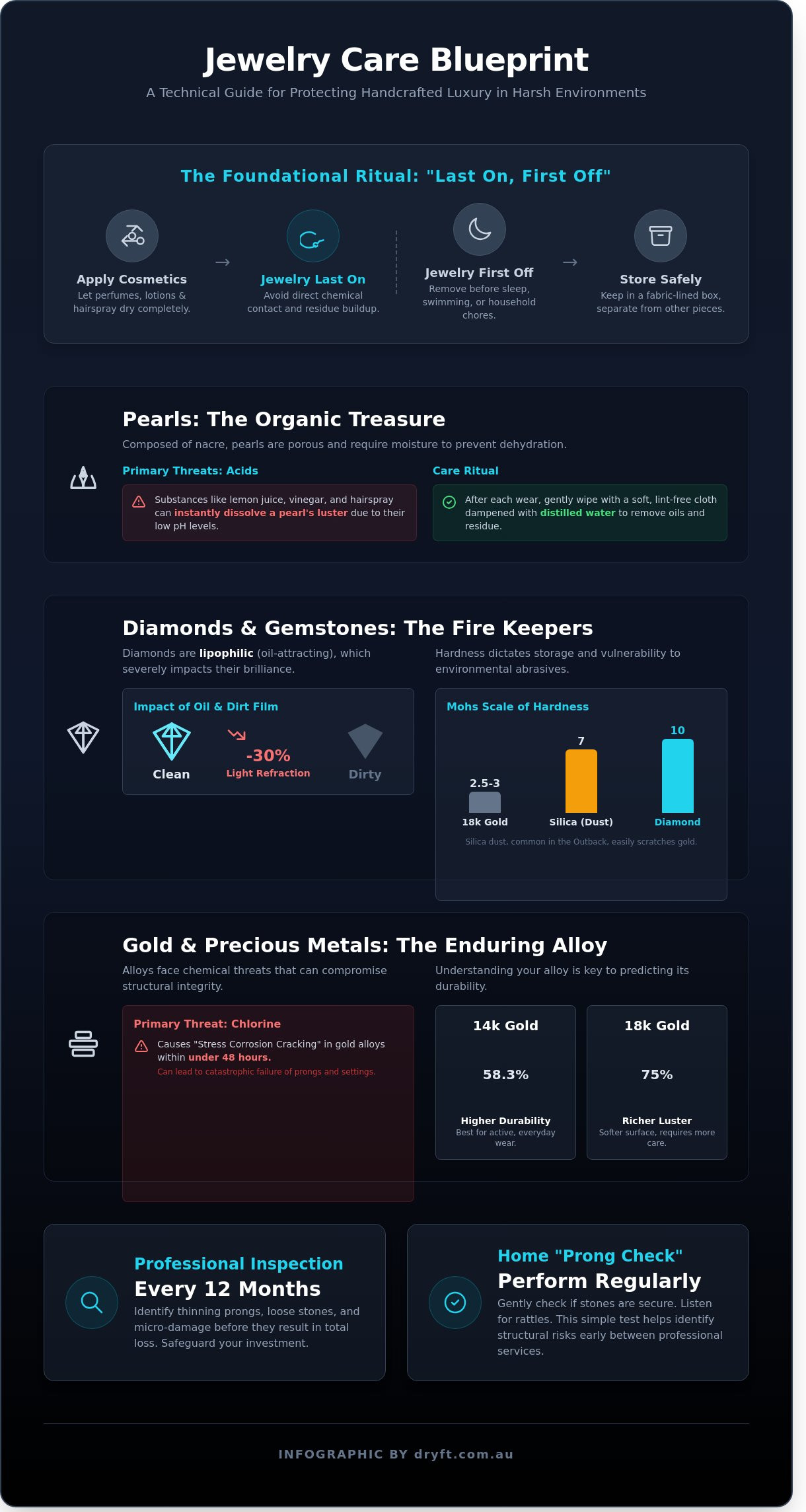
Microscopic abrasion is a silent predator. Dust in the Australian Outback often contains high concentrations of silica, which carries a hardness of 7 on the Mohs scale. This easily scratches 18k gold, which sits between 2.5 and 3. Daily application of perfumes and sunscreens creates a persistent film on gemstones. This layer can reduce light refraction in a diamond by as much as 30%, stealing its fire. Common household substances are equally dangerous. Chlorine exposure can cause stress corrosion cracking in gold alloys in under 48 hours, potentially leading to a catastrophic failure of a stone’s setting.
Investment Protection vs. Aesthetic Maintenance
Aesthetic maintenance keeps your jewelry sparkling, but investment protection keeps it intact. Professional inspections every 12 months can identify thinning prongs or loose stones before they result in a total loss. It’s a pragmatic approach to luxury. You aren’t just cleaning a ring; you’re safeguarding an asset that carries immense emotional and financial weight. Preserving a handcrafted piece ensures it remains a viable legacy for the next generation. It transforms a purchase into a permanent companion for a life lived without limits. By following a structured jewelry care guide, you ensure your equipment is as ready for the journey as you are.
Material Mastery: Specific Care for Pearls, Diamonds, and Gold
Handcrafted luxury requires a nuanced jewelry care guide to survive both the salt-laden coastal breeze and the refined evening gala. The foundation of preservation rests on the “Last On, First Off” ritual. Your pieces should be the final touch after perfumes have settled and the first items removed before the day’s grit takes hold. This practice protects delicate settings from the chemical residues of modern life.
Caring for the Queen of Gems: Pearls
Unlike mineral stones forged in the earth, pearls are organic treasures. They consist of nacre, a crystalline substance that needs to breathe and absorb trace amounts of moisture from the air to prevent dehydration. Acids are the primary enemy. Substances like vinegar, lemon juice, or hairspray possess pH levels low enough to dissolve pearl luster instantly. For baroque pearls, their irregular silhouettes create unique crevices where oils accumulate. Use a soft, lint-free cloth dampened with distilled water to gently navigate these contours after every wear.
Diamonds and Gemstones: Keeping the Fire Alive
Diamonds are naturally lipophilic, acting as magnets for skin oils and lotions. A microscopic film of grease can dim the refractive index of a A$10,000 stone in a single afternoon, killing the “fire” that defines its value. While diamonds are incredibly tough, many accompanying gemstones don’t survive the high-frequency vibrations of ultrasonic cleaners, which can shatter emeralds or opals. The Mohs scale measures a mineral’s scratch resistance on a scale from 1 to 10, with diamonds sitting at the peak of geological hardness. This rating dictates why you should never store a diamond against a softer sapphire or metal setting.
Gold and Precious Metals: Preventing Oxidation
Gold alloys face a specific mechanical threat in Australian lifestyle settings, particularly from chlorinated pools. Chlorine causes “stress corrosion cracking” in gold, a microscopic breakdown that can lead to a snapped prong or a lost stone. Understanding your alloy is vital. 18k gold contains 75% pure gold, offering a richer hue but a softer surface than 14k gold, which contains 58.3% gold and higher concentrations of hardening base metals.
- 14k Gold: Higher durability for active, everyday wear.
- 18k Gold: Superior luster and prestige, requiring more frequent checks for structural wear.
- Patina: Handcrafted gold develops a soft matte finish over time, a natural record of your experiences.
Maintaining your fine jewelry requires the same attention to detail as servicing a Dryft luxury hybrid camper before a long-haul expedition. Both represent a significant investment in quality that thrives on proactive maintenance rather than reactive repairs.
Elegance in the Wild: Protecting Your Pieces from the Elements
The Australian landscape demands resilience. It’s a place where rugged capability meets refined taste. Wearing fine jewelry in the outback or along the coastline introduces specific risks that standard advice often ignores. This jewelry care guide focuses on the intersection of adventure and preservation. Metal-on-metal contact during heavy lifting or off-road repairs is a recipe for disaster. A 20kg dumbbell or a steel wrench can easily crush a gold band, leading to a repair bill that often exceeds A$450 for basic reshaping and stone tightening.
Extreme heat also plays a role in the longevity of your collection. Direct UV radiation in the Australian summer can reach extreme levels, potentially fading the vibrant hues of stones like kunzite or amethyst after just 4 hours of exposure. High temperatures in the interior, often exceeding 45°C, can cause thermal shock in stones with high water content. Australian opals are particularly susceptible to this, as they contain up to 21% water and can crack if moved too quickly from a chilled interior to the harsh midday sun.
The Beach and Surf Protocol
The ocean offers freedom but hides dangers for your collection. Cold water causes peripheral vasoconstriction. This physiological response shrinks your fingers by as much as half a ring size, making it easy for a band to slip off in the break. Saltwater is equally aggressive. It acts as an electrolyte that speeds up the tarnishing of silver and low-karat gold alloys. Sand is comprised of silica. With a Mohs hardness of 7, these tiny grains act like sandpaper against 18ct gold, which only rates around 2.5 to 3. Sand particles can also lodge in delicate hinge mechanisms, causing permanent mechanical failure.
Everyday Chemical Hazards
Modern life introduces a chemical cocktail that dulls your pieces. Sunscreen and lotions are the most common offenders. They leave a greasy residue that can trap dirt and reduce a gemstone’s light refraction by 35% or more. Hand sanitizers are another modern threat. Frequent use of 70% alcohol solutions can erode the rhodium plating on white gold, forcing a trip to the jeweler for a A$120 replating service. Never wear jewelry when using household bleach. A 5% concentration of sodium hypochlorite can cause stress corrosion cracking in gold alloys, leading to structural collapse. This jewelry care guide recommends removing all pieces before handling any domestic chemicals.
Rituals of Restoration: Safe At-Home Cleaning Techniques
True luxury isn’t fragile, yet it demands a specific kind of respect. The “Mild and Minimal” philosophy is the cornerstone of this jewelry care guide. It mirrors the way a seasoned explorer maintains high-performance equipment; you use the right tools and avoid unnecessary friction. Statistics from professional restoration labs suggest that 70% of preventable jewelry wear comes from using abrasive chemicals or tools that are too stiff for the task. Preservation is about restraint.
The Universal Cleaning Method
Restoring the brilliance of your pieces doesn’t require a laboratory. It requires patience. Follow this engineered process to remove the environmental grit of the Australian outback or the city streets:
- Mix a solution of warm water and two drops of mild, fragrance-free dish soap in a ceramic bowl.
- Soak the piece for 25 minutes. This allows the solution to penetrate and loosen accumulated skin oils and dust.
- Use a dedicated baby-soft toothbrush to gently agitate the settings. Focus on the underside of the stone where light enters.
- Rinse the item in a separate bowl of clean, room-temperature water. Never rinse over an open drain; a single slip can lead to a costly recovery mission.
Once clean, dry the piece using a fresh, lint-free microfibre cloth. Avoid paper towels, as their wood-pulp fibres can create microscopic scratches on gold and silver surfaces. Pat the metal dry to prevent water spots, which are particularly visible on high-polish finishes.
Safe Storage Rituals
Your jewelry requires a dedicated sanctuary when it’s not in use. Constant friction is a silent thief of polish. Storing multiple pieces in a single tray leads to “stone-on-stone” scratching, which can permanently dull the surface of even the hardest gems. Individual soft-lined pouches are essential for every item in your collection. This is especially true for organic gems like pearls. They require a specific environment; never store them in airtight plastic bags. Pearls need to breathe and absorb trace amounts of moisture from the air to prevent the nacre from cracking. Maintain a consistent humidity level in your storage area to ensure they remain as vibrant as the day you acquired them. For those who value precision and quality in every aspect of life, you can explore the Dryft philosophy of refined living to see how we balance grit with glamour.
Beyond the Surface: When to Seek Professional Jewelry Repair
Home maintenance forms the backbone of any jewelry care guide, yet even the most diligent routine has its limits. High-end engineering requires professional calibration. Your jewelry faces daily friction, thermal expansion, and accidental impacts that create structural fatigue invisible to the naked eye. Recognizing when to step back from DIY cleaning and consult a master jeweler is vital for preventing the permanent loss of a gemstone.
Perform a “Prong Check” every month. Hold the piece close to your ear and gently tap the stone with a fingernail or a toothpick. If you hear a faint clicking sound, the setting has loosened. This indicates the metal has moved or thinned, a common issue after three to five years of consistent wear. Professional intervention at this stage prevents the claw from snapping entirely.
Professional ultrasonic cleaning operates at a frequency home kits cannot match. While a soft brush removes surface grime, our industrial-grade equipment uses cavitation bubbles to reach internal galleries where skin oils and debris calcify. This deep-cleansing process restores the “fire” of a diamond by clearing the pavilion, a result impossible to achieve on a kitchen bench. It is the difference between a quick wash and a full mechanical detail.
Signs Your Jewelry Needs Expert Attention
Watch for your rings catching on fine knitwear or silk scarves. This snagging is often the first warning of a lifted or thinned claw. If your gold or platinum appears dull despite cleaning, it likely requires a professional high-speed polish to remove microscopic surface abrasions. For those wearing pearls, inspect the thread for sagging. If you see gaps between the pearls and the knots, the silk has stretched and reached its failure point. Restringing every 18 to 24 months ensures the strand remains secure. Understanding when to service jewelry professionally can prevent catastrophic failures and preserve your investment for decades.
The Dryft Maintenance Service
At Dryft, we treat jewelry maintenance with the same technical precision used to engineer a luxury off-road chassis. Our service is a sanctuary for your most prized possessions, focusing on structural integrity and the seamless restoration of original design lines. Whether it is a complex stone resetting or a professional resizing, we ensure the balance and weight of the piece remain uncompromised.
Regular maintenance extends the horizon of your jewelry’s life, transforming a beautiful object into a lifelong companion. We provide the expertise needed to navigate the wear and tear of an active lifestyle. When structural issues arise that require professional jewelry repair and resizing, our master craftsmen restore your pieces to their original engineering specifications without compromising their aesthetic integrity. Explore our professional repair and maintenance services to keep your collection in peak condition for your next adventure. Your jewelry is built for the journey; we make sure it lasts the distance.
Protect Your Legacy on the Open Road
Your jewelry is a testament to your journey. It’s built to endure. By integrating this jewelry care guide into your routine, you protect the mechanical integrity and aesthetic brilliance of your collection. Focus on the 3 core pillars of preservation: material-specific cleaning for your 100% ethically sourced diamonds, shielding freshwater pearls from harsh coastal elements, and scheduling a professional assessment every 12 months. These small rituals ensure your handcrafted pieces remain as resilient as the Australian outback they were designed to traverse.
Every piece we craft in our Australian studio is engineered for the modern adventurer who demands both toughness and elegance. We provide complimentary care advice with every single purchase to ensure your investment stands the test of time. It’s about more than just shine; it’s about maintaining a sanctuary of style wherever the trail leads you. Explore our range of durable, refined pieces and start your next chapter with confidence. The horizon is waiting for you.
Shop our handcrafted and ethically sourced collections
Frequently Asked Questions
Can I use toothpaste to clean my gold jewelry?
No, you shouldn’t use toothpaste to clean gold because its abrasive particles cause permanent micro-scratches on the polished surface. While gold is engineered for durability, it sits at a low 2.5 to 3 on the Mohs scale in its pure form. Toothpaste contains calcium carbonate or silicas that strip away the refined finish of handcrafted luxury. Use a solution of warm water and mild detergent to maintain that sanctuary-like glow instead.
Is it safe to wear my diamond ring in the shower?
It’s best to remove your diamond ring before showering to prevent the buildup of soaps, oils, and hard water minerals. These substances create a film that blocks light, reducing the diamond’s refractive index by up to 15 percent. In the Australian climate, your fingers can also shrink in cool water, increasing the risk of a ring slipping down the drain. Secure your investment in a dedicated tray before stepping into the steam.
How often should I have my jewelry professionally serviced?
You should schedule a professional inspection every 6 to 12 months to ensure the structural integrity of your collection. This jewelry care guide recommends a bi-annual check to identify thinning prongs or weakened clasps before they fail. A qualified Australian jeweller typically charges between A$50 and A$150 for a comprehensive cleaning and safety check. Regular maintenance acts like a scheduled service for a high-performance vehicle, preventing catastrophic loss.
Why has my pearl jewelry lost its shine?
Pearls lose their lustre because they are organic gemstones sensitive to the pH balance of your skin and chemical exposure. Contact with perfumes or hairsprays causes the nacre to dissolve, leading to a dull, chalky appearance over time. This jewelry care guide advises the “last on, first off” rule to protect their delicate surface. Wipe them with a soft, damp cloth after every wear to remove acidic residues and preserve their deep, watery glow.
Can I use an ultrasonic cleaner for all my jewelry?
No, ultrasonic cleaners use high-frequency sound waves that can shatter porous stones like Australian opals or emeralds. These machines generate 40,000 vibrations per second, which is enough to dislodge stones from tension settings or aggravate internal inclusions. Avoid putting any treated gemstones or organic materials into these devices. Stick to manual cleaning methods for any piece that features a complex arrangement of varied gemstones to ensure total safety.
What should I do if a stone feels loose in its setting?
Stop wearing the piece immediately and place it in a sealed container to prevent the stone from falling out. A loose stone indicates that the metal housing has shifted or worn down, usually requiring a retipping service that costs approximately A$40 to A$80 per prong. Don’t attempt a DIY fix with adhesives. Take it to a master craftsman who understands the engineering of fine settings to restore its original security and peace of mind.
How do I store my jewelry when traveling?
Store each piece in an individual padded pouch or a dedicated travel roll to prevent metal-on-metal friction. When you’re crossing horizons, vibration and movement can cause harder diamonds to scratch softer metals or gemstones. Use a case with a rigid exterior to protect against impact during transit. Organizing your collection this way ensures your handcrafted luxury remains as pristine as the day you left home, regardless of the terrain.
Is it okay to sleep in my jewelry every night?
You shouldn’t sleep in your jewelry because the constant friction against bedding causes unnecessary wear on delicate chains and prongs. Data suggests that 30 percent of accidental jewelry damage occurs during sleep when pieces snag on fabric or become crushed under body weight. Removing your items at night also allows your skin to breathe and prevents the accumulation of oils. Establish a nightly ritual of placing your treasures in a safe sanctuary.