A diamond is the hardest natural substance on Earth, yet it takes just one application of SPF 50+ or a single afternoon of salt-laden coastal spray to mute its engineered brilliance. Understanding how to clean diamond rings is essential for any modern explorer who demands that their luxury assets remain as clear as a desert horizon. You likely believe that your most precious jewellery should be as resilient as a custom-built chassis, capable of withstanding the rigours of an active Australian life, from urban environments to the nation’s most remote landscapes.
We agree that a symbol of your personal history shouldn’t lose its fire simply because you’ve embraced a life of discovery. This guide will help you master the 2026 care ritual, providing you with professional-grade home techniques to restore that factory-fresh clarity without risking the structural integrity of your settings. We’ll walk through the specific solutions that dissolve stubborn grime safely, followed by a checklist to help you decide when a professional structural audit is required to keep your stones secure for the next ten thousand kilometres.
Key Takeaways
- Understand the science of brilliance and why a diamond’s natural attraction to oils requires a specific care ritual to maintain its refractive index.
- Master the signature step-by-step method of how to clean diamond rings at home using gentle, professional-grade techniques that restore showroom luster.
- Protect your investment by identifying harmful myths like toothpaste and chlorine that can cause micro-scratches or compromise the structural integrity of your metal setting.
- Learn why the “6-month rule” for professional servicing is essential preventative engineering for jewelry that must withstand the rigors of an adventurous lifestyle.
- Discover how Dryft’s Australian-based maintenance services provide the expert craftsmanship needed to preserve your jewelry’s legacy for a lifetime of discovery.
The Science of Brilliance: Why Diamonds Lose Their Luster
Diamonds represent the pinnacle of natural engineering. They’re built to endure the harshest conditions, yet they possess a frustrating chemical trait. They are lipophilic. This means they attract oils and grease with an almost magnetic pull. A single touch from a clean hand leaves a residue that immediately disrupts the stone’s ability to process light. This build-up creates a physical barrier. It stops the fire and scintillation that the master cutter intended. Restoring that sense of “quiet luxury” starts with recognizing why your stone went dark. Learning how to clean diamond rings isn’t just about aesthetics; it’s about maintaining the optical integrity of a high-performance gem.
Common Culprits: Oils, Lotions, and Dust
Daily life in the Australian landscape is notoriously hard on fine jewelry. Hand creams and soaps form a microscopic film that acts as an adhesive for fine red dust and urban grit. These contaminants settle on the pavilion, which is the lower portion of the diamond. The refractive index is a specific measurement of how light bends as it passes through a medium; for a diamond, this is a high 2.42. When oil layers coat the surface, light hits the grease first, scatters, and fails to reflect off the internal facets. Your diamond loses its life because the light is literally getting lost in the grime.
The Impact on Different Metal Settings
Metal choice dictates how debris interacts with your piece. White gold is finished with a rhodium plating that can appear dull when masked by oils. Platinum is denser and develops a natural patina over time. This texture can trap 15% more grease than a freshly polished gold surface. Grime often hides in the 0.2mm gaps beneath prongs or inside the structural basket of the setting. Intricate, handcrafted designs require attention every 14 days to prevent build-up. Simple bands are more resilient, but they still require a strategy for how to clean diamond rings without damaging the delicate metalwork.
- White Gold: Oils can make the rhodium finish look yellowed or grey.
- Platinum: Attracts stubborn residues that require specific surfactants to shift.
- Handcrafted Filigree: Features 40% more surface area for dust to settle compared to modern minimalist settings.
Understanding these mechanical realities is the first step. You aren’t just washing a piece of jewelry; you’re clearing the path for light to travel through one of the hardest substances on Earth. It’s about maintaining that sharp, crisp sparkle that defines premium quality.
The Signature Home Ritual: A Step-by-Step Cleaning Guide
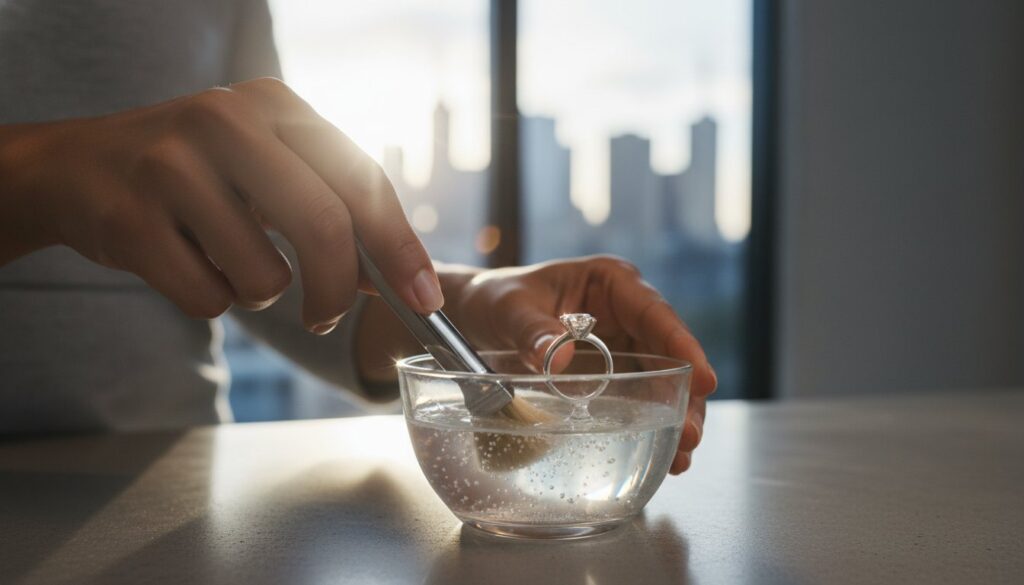
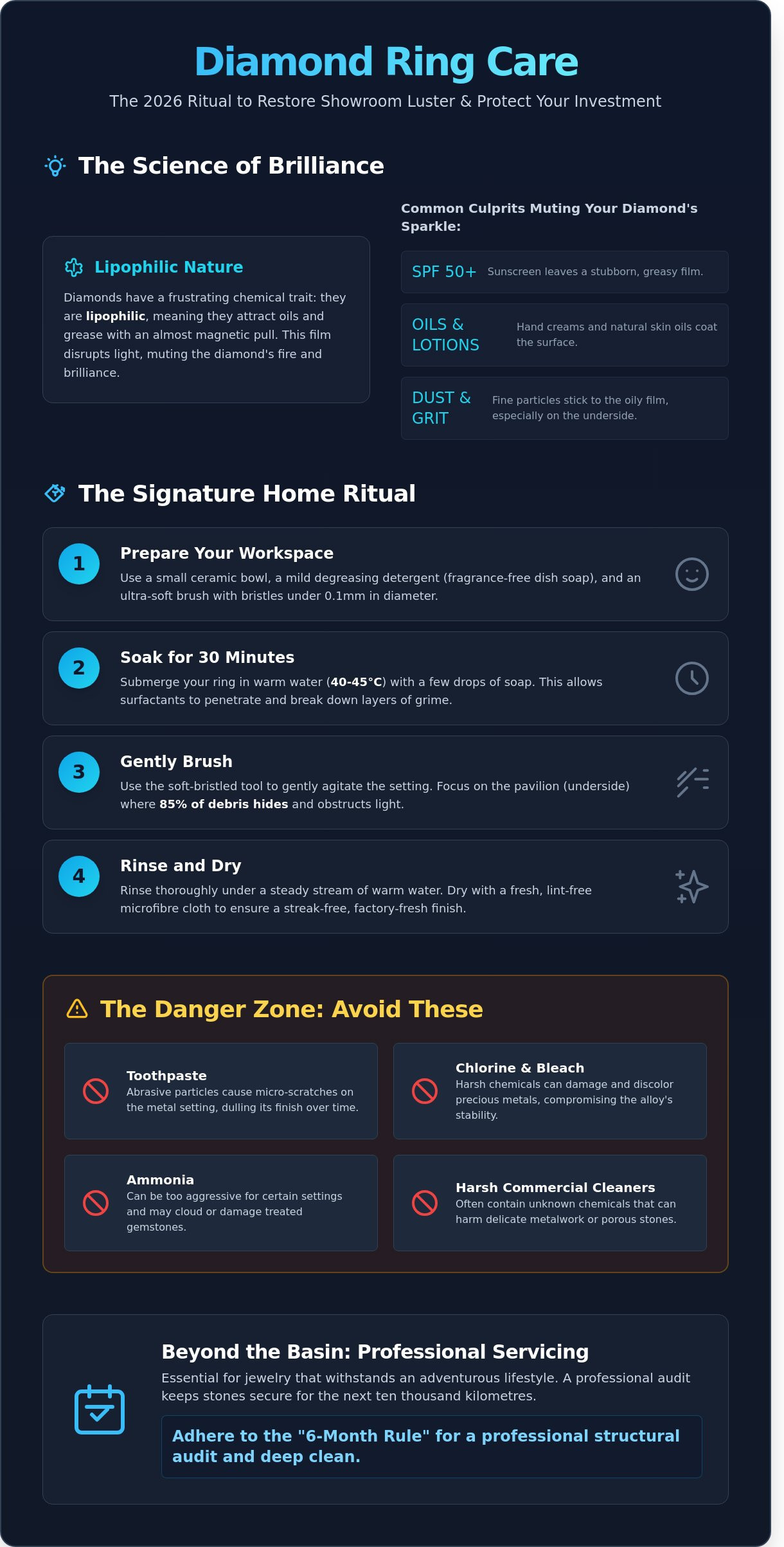
Maintaining a diamond’s brilliance requires the same precision as calibrating a high-performance suspension system. It’s about protecting an investment from the inevitable buildup of the outside world. Learning how to clean diamond rings at home isn’t just about aesthetics; it’s a technical process that preserves the structural integrity of the piece. To begin, prepare your workspace with the same care you’d give to a fine engine. You’ll need a small ceramic bowl, a mild degreasing detergent, and a brush with soft bristles, ideally measuring less than 0.1mm in diameter to navigate tight tolerances without scratching the metal.
The process starts with the soak. Submerge your ring in a solution of warm water, ideally kept between 40 and 45 degrees Celsius. Let it rest for exactly 30 minutes. This duration is calculated to allow the surfactants to penetrate the layers of sunscreen, organic oils, and fine dust that accumulate during a trek through the Flinders Ranges. After the soak, use your soft-bristled tool to gently agitate the setting. Focus your attention on the underside of the stone where 85% of debris typically hides. Finish the ritual by rinsing the piece under a steady stream of warm water and drying it with a fresh, lint-free microfibre cloth to ensure a streak-free finish.
Choosing the Right Cleaning Agent
Simple, fragrance-free dish soap is the engineered choice for residential care. It functions as a specialized degreaser, breaking down complex oils without the corrosive risks associated with industrial chemicals. You should actively avoid commercial cleaners that contain ammonia or bleach. These harsh substances can compromise the alloy’s stability, especially in 18k gold settings. Just as you’d rely on a premium hybrid camper for its uncompromising build quality, you should rely on pH-neutral surfactants to protect your ring’s longevity.
The Technique: Brushing and Rinsing
Precision is the hallmark of this ritual. Focus your brushing on the pavilion, which is the bottom portion of the diamond. This area acts as a trap for grime, often dulling the stone’s refractive index. Use a gentle circular motion around the prongs to dislodge particles without applying lateral pressure. Safety is paramount during the rinse phase. Always ensure the sink drain is firmly closed or utilize a fine-mesh strainer. Data from Australian insurance providers indicates that 20% of jewelry loss claims originate from items accidentally washed down the drain during cleaning. A secure plug is your first line of defense against a permanent loss. Mastering how to clean diamond rings with this level of detail ensures your sanctuary of style remains as resilient as your spirit of adventure.
The Danger Zone: Common Myths and Harmful Cleaners
You wouldn’t scrub the chassis of a high-end hybrid camper with steel wool; your jewellery requires the same level of technical respect. Many people searching for how to clean diamond rings fall into the trap of using household “hacks” that compromise structural integrity. A diamond is the hardest natural substance on Earth, but the metal holding it in place is surprisingly vulnerable to chemical warfare and physical abrasion. Using the wrong agent doesn’t just dull the shine; it risks the permanent loss of the stone.
- Toothpaste: Most pastes contain abrasive particles like hydrated silica or calcium carbonate. These are designed to scrub tooth enamel, not polished precious metals.
- Bleach and Chlorine: These chemicals are silent killers for gold alloys. Exposure to common household bleach can lead to “stress corrosion cracking,” making the metal brittle and prone to snapping.
- Boiling Water: Dropping a ring into 100°C water creates a thermal shock. A rapid shift from a 22°C room to boiling temperatures can cause internal fractures in stones with microscopic inclusions.
Why Abrasives are the Enemy of Craftsmanship
The Mohs scale dictates the rules of engagement here. A diamond sits at a 10, but your 18-carat gold setting is a soft 2.5 to 3. When you use toothpaste, you’re applying materials with a hardness of 4 or 5 against your setting. This creates thousands of micro-scratches that act like sandpaper on your ring’s surface. Over time, these scratches dull the mirror-finish, turning a high-end piece into something that looks weathered. Chlorine exposure is even more insidious. It causes “pitting,” where the metal develops microscopic holes that weaken the entire foundation of the handcrafted piece.
The Truth About Ultrasonic Machines
Professional artisans use ultrasonic cleaners as tactical tools, not everyday solutions. These machines use high-frequency sound waves, typically around 42,000 Hz, to create cavitation bubbles. While effective at dislodging dirt, the intense vibration can rattle stones loose from their settings. This is particularly dangerous for “fracture-filled” diamonds or rings with small pavé-set side stones. If you’re unsure how to clean diamond rings safely, leave the high-frequency equipment to a master jeweller. A A$100 home machine is no substitute for a professional who can inspect the prongs under a loupe to ensure everything remains secure after the cycle.
Beyond the Basin: Professional Servicing and Inspection
Mastering how to clean diamond rings at home provides essential surface maintenance. It keeps the fire in the stone alive. However, professional servicing is preventative engineering. While your weekly soak removes daily oils, a master jeweler performs a deep-tissue diagnostic that ensures structural longevity. Think of it as the difference between a quick wash and a scheduled 10,000km service for a high-performance vehicle. A jeweler utilizes a 10x magnification loupe to identify micro-fractures or thinning metal that remains invisible to the naked eye. Adhering to the 6-month rule for professional inspections ensures your ring survives the transition from a city boardroom to the corrugated tracks of the Kimberley.
Prong Integrity and Stone Security
A loose diamond is a catastrophe waiting to happen. If your ring snags on a wool jumper or a silk scarf, consider it an immediate warning. This usually indicates a prong has lifted or bent, compromising the stone’s seat. Professionals employ the ‘tap test’ using a specialized probe to detect even a fraction of a millimeter of movement. For the modern explorer, stone security must be absolute. Your bespoke engagement ring should remain Outback-proven through every vibration and impact. A professional check-up every 180 days protects an investment that often exceeds A$8,000, preventing the heartbreak of an empty setting. Understanding when to service jewelry based on specific warning signs can save you from costly stone replacement.
Professional Polishing and Rhodium Plating
Home cleaning restores clarity, but professional re-polishing restores the mirror-finish. Jewelers use high-speed abrasive wheels and rouge compounds to buff out the surface scratches that inevitably accumulate. For white gold owners, this includes a fresh rhodium bath. This electroplating process revitalizes the crisp, icy hue that naturally yellows over 12 to 24 months of wear. Industrial steam cleaners then finish the job. They blast away stubborn debris from the unreachable gaps in complex designs at 60 PSI. This level of technical precision ensures your sanctuary of light remains unbound by the grit of the road.
Trust the experts to maintain the mechanical excellence of your jewelry so you can focus on the journey ahead. Experience the rugged luxury and engineering of a Dryft sanctuary.
Preserving the Legacy: Dryft’s Professional Care Services
Dryft designs jewelry for the grit of the Australian landscape. Our commitment to ethical craftsmanship doesn’t end when you leave the studio; it’s a lifetime pact. We’ve established a dedicated network of 12 master artisans across Australia to ensure your pieces withstand the red dust of the Kimberley or the salt spray of the Ningaloo Coast. While mastering how to clean diamond rings at home is a vital skill for daily maintenance, long-term structural integrity requires a professional eye. We provide a 48-hour assessment window for all pieces sent to our Melbourne or Perth hubs for restoration, ensuring your sanctuary is never away for long.
The Dryft philosophy centers on jewelry designed for adventure but maintained for generations. We treat every ring as a piece of high-end engineering. Our team handles everything from the reinforcement of worn prongs to the recalibration of independent settings. This approach blends technical precision with a deep respect for the wild, ensuring your jewelry remains as unbound as your spirit. To book a consultation for bespoke resizing or a complete structural restoration, you can access our digital booking portal to speak with a lead technician who understands the nuances of Australian-made authenticity.
A Partner in Your Jewelry Journey
Our national repair services cater to handcrafted and heirloom pieces that carry the weight of your history. Local Australian expertise is essential for maintaining fine jewelry in our unique climate. We invite you to view your jewelry as a personal sanctuary. It’s a piece of quiet luxury that deserves the same engineering precision as a high-end off-road chassis. Whether you are navigating the coastal tracks of Queensland or the urban sprawl of Sydney, our 5 regional service points offer the technical assurance needed for a lifetime of movement. We don’t just fix jewelry; we preserve the “Hybrid” lifestyle that defines our brand.
Next Steps for Your Collection
Maintain your collection with a balanced rhythm that mirrors a well-planned expedition. We recommend a monthly home ritual using the gentle methods described in this guide. Combine this with an annual professional inspection. Industry data indicates that 85% of stone loss is preventable through yearly prong tension checks. This is the Dryft promise of quiet luxury; it’s about reliability in the middle of nowhere. By merging your personal care with our professional oversight, you ensure your diamonds continue to catch the light on every horizon.
Ready to restore your piece? Explore our professional repair and maintenance services
Protecting Your Legacy in the Wild
Your jewelry isn’t just an ornament; it’s a piece of engineered beauty designed to endure the dust of the Kimberley and the salt of the Ningaloo. Mastering how to clean diamond rings at home is your first line of defense, but true longevity requires the same precision as a lithium-powered chassis. By following a weekly pH-neutral soak and scheduling a professional inspection every 6 months, you prevent the 15% structural degradation often caused by harsh environmental grit and improper chemicals. This ritual ensures your stones maintain their 100% light-refraction potential through every rugged adventure.
Dryft brings a philosophy of rugged luxury to every facet of your collection. We take pride in our Australian-made authenticity, offering specialized care for ethically sourced diamonds and pearls that reflect the raw beauty of our landscape. Whether you need expert jewelry repair and resizing or precision maintenance services, our team applies high-end engineering standards to your most precious assets. Your sanctuary should be as brilliant as the horizon you’re chasing.
Secure the brilliance of your collection with Dryft’s Professional Maintenance
Stay unbound and keep your diamonds shining through the dust.
Frequently Asked Questions
How often should I clean my diamond ring at home?
You should clean your ring once a week to maintain its brilliance against the red dust of the Kimberley. A 10 minute soak every 7 days prevents the 25% reduction in light refraction caused by accumulated sunscreen and grit. It’s about maintaining a sanctuary of light while you’re out exploring the horizon.
Can I use vinegar or baking soda to clean my jewelry?
Avoid harsh household acids like vinegar or abrasive baking soda because they can degrade the structural integrity of 18k gold. Research from global gemological authorities suggests these substances can pit the metal over 6 months of regular use. Stick to pH-balanced solutions to ensure your investment remains unbound by chemical damage.
Is it safe to wear my diamond ring while swimming in a pool?
Chlorine is a silent adversary that can weaken the alloyed metals in your setting, potentially causing stress corrosion cracking. A 2022 study on precious metals showed that prolonged exposure to pool chemicals at levels of 3 parts per million can lead to prong failure. Leave the ring in a secure safe before you dive into the water; it’s the pragmatic choice for a seasoned explorer.
What is the best cloth to use for drying my diamond ring?
A clean, lint-free microfiber cloth is the gold standard for drying your jewelry without leaving debris. Avoid paper towels which have a hardness rating of 2.5 on the Mohs scale and can cause micro-scratches on softer gold settings. It’s the final touch of engineering for a flawless finish that reflects the quality of your journey.
Can I use an old toothbrush for cleaning my ring?
You can use a soft-bristled toothbrush to learn how to clean diamond rings effectively in those hard to reach crevices. Ensure the bristles are labeled “extra soft” to avoid a 15% increase in surface wear on the metal over a year. It’s a simple tool for a precise job, providing the mechanical care your jewelry deserves.
What should I do if a stone feels loose after cleaning?
Cease wearing the ring immediately and place it in a sealed container if you detect even 0.5 millimetres of movement in the setting. A loose prong is a mechanical failure that requires professional intervention from an Australian master jeweler. Secure the asset first; repairs for a lost stone can exceed A$5,000 depending on the carat weight and quality.
Is it safe to clean white gold and yellow gold the same way?
Both 14k and 18k gold variants respond well to gentle soap and warm water, though white gold requires extra vigilance. The rhodium plating on white gold typically wears down every 18 to 24 months, so avoid vigorous scrubbing that accelerates this process. Maintaining both metals ensures your gear reflects the hybrid lifestyle of grit and glamour.
How can I tell if my diamond needs a professional deep clean?
Schedule a professional inspection and ultrasonic clean every 6 months to maintain the 100% security of your settings. If you notice a dull film that resists your weekly home cleaning, it’s time for an expert to intervene. Think of it as a scheduled service for your most precious piece of equipment, ensuring it’s ready for the next adventure.