The label “hypoallergenic” is often a marketing veneer that crumbles under the heat of a 35-degree Queensland afternoon. You’ve likely felt that familiar, nagging itch within 120 minutes of fastening a new pair of studs, realizing another investment has failed your skin. It’s a frustrating cycle of wasting money on pieces that promise safety but deliver redness. Finding the best everyday earrings for sensitive ears shouldn’t be a compromise between your health and your personal style. We believe your jewelry should perform as reliably as high-end engineering, standing up to the elements without faltering.
You deserve a collection of sophisticated staples that transition from a coastal trail to a premium sanctuary without a second thought. This guide bridges the gap between technical metallurgy and refined luxury. We’ll explain why the 4% difference in alloy composition between 14k and 18k gold is the deciding factor for your comfort. You’ll gain a curated list of Australian-tested options, priced in A$, that offer a permanent solution for your skin. It’s time to stop settling for temporary fixes and start investing in the quiet luxury of irritation-free elegance.
Key Takeaways
- Identify the specific metals that trigger contact dermatitis and learn why 18k gold and titanium provide a superior skin sanctuary for all-day wear.
- Discover how to select the best everyday earrings for sensitive ears by opting for streamlined sleeper hoops and low-profile studs that promote hygiene.
- Master a maintenance routine tailored for the Australian climate to prevent salt, sweat, and sunscreen from causing perceived metal sensitivities.
- Understand the “Quiet Luxury” advantage of handcrafted jewelry, where hand-polished posts eliminate the industrial micro-burrs that often cause irritation.
- Curate a versatile collection that bridges the gap between rugged outback exploration and refined elegance without sacrificing durability or comfort.
The Science of Sensitivity: Why Your Ears React and How to Stop It
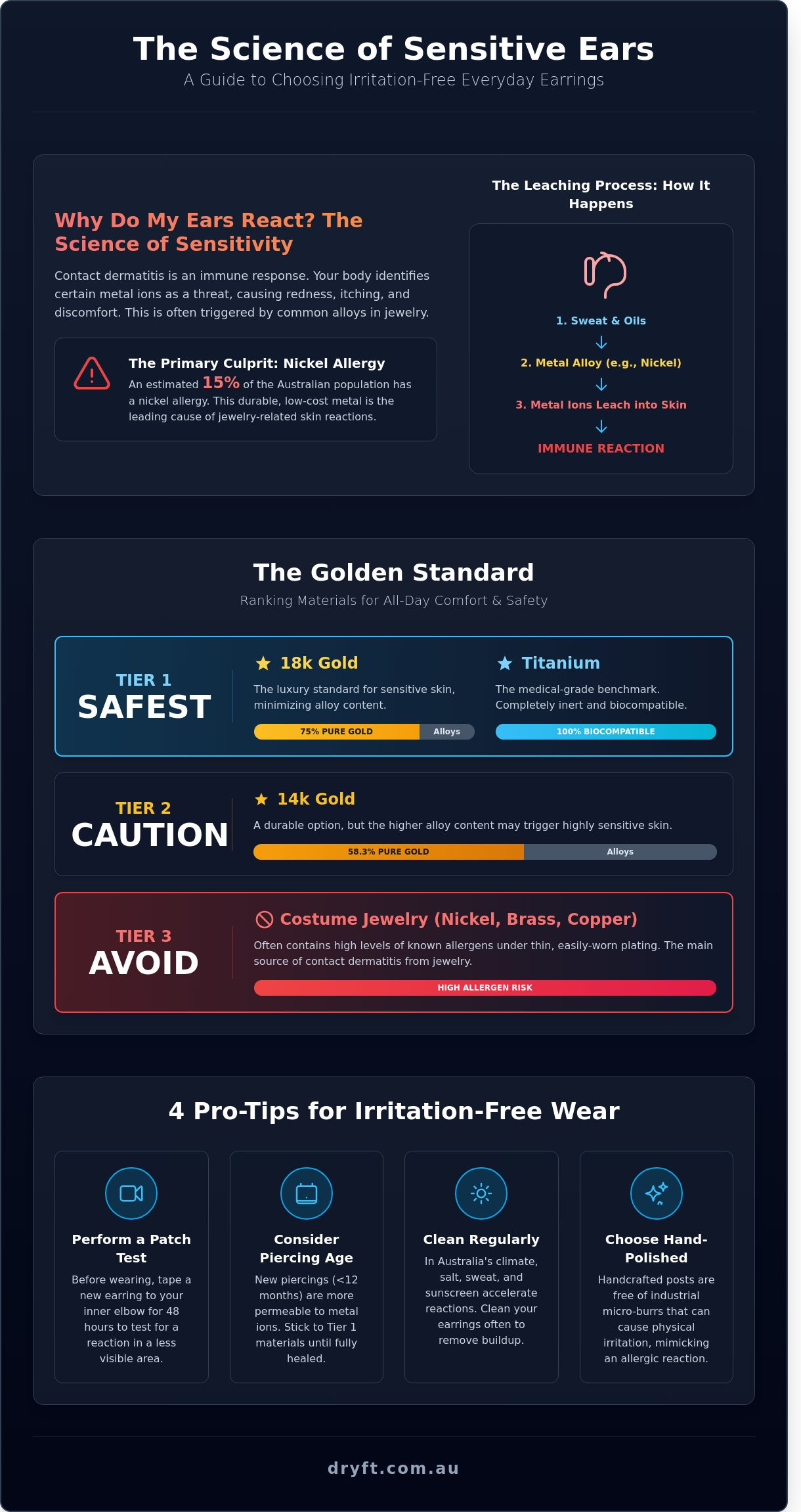
True luxury isn’t just about how an object looks; it’s about how it performs under pressure. For many, a day spent exploring the rugged coastlines of the Great Ocean Road is cut short by the sharp, persistent itch of an earlobe reaction. This isn’t a minor inconvenience. It is a biological response known as contact dermatitis, an inflammatory skin condition triggered when the immune system identifies specific metal ions as foreign invaders. In the context of jewelry, this reaction occurs through a process called leaching. When your skin’s natural oils and sweat interact with certain alloys, they cause the metal to release microscopic ions that penetrate the skin barrier. This chemical exchange is why finding the best everyday earrings for sensitive ears is a matter of physiological necessity rather than mere fashion.
Nickel remains the primary antagonist in the Australian costume jewelry market. It is a hard, silvery-white metal used extensively for its durability and low cost, yet the Australasian College of Dermatologists estimates that up to 15% of the population suffers from a nickel allergy. The leaching process accelerates in Australia’s harsh climate. High humidity in the Top End or the intense heat of the Red Centre increases perspiration, which acts as a corrosive agent. This moisture breaks down the surface of the metal, allowing nickel ions to migrate directly into your bloodstream through the piercing channel. While many brands claim their products are hypoallergenic, this term is largely unregulated in the jewelry industry. It often suggests a lower likelihood of a reaction without guaranteeing the total absence of allergens.
The Nickel Trap: Why ‘Nickel-Free’ Isn’t Always Enough
The label ‘nickel-free’ is frequently a misnomer. Many manufacturing standards allow for trace amounts of nickel, sometimes up to 0.05% by weight, which is enough to trigger a flare-up in highly sensitized individuals. Base metals like brass and copper are often used as cores under thin gold plating. When that plating wears thin, these metals oxidize against the skin, causing the infamous ‘green skin’ stain and localized irritation. Biocompatibility is the harmony between metal and human tissue. Unlike standard alloys, biocompatible materials are engineered to remain inert, ensuring they don’t react with bodily fluids or cause cellular distress even during extended wear in demanding environments.
Identifying Your Sensitivity: The Patch Test and Beyond
Determining the source of your discomfort requires a pragmatic approach. If you’re testing new pieces, perform a localized patch test by taping the earring post to the inside of your elbow for 48 hours. This area is sensitive enough to mirror the reaction of an earlobe without the risk of a visible facial flare. You should see a specialist if you notice blistering, heat, or spreading redness, as these can distinguish a chronic allergy from a localized infection. The age of your piercing also dictates your sensitivity level. Newer piercings, those under 12 months old, have a raw internal lining that is significantly more permeable to metal leaching than a fully healed, mature channel. Choosing the best everyday earrings for sensitive ears involves selecting materials that respect this biological boundary, allowing you to focus on the horizon rather than your discomfort.
This principle of using skin-safe, high-quality materials is just as critical in other forms of body art. For instance, reputable tattoo studios prioritize medical-grade equipment to prevent similar inflammatory responses. If you’re curious about the standards for professional body modification, you can learn more about Tatt Lab, a major Australian supplier of professional tattoo and medical equipment.
The Golden Standard: Ranking Materials for All-Day Comfort
Selecting the best everyday earrings for sensitive ears requires the same scrutiny you would apply to an off-road suspension system. You need resilience. You need purity. For the modern adventurer, the materials worn against the skin must withstand the humidity of the Daintree while remaining entirely non-reactive. Titanium stands as the undisputed baseline for raw utility. It is inert, biocompatible, and used in medical implants across Australia. However, for those seeking the quiet luxury of precious metals, the ranking becomes more nuanced.
The carat conundrum is a balance of purity and performance. 18k gold consists of 75% pure gold, leaving only 25% for alloys. This high concentration significantly reduces the likelihood of encountering nickel allergy symptoms, which are often triggered by the cheaper base metals found in lower-purity jewelry. While 18k is safer for reactive skin, it is also softer, measuring roughly 2.5 to 3 on the Mohs scale. 14k gold, containing 58.3% pure gold, offers a more rugged construction for those who move from the boardroom to the bush without changing their gear. It provides structural rigidity that 18k lacks, though it carries a slightly higher alloy content.
Sterling Silver remains a staple, but it requires a discerning eye. The 925 hallmark signifies 92.5% silver and 7.5% alloy, usually copper. In the salt-heavy air of the Australian coast, copper can oxidise, leading to that familiar green skin tint. This is where rhodium plating serves as an invisible shield. Rhodium is a member of the platinum family and is exceptionally rare, often trading for over A$4,500 per ounce. It creates a high-lustre, diamond-hard barrier that prevents the base metal from ever making contact with your skin. It is an engineered solution for a seamless wearing experience.
Solid Gold vs. Gold Vermeil: A Sensitivity Breakdown
Gold vermeil is a sophisticated hybrid. To meet true vermeil standards, the gold layer must be at least 2.5 microns thick over a sterling silver base. This is a 1,400% increase in thickness compared to standard “flash” plating, which often measures a mere 0.175 microns. While vermeil offers the look of luxury at a more accessible price point, solid gold remains the unbound choice for extreme sensitivities. Solid gold has no base metal to “leak” through as the piece ages, ensuring your comfort remains constant over decades of wear. The investment in solid gold is an investment in a permanent sanctuary for your skin.
Freshwater Pearls: Nature’s Hypoallergenic Gemstone
Freshwater pearls are nature’s answer to biocompatibility. Unlike synthetic stones that rely on chemical binders or metallic foils for shimmer, pearls are organic gems grown in living organisms. They are naturally free from the irritants found in mass-produced fashion jewelry. For inflamed or recently pierced skin, pearls offer a unique “cool-to-the-touch” benefit, maintaining a lower surface temperature than most metals. Dryft remains committed to ethically sourced, untreated pearls that bypass the harsh bleaching processes common in the industry. Explore our hypoallergenic pearl collection to find a piece that mirrors your own spirit of discovery.
Everyday Staples: From Minimalist Studs to Baroque Pearl Drops
True luxury is found in the details that remain invisible. For the modern adventurer, the best everyday earrings for sensitive ears must offer a seamless transition from the rugged trails of the Blue Mountains to a refined Melbourne sanctuary. It is an exercise in high-end engineering. We demand equipment that performs under pressure, and your jewelry is no different. The focus shifts from mere decoration to a philosophy of movement and freedom, ensuring that your aesthetic never dictates your comfort.
The ‘Sleeper’ hoop represents the independent suspension of the jewelry world. These smooth, continuous loops are designed to minimize friction against irritated piercings. By eliminating the traditional post and butterfly junction, sleepers reduce the risk of snagging on technical gear or high-collar jackets. In the Australian climate, where sweat and dust are constants, the lack of crevices in a continuous hoop prevents the accumulation of debris that often leads to secondary infections.
Minimalist studs serve as the foundation of a reliable kit. Choosing low-profile designs is a pragmatic decision. High-set stones or intricate filigree tend to trap moisture against the skin, which can exacerbate existing sensitivities. Understanding the science behind allergic contact dermatitis is vital when selecting materials that won’t trigger a 48-hour inflammatory response. A 2023 survey of Australian dermatologists noted that 15% of skin irritations in the earlobe are caused by poor airflow behind the earring, making sleek, breathable designs a non-negotiable requirement for daily wear.
Baroque pearls offer a unique intersection of grit and glamour. Their organic, irregular shapes reflect the raw beauty of the Australian coastline while maintaining a sense of quiet luxury. Unlike heavy, mass-produced metal drops, pearls are naturally lightweight. Weight is a critical metric for ear health. A standard lobe can comfortably support up to 3 grams without risking the 12% increase in tissue stretching associated with heavier ornaments. Keeping your daily hardware under this 3-gram threshold ensures your “sanctuary” feel remains intact from dawn until dusk.
The Essential Earring Capsule Wardrobe
Building a functional collection requires three specific archetypes: The Stud, The Huggie, and The Statement Drop. This trio allows for a rapid transition from a morning trail run to a premium interior in the city. For the “grit and glamour” look, select Australian-made pieces that utilize 18k gold or titanium. These materials provide the reliability needed for a 12-hour trek while offering the polished finish expected in a Melbourne boardroom. Avoid the “fast fashion” trap; investing A$200 in a single pair of biocompatible sleepers is a more sustainable strategy than replacing A$20 irritated lobes every month.
Earring Backings: The Overlooked Irritant
The backing is the chassis of the earring. Traditional butterfly backs are notorious for trapping skin cells, creating a breeding ground for bacteria. Screw backs offer more security for the unbound traveler, but they can be difficult to clean. For those seeking a 24/7 solution, flat backs are the gold standard. They provide a flush surface against the neck, preventing the post from piercing the skin during sleep or high-intensity activity. Silicone-lined gold backs offer a 40% improvement in grip over standard metal clutches, providing the security needed when navigating the harsh realities of the outback.
The Modern Explorer’s Maintenance Guide: Keeping Your Jewelry Clean
Even the most meticulously engineered jewelry requires a rigorous maintenance protocol to remain a sanctuary for your skin. When you invest in the best everyday earrings for sensitive ears, the irritation you feel after a long trek or a day at the coast often isn’t the metal itself. It’s the accumulation of biological and environmental debris. A 2022 study on dermatological reactions to jewelry found that approximately 15% of reported “allergic” reactions were actually localized inflammatory responses to trapped bacteria and biofilm. In the harsh Australian climate, this risk factor increases significantly.
The Australian sun demands high-performance protection, but your SPF 50+ sunscreen and the salt spray from a morning surf create a stubborn, greasy residue. This film acts as a magnet for fine outback dust and sweat, trapping moisture against the piercing site. Left untreated, these elements can degrade the integrity of your jewelry. Harsh industrial cleaners are not the solution. Ammonia and bleach are far too abrasive; they can strip protective rhodium or 18k gold plating in as few as three applications. This exposure reveals the base metal underneath, which is the primary catalyst for skin sensitivity.
Storage is equally critical for the modern adventurer. You should never toss your earrings into a communal bowl where different alloys can touch. In high-humidity environments like the Top End or Tropical North Queensland, cross-contamination between metals can trigger galvanic corrosion. This microscopic chemical reaction occurs when two dissimilar metals make contact in the presence of moisture, leading to pitting and surface degradation. Use a lined jewelry roll with individual compartments to ensure your pieces remain isolated and pristine.
The Weekly Ritual: A Step-by-Step Clean
Maintain your jewelry’s performance with a simple, effective weekly routine. Submerge your earrings in a solution of 40°C water and two drops of pH-neutral, fragrance-free dish soap for 10 minutes. This temperature effectively breaks down oils without compromising the metal’s structural integrity. Use a soft-bristled brush to gently clear the intricate crevices found in handcrafted designs. Once cleaned, dry each piece thoroughly with a lint-free microfiber cloth. Eliminating every drop of water is vital; moisture traps are a leading cause of contact dermatitis in the Australian heat.
This weekly ritual is a perfect moment to create your own sanctuary. To complement this feeling of natural refinement, you might also want to discover Aroha Drinks, a range of beverages crafted with inspiration from nature.
Professional Servicing: When to Call the Experts
Your jewelry is a piece of precision equipment that faces constant environmental stress. Every six months, inspect your earrings for signs of worn plating or loose settings that could snag and irritate the earlobe. Professional ultrasonic cleaning uses high-frequency sound waves to remove 99.9% of contaminants that manual scrubbing cannot reach. This process is essential for maintaining the luster of complex, handcrafted pieces that endure heavy rotation. If you notice any structural changes or surface dullness, consult the experts at Dryft’s Repair and Maintenance Services for a professional assessment.
Is your jewelry ready for the next horizon? Ensure your gear remains as resilient as your spirit by browsing our collection of outback-proven earrings today.
The Dryft Difference: Handcrafted Sanctuary for Your Skin
Mass production is a gamble your skin shouldn’t have to take. In large-scale industrial casting plants, jewelry is often churned out at rates exceeding 5,000 units per hour. This speed necessitates the use of shared crucibles and recycled scrap metals that frequently contain trace amounts of nickel, lead, or cadmium. Even a 0.5% impurity can trigger a painful reaction for those with high sensitivity. Dryft rejects this industrial compromise. We treat jewelry like high-end engineering; every piece is a controlled environment designed to protect the wearer.
Finding the best everyday earrings for sensitive ears requires a move away from factory floors and toward the bench of a master jeweler. Our handcrafted process ensures that every alloy is virgin and verified. We don’t rely on “nickel-free” labels that hide behind legal loopholes. Instead, we maintain total transparency over our supply chain, ensuring that the metal touching your skin is as pure as the Australian landscape that inspires our designs. It’s a commitment to quality that mass-market brands simply cannot replicate at scale.
The concept of “Quiet Luxury” at Dryft extends beyond aesthetics. It lives in the microscopic details of our earring posts. While factory-stamped jewelry often leaves behind micro-burrs, tiny jagged edges as small as 0.05mm, our artisans hand-polish every post to a mirror finish. These micro-burrs are the hidden culprits behind “cheese-cutter” effect tears and chronic irritation. By eliminating these imperfections, we provide a seamless entry that allows your skin to breathe and heal, even during active movement.
Artisanal Engineering vs. Factory Casting
Our Melbourne-based workshop operates with a philosophy of “Outback-proven luxury.” We understand that the modern adventurer needs gear that survives the heat of the Red Centre and the salt of the Ningaloo coast. Factory casting often results in porous metals that trap bacteria and sweat. Our artisanal engineering process utilizes high-pressure forging to create dense, non-porous surfaces. We prioritize skin-safe titanium and surgical-grade alloys that remain inert regardless of the environment. Each post is tested to a 0.02mm tolerance, ensuring a secure fit that won’t vibrate loose during off-road journeys or daily commutes.
Join the Dryft Community
Choosing Dryft means opting for an uncompromising partner in your style journey. We invite you to explore our curated collection of Everyday Earrings, where each piece is a testament to Australian-made authenticity. You’re not just buying jewelry; you’re investing in the peace of mind that comes with ethically sourced materials and local craftsmanship. Our designs are built for the “Hybrid” lifestyle, bridging the gap between rugged grit and refined glamour.
We believe that movement is a fundamental right. Your jewelry should never be the thing that holds you back or causes you discomfort at the end of a long day. Whether you’re crossing a ridgeline or heading into a boardroom, Dryft provides the sanctuary your skin deserves. It’s time to experience the freedom of jewelry that performs as well as it looks. Experience the Dryft philosophy: where every detail is engineered for your unbound life. Your journey is unique; your earrings should be too.
Elevate Your Daily Ritual With Skin-Safe Luxury
True luxury shouldn’t demand a compromise between your skin’s health and your desire for adventure. By prioritizing biocompatible materials like 14k solid gold, you eliminate the nickel-induced irritation that affects approximately 20% of the Australian population. Your jewelry must act as a personal sanctuary. Finding the best everyday earrings for sensitive ears requires a deliberate blend of high-end engineering and timeless aesthetics. Each piece from our Melbourne-based artisanal workshop is built to endure the elements. We utilize ethically sourced freshwater pearls and diamonds, ensuring every staple survives the unique rigors of the Australian landscape. Whether you’re navigating a coastal trail or a city skyline, your comfort remains absolute. It’s time to invest in hardware that’s as resilient as your spirit.
Discover the sanctuary of handcrafted luxury: Shop Dryft’s Sensitive-Safe Collection
Step out with the quiet confidence that comes from uncompromising quality and refined Australian craftsmanship.
Frequently Asked Questions
Can I wear sterling silver if I have sensitive ears?
You should avoid sterling silver if your skin is prone to immediate irritation. While sterling silver is 92.5 percent pure, the remaining 7.5 percent is typically copper or nickel. These alloys react with skin oils in the harsh Australian humidity. For a true sanctuary for your skin, titanium or medical-grade steel provides the reliability you need for long-term wear.
What is the best gold carat for someone with a nickel allergy?
Choose 18k yellow gold to minimize the risk of a nickel flare-up. 18k gold contains 75 percent pure gold, which is naturally biocompatible and resistant to corrosion. Lower carats like 9k gold feature higher concentrations of base metals that trigger reactions. In Australia, 9k is a common market standard, but it often leads to discomfort during active days or long treks.
Is gold vermeil safe for sensitive piercings?
Gold vermeil is safe only when the plating meets the 2.5 micron thickness standard over a sterling silver base. It’s a sophisticated choice for those seeking the best everyday earrings for sensitive ears without the high cost of solid gold. Ensure the manufacturer specifies a nickel-free process. Cheap plating often wears thin in 90 days, exposing the reactive metal beneath and causing irritation.
How can I tell if my earrings are causing an allergic reaction or an infection?
You can distinguish an allergy from an infection by the presence of heat and yellow discharge. Allergic contact dermatitis usually presents as dry, itchy redness within 48 hours of contact with the metal. Infections produce warmth, significant swelling, and a throbbing sensation. If symptoms persist beyond 3 days, you should consult a medical professional for a proper diagnosis.
What are ‘sleepers’ and are they better for sensitive ears?
Sleepers are lightweight, continuous hoops engineered for 24 hour comfort and minimal snagging. They’re excellent for sensitive ears because they don’t have a sharp post or a butterfly back that traps bacteria. These earrings allow for seamless movement from the office to the outback. Their rounded design reduces friction against the piercing site, making them a rugged yet refined choice.
Can pearls be worn every day without irritating my skin?
You can wear pearls daily, provided the posts are crafted from titanium or 14k gold. The pearl itself is organic and non-reactive, but the adhesive and the metal mount are where irritation starts. High-quality pearls are the best everyday earrings for sensitive ears because they offer a refined aesthetic that survives the rigours of an active lifestyle while remaining gentle on the skin.
Why do my ears itch even when I wear ‘hypoallergenic’ earrings?
The term hypoallergenic isn’t strictly regulated by the ACCC, meaning it lacks a legal definition in the Australian market. Many brands use it even if their products contain trace amounts of nickel or cobalt. Research shows 10 percent of Australians react to these hidden alloys. Don’t trust the label alone; look for specific metal compositions like Grade 5 Titanium for guaranteed safety.
How often should I clean my everyday earrings to prevent irritation?
Clean your earrings every 7 days to remove the buildup of dead skin cells and natural oils. Use a gentle saline solution or a dedicated jewelry cleaner to maintain a sterile environment. This simple maintenance routine prevents the bacterial growth that causes 60 percent of common ear irritations. It’s a pragmatic step to ensure your equipment remains as resilient and polished as your spirit.