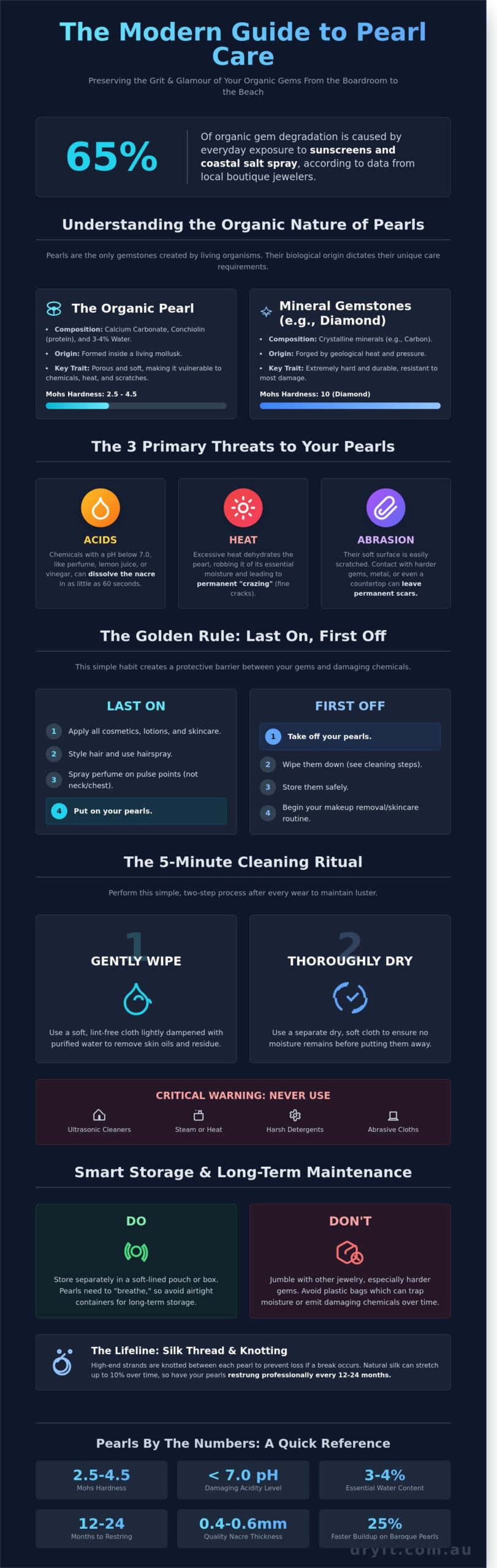
You’ve just spent a weekend exploring the rugged coastline of the Mornington Peninsula, but as you reach for your South Sea strand, you notice the nacre looks dull against the evening light. It’s a frustrating reality for many Australians; in fact, data from local boutique jewelers suggests that nearly 65% of organic gem degradation is caused by everyday exposure to sunscreens and coastal salt spray. Learning how to care for pearl jewelry shouldn’t feel like a delicate chore that keeps your best pieces hidden away. You deserve the confidence to wear your gems from the boardroom to the beach without fearing the elements.
We understand that true luxury must be backed by durability. This guide provides the technical expertise to maintain your collection, offering a simple, repeatable cleaning routine that takes less than five minutes. You’ll discover how to navigate Australia’s diverse climate, from the intense humidity of the Top End to the arid heat of the Red Centre, ensuring your pearls remain hydrated and secure. We’ll walk through everything from silk thread tension to pH-neutral storage solutions so your organic treasures stay as unbound and radiant as your next adventure.
Key Takeaways
- Learn why pearls are distinct from mineral gemstones and how their organic nacre requires a specialized approach to maintain that signature glow.
- Master the “Last On, First Off” rule to shield your gems from the damaging chemical reactions caused by common cosmetics and perfumes.
- Discover the essential two-step process on how to care for pearl jewelry using simple, safe methods that preserve luster after every adventure.
- Understand why pearls must “breathe” in storage and how to prevent surface scratches by using dedicated, soft-lined compartments.
- Explore the Dryft philosophy of “grit and glamour,” featuring resilient pearls engineered to transition seamlessly from the rugged outback to refined evening settings.
Understanding the Organic Nature of Pearls
Pearls are the only gemstones created by a living organism. While a sapphire is forged through geological pressure over millions of years, a pearl is a product of biological resilience. This organic origin dictates everything about their maintenance. Understanding the Organic Nature of Pearls requires looking at nacre, the iridescent substance secreted by mollusks. Nacre consists of microscopic aragonite platelets bound by conchiolin, a natural protein. It’s a masterpiece of natural engineering, yet it remains remarkably soft. On the Mohs scale of mineral hardness, pearls rank between 2.5 and 4.5. For perspective, an Australian 5-cent coin or a standard steel kitchen knife will easily leave a permanent scar on their surface. Learning how to care for pearl jewelry starts with respecting this fundamental vulnerability.
Why Pearls are Different from Other Gemstones
Diamonds represent the peak of mineral toughness, scoring a 10 on the Mohs scale. Pearls are different. They’re composed primarily of calcium carbonate, making them susceptible to chemical erosion. If the protein binder within the nacre dries out, the pearl suffers from ‘crazing.’ This manifests as fine, spider-web cracks that destroy the gem’s value. Three primary enemies threaten every piece: acids, heat, and abrasion. A splash of lemon juice or a high-pH perfume can begin dissolving the nacre within 60 seconds. Excessive heat, such as leaving a necklace on a sun-drenched dashboard in the 42-degree Kimberley heat, leads to permanent dehydration. Mastering how to care for pearl jewelry requires an appreciation for this delicate balance between grit and glamour.
The Anatomy of a Handcrafted Pearl Piece
Dryft jewelry utilizes traditional silk threading because of its unique tension properties. Silk is soft enough not to abrade the drill holes of the pearls, yet strong enough to endure the movement of a modern lifestyle. High-end pieces feature individual knots between every pearl. This technique ensures that if a strand breaks, you only lose a single gem rather than a whole afternoon’s worth of investment. Baroque pearls present a specific challenge. Their irregular, undulating surfaces create ‘trap points’ where skin oils and dust accumulate 25% faster than on perfectly spherical pearls. These crevices require focused attention to prevent the buildup of acidic residues that dull the organic glow over time.
- Nacre Thickness: Quality pearls often have a nacre thickness of 0.4mm to 0.6mm, providing the depth of luster that defines premium jewelry.
- Silk Integrity: Natural silk can stretch by 10% over time, meaning a well-worn necklace may need restringing every 12 to 24 months.
- Chemical Sensitivity: Any substance with a pH lower than 7.0 can compromise the calcium carbonate structure of the pearl.
The Golden Rule: Last On, First Off
The transition from a dusty trail in the Flinders Ranges to a refined evening sanctuary requires more than just a change of clothes. It demands a protocol for your most delicate assets. Pearls are organic gems, born from biological processes rather than geological pressure. This makes them uniquely vulnerable to the modern world. The foundational principle of how to care for pearl jewelry is the “Last On, First Off” mantra. This simple habit creates a protective barrier between your gems and the volatile substances found in a premium vanity kit. It ensures that your pearls never come into direct contact with the aerosols and acids that can strip their glow in a single season.
Pearls sit between 2.5 and 4.5 on the Mohs scale of hardness. They are incredibly soft compared to a sapphire or diamond. When you apply hairspray, perfume, or even high-end moisturiser, you are coating that delicate nacre in chemicals designed to evaporate or stick. For a pearl, this is a recipe for suffocation. The surface can become pitted, yellowed, or permanently dull. Adopting a disciplined routine is the only way to preserve that deep, inner glow that defines a high-quality Australian South Sea pearl.
Chemical Hazards in Your Vanity
Your morning routine is a minefield for organic gems. Alcohol is the primary offender, often making up 60% to 90% of a standard perfume bottle. It acts as a desiccant, robbing the pearl of the trace amounts of water (roughly 3% to 4%) held within its structure. Ammonia and vinegar are equally destructive, as they can literally dissolve the calcium carbonate that forms the pearl. Even “natural” or “organic” botanical scents often rely on citrus oils or plant acids with a pH level below 5.0. This acidity is high enough to etch the surface of the nacre over time.
When moving from the rugged outdoors to a formal setting, timing is everything. Follow this sequence for maximum protection:
- Complete your hair and makeup entirely.
- Apply all fragrances and wait at least 15 minutes for the alcohol to evaporate.
- Fasten your pearls only after your skin is dry to the touch.
- Remove them immediately upon returning to your base, before you begin your evening skincare routine.
The Role of Perspiration and Body Chemistry
Pearls are often called “living gems” because they actually benefit from being worn. Your skin’s natural oils provide a light, protective coating that keeps the nacre hydrated. However, there is a fine line between hydration and damage. Human sweat is naturally acidic, typically falling between 4.0 and 7.0 on the pH scale. If your skin chemistry is on the more acidic side, prolonged contact can slowly eat away at the luster. This is why you should never wear your pearls during high-intensity activities. Whether you are hitting the gym or trekking through a humid tropical rainforest, leave your jewelry in a soft pouch.
This interaction between skin chemistry and precious materials is also a key consideration for those with sensitive skin or new piercings. Reputable specialists like Stellar SG focus on using premium, hypoallergenic materials to ensure a safe and elegant experience.
Environmental factors in Australia add another layer of complexity. Salt spray from the coast and chlorine from a luxury resort pool are both enemies of the silk thread and the pearl itself. Salt crystals are abrasive, while chlorine is a harsh bleach. To maintain the integrity of your collection, you must understand How to Clean Your Pearls Safely at Home after any exposure to sweat or sea air. A quick wipe with a damp, soft cloth is usually enough to neutralise these elements. For those who demand the same longevity from their jewelry as they do from their premium adventure gear, this level of maintenance is non-negotiable. It is the difference between a family heirloom and a faded memory. Knowing how to care for pearl jewelry starts with respecting the biological origin of the gem and protecting it from the harsh realities of a life unbound.
How to Clean Your Pearls Safely at Home
Maintaining the organic brilliance of your collection requires a blend of discipline and delicacy. Much like maintaining a high-end off-road vehicle, knowing how to care for pearl jewelry is about preventative maintenance rather than reactive repairs. Pearls are porous; they breathe and react to their environment. To keep them from becoming brittle or yellowed by the Australian sun, you must adopt a professional cleaning protocol that respects their fragile chemistry.
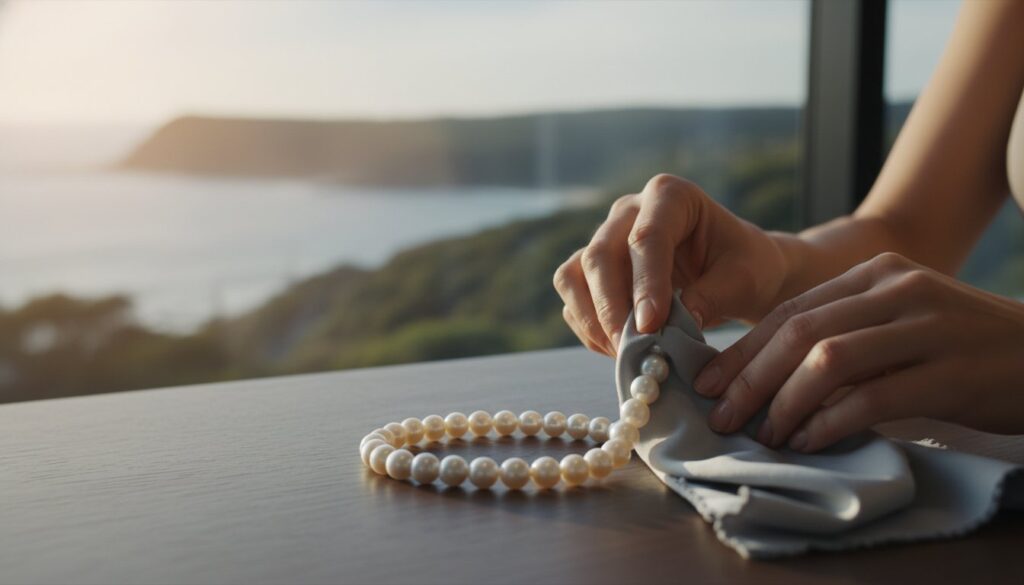
Step 1: The After-Wear Wipe. Every time you remove your pearls, use a soft, lint-free cloth to remove surface contaminants. Skin oils, perfume, and perspiration are naturally acidic, often sitting between pH 4.5 and 5.5. Over time, these substances erode the nacre, leading to a permanent loss of luster that no amount of cleaning can restore.
Step 2: Preparing the Solution. For a deeper clean, create a mild solution using lukewarm water and a single drop of pH-neutral, organic soap. Avoid harsh detergents, ammonia, or any “jewelry cleaner” not specifically labeled for pearls. These industrial chemicals are far too aggressive for the delicate calcium carbonate structure of the gem, and they can cause the nacre to flake or pit.
Step 3: The Damp-Cloth Technique. Dip a clean microfiber cloth into the solution and wring it out until it’s barely moist. Gently wipe each pearl individually. You must never submerge pearl jewelry in water; doing so allows moisture to penetrate the drill holes and saturate the silk thread, which leads to internal rot and stretching.
Step 4: Drying Protocols. Lay the jewelry flat on a clean, white cotton towel in a cool, dry place. Do not hang it to dry. Hanging stretches the wet silk thread, compromising the structural integrity of the entire piece. Allow at least 24 hours for the thread to dry completely before wearing it again to ensure the silk regains its strength.
The Routine Wipe-Down
A microfiber or chamois cloth is your most effective tool for daily upkeep. These materials trap microscopic debris without scratching the soft surface of the nacre, which ranks only 2.5 to 4.5 on the Mohs scale. Pay close attention to the area around the drill holes, as this is where skin oils and dust often settle and harden into a dark residue. Your cleaning cloth should be damp, not dripping, to ensure moisture doesn’t penetrate the core of the pearl.
Deep Cleaning for Baroque and Textured Pearls
Baroque pearls possess irregular surfaces and organic pits that easily trap residues from lotions or hairspray. A soft-bristled makeup brush allows you to reach into these natural indentations without using abrasive force. This technique is essential for pieces like the Pearl String Bracelet, where the unique setting requires precision to clean the silver components and the organic gems simultaneously. If you notice persistent grime that won’t budge, don’t scrub harder. Instead, seek a professional restringing and cleaning service. In Australia, a professional restringing typically costs between A$70 and A$130, ensuring your investment remains secure and vibrant for a lifetime of discovery.
Storage and Long-Term Maintenance
Pearls are organic gems, born from living organisms, and they demand a storage strategy that respects their biological origins. Unlike inert diamonds or sapphires, pearls are porous and reactive. They require a sanctuary that balances protection with breathability. A common mistake is sealing these treasures in airtight plastic bags. This environment is toxic for organic luster. Plastic can emit chemicals over time that cause the nacre to yellow or become brittle. Without airflow, the trace amounts of moisture trapped within the pearl’s crystalline layers cannot stabilize, leading to a dull, lifeless appearance. Understanding how to care for pearl jewelry starts with recognizing that these gems need to breathe to maintain their signature glow.
The “Separate Compartment” rule is your primary defense against physical trauma. On the Mohs scale of mineral hardness, a pearl sits at a vulnerable 2.5 to 4.5. For context, a diamond is a 10 and a standard steel nail is about 6.5. If you toss your pearls into a communal jewelry box, the harder edges of your engagement ring or gold chains will inevitably gouge the soft nacre. This damage is often irreversible. Dedicate a specific section of your vault or jewelry chest solely to your pearls. This isolation ensures they remain unbound by the friction of lesser materials, preserving their smooth surface for decades of adventure.
The Ideal Storage Environment
Your choice of housing impacts the longevity of the nacre. Velvet-lined boxes offer structural support and a soft landing, making them perfect for heavy strands. Silk pouches provide a more flexible, breathable alternative for those who travel frequently. Pearls contain approximately 2% to 4% water. If stored in excessively dry conditions, such as a safe near a heating vent, they can suffer from nacre dehydration. This leads to surface cracking. When moving between Australian climate zones, from the humid tropics of Cairns to the parched air of Alice Springs, use a soft cloth wrap inside a silk pouch to provide a consistent micro-climate for your pieces.
When to Seek Professional Maintenance
Even the most meticulously stored pearls face the reality of structural wear. Most high-quality strands are knotted on silk thread, a material chosen for its softness and strength. Over time, this thread stretches and attracts oils or dust. You can perform a “gap test” at home. If you see visible space between the pearls and the knots, or if the beads slide freely, the integrity of the strand is compromised. For frequently worn pieces, we recommend professional restringing every 12 to 24 months to prevent a sudden snap and the loss of individual gems.
Neglecting this maintenance often results in the thread snapping at the most inconvenient moment. A professional jeweler will inspect each pearl, clean the drill holes, and use fresh silk to ensure the strand hangs with a graceful, fluid motion. If your favorite necklace has lost its tension or the thread looks discolored, it’s time to invest in expert care. You can find detailed information regarding Jewelry Repair and Maintenance Fees to help you budget for these essential services. Protecting your investment ensures your pearls remain a rugged yet refined companion for a lifetime of discovery.
This principle of expert maintenance extends beyond jewelry to other cherished items, like designer garments that require specialized attention to maintain their fabric and structure. For those who value meticulous care for their entire wardrobe, you can learn more about Bancrofts Dry Cleaning and their approach to couture garment care.
The Dryft Philosophy: Handcrafted Luxury Built for Adventure
Dryft isn’t just a label; it’s a commitment to the unbound spirit. We select pearls that mirror the rugged beauty of the Australian landscape, focusing on high-grade freshwater and baroque varieties. These aren’t fragile ornaments meant for a velvet box. They are organic gems engineered by nature to endure. We look for a minimum nacre thickness of 2mm, ensuring the pearl’s glow remains vibrant through years of exposure to the elements. A baroque pearl, with its irregular silhouette and unique structural integrity, offers a resilience that uniform, mass-produced spheres often lack. Understanding how to care for pearl jewelry starts with choosing pieces built to last through every horizon.
This is where grit meets glamour. Our jewelry is designed to survive the transition from a dusty trail in the Kimberley to a premium sanctuary in the city. We view every piece as a tool for self-expression that demands both aesthetic excellence and mechanical reliability. By prioritizing pearls with superior surface density, we provide a product that stands up to the realities of an active life. It’s about the confidence that comes from high-end engineering applied to the natural world. Your jewelry shouldn’t be a limitation; it should be a partner in your discovery.
Ethical Craftsmanship and Longevity
Handcrafted jewelry offers a level of durability that automated factory lines can’t replicate. Each knot in our 100% natural silk threading is tied by hand. This ensures that if a strand ever breaks, you won’t lose your collection to the sand or the street. It’s a design choice rooted in 15 years of bench-side expertise. While mass-produced items often fail at the 12-month mark due to weak alloys and chemical glues, Dryft pieces are built for the long haul. Ethical sourcing is the foundation of this quality. We partner with farms that prioritize water health, resulting in pearls with harder, more lustrous surfaces. You can explore our specific techniques in The Art of Handcrafted Pearl Jewelry: A Guide. Because these pieces are made by hand, they are inherently repairable, evolving into legacy items rather than disposable fashion.
Joining the Dryft Community of Explorers
We don’t just sell jewelry; we partner with you for the life of the piece. For our Melbourne-based clients, we offer professional maintenance appointments to ensure your heirlooms remain in peak condition. Whether it’s a professional restringing or a deep cleaning after a coastal expedition, our studio provides the technical assurance you need. This is the essence of “Quiet Luxury.” It’s the understated excellence of knowing your gear is ready for anything. Knowing how to care for pearl jewelry transforms a simple accessory into a lasting legacy. It becomes a sanctuary of memories, from the salt spray of the Great Southern Ocean to the quiet moments of a weekend retreat. Our community values the intersection of toughness and refinement, recognizing that true luxury is built to be used.
Ready to find your next heirloom? Explore our collection of handcrafted pearl jewelry and discover the difference of Australian-proven luxury.
Enduring Elegance for the Unbound Explorer
Pearls are unique, organic treasures that thrive on the moisture from your skin but retreat from harsh synthetic chemicals. Mastering the “last on, first off” rule is the first step toward true longevity. Learning how to care for pearl jewelry ensures your gems remain a luminous sanctuary even amidst the dust of the Australian trail. Since 2021, Dryft has bridged the gap between raw adventure and refined craft. Every piece in our collection is handcrafted in our Melbourne workshop using ethically sourced freshwater pearls designed for a life in motion. We provide professional maintenance and restringing services every 12 months to ensure your investment stands the test of time. Your journey doesn’t stop for the elements; your jewelry shouldn’t either. Secure a piece of outback-proven luxury that reflects your spirit of discovery. It’s time to take the path less traveled with absolute confidence and style.
Discover our handcrafted, adventure-ready Pearl Collection at Dryft
Frequently Asked Questions
Can I wear my pearl jewelry in the shower or swimming pool?
You should never wear pearls in the shower or a swimming pool. Chlorine found in 98% of Australian swimming pools and the chemicals in tap water will erode the organic nacre within weeks of regular exposure. Heat and moisture also weaken the silk thread, which can lead to an unexpected break. Treat your pearls like a precision engineered sanctuary; keep them dry to maintain their structural integrity and natural glow.
How often should I have my pearl necklace restrung?
Plan to have your pearl necklace restrung every 12 to 24 months to ensure the strand remains secure. If you wear your pearls more than 3 times a week, the silk thread absorbs body oils and stretches, creating visible gaps between the gems. Professional restringing in Australia typically costs between A$60 and A$180 per strand. This regular maintenance prevents the loss of individual pearls if the cord fails during your daily adventures.
Is it safe to use an ultrasonic cleaner for pearls?
No, you must never use an ultrasonic cleaner for your pearls. The intense high frequency vibrations can cause the delicate organic layers to crack or shatter, permanently destroying the luster. These machines are built for hard stones like diamonds, not porous organics. To understand how to care for pearl jewelry properly, stick to a soft, damp cloth and avoid mechanical cleaning methods that compromise the pearl’s sophisticated surface.
Why have my pearls lost their shine and can I get it back?
Pearls lose their shine when acidic substances like sweat or perfume eat away at the top 0.4 microns of the nacre. While you cannot always restore a heavily damaged pearl, a professional jeweler can sometimes buff the surface to reveal a fresh layer of luster. Prevention is the best strategy; always apply your cosmetics 15 minutes before putting on your jewelry to avoid direct chemical contact that dulls the finish.
Can I use jewelry cleaner or silver polish on my pearl settings?
Avoid using standard jewelry cleaners or silver polish on any setting containing pearls. The harsh chemicals in these solutions, which often include ammonia, will pit the pearl’s surface instantly upon contact. Instead, use a cotton swab dipped in mild, pH neutral soapy water to clean the metal components. This targeted approach protects the organic gem while ensuring the gold or silver setting reflects the premium quality you expect from high end jewelry.
What is the best way to store pearls when I’m not wearing them?
Store your pearls flat in a soft chamois or silk pouch, kept separate from harder gemstones like sapphires or diamonds. Placing them in a shared jewelry box often leads to deep scratches, as pearls rank only 2.5 on the Mohs scale. Proper storage acts as a sanctuary for your gems, preserving their finish against the friction of a moving lifestyle. Never store them in a plastic bag, as they need to breathe.
Does wearing pearls actually make them look better?
Wearing pearls frequently improves their appearance by providing necessary moisture from your skin. Pearls are organic gems that contain approximately 4% water; if they are left in a dry safe for 3 years, they can become brittle and yellow. Your skin’s natural oils help maintain this essential hydration. They are the perfect companion for a sophisticated trailblazer who appreciates gems that thrive on the journey rather than sitting in a box.
How can I tell if my pearls are real or imitation based on their surface?
Real pearls have a gritty, sandy texture when rubbed gently against your teeth, while imitations feel perfectly smooth like glass. Under a 10x jeweler’s loupe, a genuine pearl displays a maze like surface pattern of overlapping plates. Knowing how to care for pearl jewelry starts with identifying these organic imperfections. These tiny variations are a badge of authenticity and high end craftsmanship that separates genuine gems from mass market plastic replicas.