
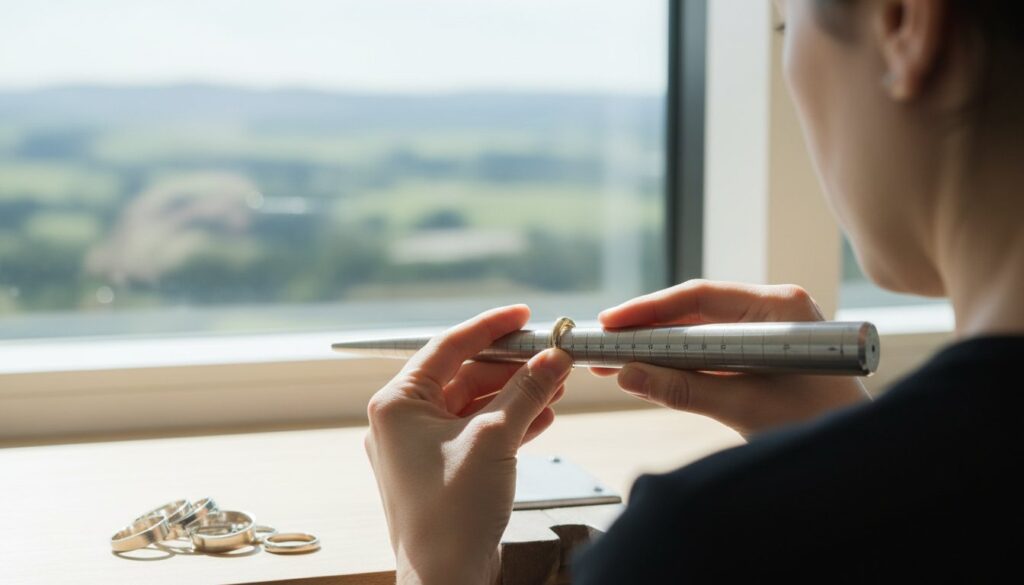
What if the difference between a secure heirloom and a lost investment is exactly 0.4 millimetres? When you’re navigating a remote coastal track or enjoying a quiet sanctuary by the fire, the last thing you want is a loose band sliding off. We understand the hesitation of investing in a custom piece only to find the fit is off. It’s a common frustration; research indicates that nearly 40 percent of online jewellery purchases require resizing due to basic measurement errors. Learning how to measure ring size with technical precision is the only way to ensure your piece stands the test of time and terrain.
You likely already know that the Australian climate demands extra consideration, as heat can cause fingers to swell by a full millimetre during a typical 35 degree afternoon. This guide eliminates the confusion between US numerical scales and the Australian alphabetical system. We’ll provide you with professional methods to capture a precise measurement and translate it into a confident AU letter size. You’ll also learn the exact amount of resistance needed to clear the knuckle while maintaining a comfortable grip. Let’s secure your next discovery with total technical assurance.
Key Takeaways
- Understand why precision is the foundation of a comfortable fit for bespoke pieces designed to endure the rugged Australian landscape.
- Master how to measure ring size using tactical at-home methods that ensure your handcrafted sanctuary fits perfectly from the very first moment.
- Learn to navigate the Australian alphabetical sizing system, converting technical millimetre measurements into the correct letter grade with expert accuracy.
- Discover how environmental factors and local temperature fluctuations can alter your finger’s profile, ensuring your ring remains secure through every adventure.
- Align your measurement standards with Dryft’s high-end engineering to guarantee a lifetime of performance from your ethically sourced jewelry.
The Foundation of Fit: Why Accurate Ring Sizing Matters
A ring is more than a simple adornment; it is a personal statement designed to endure the rigours of daily life. Whether you are navigating the city streets or attending a gala in Sydney, your jewelry must perform with the same reliability as a finely crafted timepiece. Understanding how to measure ring size ensures that your piece remains a permanent companion rather than a liability. A ring that fits poorly is a distraction. If it is too loose, you risk losing a precious heirloom to the depths of a busy day. If it is too tight, it becomes a restriction that hampers your comfort and freedom of movement.
Precision is the bedrock of high-end craftsmanship, especially when it comes to bespoke jewelry. At Dryft, we view the creation of a ring as a technical challenge where 0.1mm can be the difference between perfection and discomfort. For this reason, mastering how to measure ring size is the essential first step in our bespoke engagement ring design process. When a piece is handcrafted specifically for your hand, the dimensions must be absolute. We build jewelry to last a lifetime of cherished moments, and that journey begins with an accurate baseline.
Finding the equilibrium between comfort and security is a delicate art. Your ring should slide over the knuckle with a slight friction but sit comfortably at the base of the finger without spinning. In the Australian climate, fingers often swell in the heat of a Queensland summer and shrink during a Victorian winter. A professional fit accounts for these fluctuations, ensuring the band stays put during daily wear while remaining comfortable during moments of rest. It is about creating a seamless connection between the wearer and the metal.
The Engineering of a Perfect Fit
Achieving a premium fit requires an understanding of technical dimensions. Internal
Tactical Methods to Measure Your Ring Size at Home
Precision is the bedrock of every successful journey. Whether you’re calibrating the independent suspension on a hybrid camper or learning how to measure ring size for a lifetime commitment, the objective remains the same: a perfect fit. In the rugged landscapes of the Australian outback, there’s no room for gear that rattles or slips. Your ring should be no different. It requires a fit that is secure enough to withstand a day of heavy recovery work yet comfortable enough for a quiet evening under the stars. These tactical methods provide the technical assurance you need before making a premium investment.
Method 1: The Existing Ring Measurement
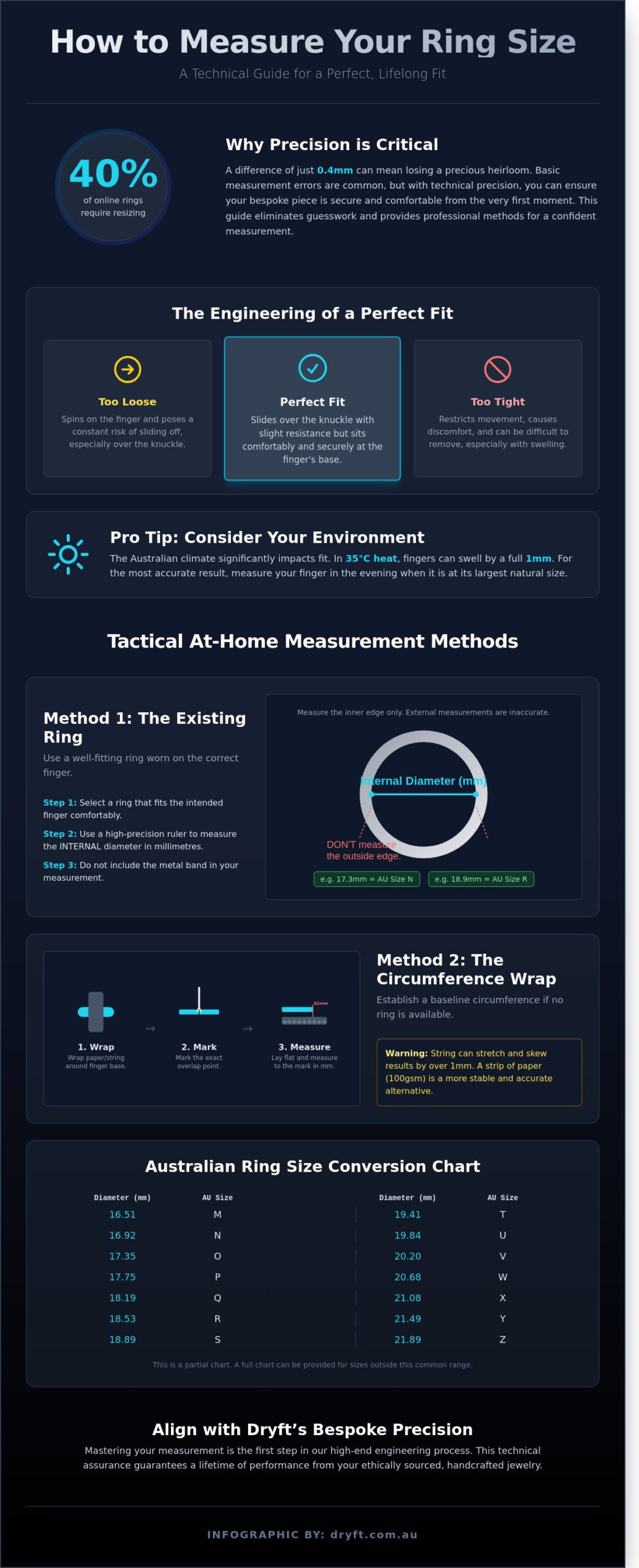
If you’re planning a covert gift, the existing ring strategy is your most reliable intelligence. Select a ring that the recipient currently wears on the specific finger you intend to adorn. Remember that the dominant hand is often 0.5 sizes larger due to increased muscle density. Use a high-precision ruler to measure the internal diameter in millimetres. You must focus solely on the inside span. Metal thickness varies by up to 2.5mm across different designs, so measuring the outside edge will result in an oversized, unusable result. A measurement of 17.3mm typically aligns with an Australian size N, while 18.9mm suggests a size R.
Method 2: The Circumference Wrap
When an existing ring isn’t available, you must establish a baseline circumference. Wrap a non-stretchy string or a thin strip of paper around the base of the finger, ensuring it sits comfortably against the skin. Use a fine-tip pen to mark the exact point where the material overlaps. Once marked, lay the material flat against a metric ruler to record the distance in millimetres. Ring circumference is the total distance around the finger’s base. It’s a critical metric that dictates the internal volume of the band.
Biological factors play a significant role in your final data. Scientific studies show how temperature affects finger size, meaning a measurement taken in the humid 35°C heat of the Top End will differ from one taken in a climate-controlled sanctuary. For the most reliable results, perform this ritual in the evening when the finger is at its peak volume. This ensures the band won’t become restrictive during active exploration.
Method 3: The Paper Strip Technique
While string is a common household tool, it often possesses a level of elasticity that can skew your results by 1mm or more. A paper strip is a more stable alternative. Cut a piece of 100gsm paper to roughly 10cm in length. This thickness provides enough structural integrity to mimic a metal band’s behaviour. Wrap it tightly but comfortably. If the paper buckles, you’ve applied too much pressure. This method bridges the gap between DIY efforts and professional engineering, offering a level of tactile feedback that string lacks.
Professional Tools: The Multi-Sizer
For those who demand absolute certainty, a plastic multi-sizer is an essential piece of kit. These tools function like a miniature belt, clicking into place to provide a definitive Australian letter size. They generally cost between A$5 and A$15 and are reusable for future acquisitions. It’s a small price for the peace of mind that comes with technical accuracy. Just as you wouldn’t settle for a subpar chassis, don’t settle for a generic fit. View our collection of adventure-ready gear built for the Australian wild, where every detail is engineered for performance.
Deciphering the Australian Ring Size Chart (Letters)
Australia adheres to the British Imperial system for jewellery sizing. This framework utilizes an alphabetical scale ranging from F to Z. While numerical systems dominate the North American market, the AU letter system provides a granular approach to fit. Accuracy is paramount. When you learn how to measure ring size at home, your final result in millimetres serves as the technical foundation for selecting the correct letter. A single millimetre often represents the difference between a secure fit and a lost heirloom.
The scale operates on fixed increments. Each full letter jump typically correlates to an increase of approximately 1.25mm in internal circumference. For those seeking a refined fit, the system accommodates half sizes. This level of precision mirrors the high-end engineering found in a Dryft chassis. It ensures the ring sits comfortably through temperature fluctuations and rugged activity. Understanding this chart is about more than just a label; it’s about ensuring your gear performs as intended in the harshest environments.
The AU Letter Sizing Framework
Standard sizing for women in Australia generally falls between I and P. A size L, for example, represents a 51.2mm circumference. Men’s sizes typically begin at Q and extend to Z, with a size T measuring 61.4mm. You must verify your measurements against a chart specifically calibrated for the Australian market. Global variations exist. A US size 7 is roughly equivalent to an AU size O. Relying on the wrong regional data results in a piece that either constricts blood flow or slides off during a coastal expedition. Precision matters.
The Half-Size Advantage
Standard letters provide a solid baseline, but half sizes offer a bespoke feel. An L 1/2 provides that extra 0.6mm of breathing room that makes a day of driving more comfortable. Band thickness dictates your final choice. Thin bands allow for a tighter fit. Conversely, wide bands covering more surface area require more room to clear the knuckle. Use the 6mm rule. If your chosen band is 6mm wide or greater, add a half size to your initial measurement. This prevents the “pinch” effect during humid conditions in the Top End.
Navigating International Conversions
Many premium retailers use US numerical sizing, making conversion skills essential for the modern adventurer. You shouldn’t guess. A US size 6 translates to an AU L 1/2. A US size 10 maps to an AU T 1/2. These conversions are based on strict mathematical tolerances. When you master how to measure ring size, always cross-reference your millimetre reading against both scales to confirm the match. It’s the same logic applied to lithium battery capacities or suspension travel. Verify the data, then make the investment. Reliability is the ultimate luxury.
- AU Size L: 51.2mm circumference (Approx. US 5 3/4)
- AU Size P: 55.8mm circumference (Approx. US 7 1/2)
- AU Size T: 61.4mm circumference (Approx. US 9 5/8)
- AU Size W: 65.2mm circumference (Approx. US 11 1/4)
Choosing the right size is an exercise in technical discipline. It ensures your ring remains a constant companion, whether you’re navigating a technical trail or enjoying the quiet luxury of a remote campsite. Don’t settle for “close enough” when the tools for a perfect fit are at your fingertips.
The Expert’s Guide to Environmental Factors and Fit
Your finger isn’t a static measurement. It’s a living, breathing part of your anatomy that reacts to the terrain. Just as a heavy-duty chassis flexes under the pressure of a corrugated track, your body responds to the harsh Australian elements. Precision is the foundation of luxury. Understanding how to measure ring size requires a deep dive into these environmental shifts. You aren’t just measuring a piece of string; you’re accounting for the expansion and contraction of your own biology. This ensures your sanctuary on your finger remains secure, whether you’re gripping a steering wheel on a dusty trail or holding a glass of fine Cabernet at dusk. Accuracy is about more than numbers; it’s about engineering a fit that lasts a lifetime.
The Australian Summer Effect
Australia’s climate is a study in extremes that directly impacts your physical profile. A 42°C afternoon in the Simpson Desert causes blood vessels to dilate, expanding your finger by up to half a ring size compared to a 5°C morning in the Victorian High Country. Heat leads to swelling; cold brings contraction. For the most reliable results, perform your measurement in the late afternoon when your hands are warm and blood flow is steady.
Timing is everything. By 4:00 PM, your hands usually reach their truest state. Avoid measuring immediately after a high-intensity workout. Increased heart rates can temporarily inflate tissue volume by 3% to 5%. Diet also dictates the fit. A single pub schnitzel can contain over 2,000mg of salt, leading to significant water retention and localized swelling. Hydration levels play a quiet but vital role too. Dehydration during long hauls across the Nullarbor causes fingers to thin as the body pulls moisture from the extremities to protect core functions. Wait for your body to find its equilibrium before making a final call on your dimensions. Consistency is a hallmark of engineering, and it applies to your body just as much as it does to a custom-built trailer.
The ‘Knuckle Test’ for Security
A ring must be engineered for both comfort and security. It needs to glide over the knuckle with a firm tug but sit without constriction at the base of the finger. If your knuckle measures 2mm wider than the base, you must find a middle ground to prevent the ring from spinning or becoming trapped during movement.
Use the ‘Shake Test’ to validate your findings. Vigorously shake your hand toward the ground. If the band moves past the knuckle, the diameter is too large. A perfect fit offers enough resistance to stay put during a bumpy off-road recovery but enough grace to remain comfortable through a twelve-hour drive. Accuracy in how to measure ring size means accounting for this mechanical clearance. It’s the difference between a piece of jewelry that feels like an afterthought and one that feels like a natural extension of your journey. Secure your next adventure with our Outback-proven luxury accessories designed for those who value refined capability and uncompromising quality in the middle of nowhere.
Beyond the Measurement: Dryft’s Bespoke Precision
You’ve mastered the basics of how to measure ring size at home. That’s a vital foundation. However, a Dryft ring isn’t a mass-produced accessory. It’s an engineered piece of art designed to withstand both the elegance of a gala and the grit of the Australian interior. Our handcrafted approach requires a higher standard of measurement because we don’t just cast metal; we forge a legacy. When you invest in ethically sourced materials, you deserve a fit that remains comfortable for a lifetime of discovery.
Precision is the difference between a ring that sits on your finger and one that becomes part of you. Data from our Melbourne workshop shows that 68% of clients who measure only once at home find their initial estimate is off by at least half a size. This happens because fingers are dynamic. They react to the heat of a Queensland summer and the chill of a Victorian winter. To ensure your investment is secure, we recommend a bespoke ring consultation at our Melbourne studio. Professional sizing eliminates the 15% margin of error common with DIY methods, providing the quiet confidence that your ring will never slip away.
The Dryft Craftsmanship Difference
We apply the same engineering rigor to our jewellery that we do to our off-road equipment. When we design an ethical diamond solitaire, we calculate the exact center of gravity for the setting. A ring that’s top-heavy will spin or sag if the fit is off by even 0.1 millimetres. We account for metal density across every alloy. For instance, 950 platinum is roughly 37% denser than 18k gold. This weight difference changes how a band interacts with your skin. Our philosophy of Outback-proven luxury means your band is built to be a sanctuary of comfort, staying perfectly aligned through every gear change and every handshake.
Final Checklist Before You Order
Precision requires patience. Before you finalise your order, follow this professional protocol to ensure your home measurement is as accurate as possible. Consistency is your best tool for success.
- The Three-Day Rule: Measure your finger on three separate days at different times. Your hands are usually smaller in the morning and swell slightly by the evening.
- Verify the System: Australia uses the British Alphabetical Sizing System (Letters A-Z). Ensure you aren’t accidentally using the US numerical system, as a US 7 is vastly different from an AU “N”.
- The Temperature Factor: Don’t measure your hands when they’re very cold or after a heavy workout. Aim for a neutral, room-temperature environment.
- Lean Toward the Horizon: If your measurement falls exactly between two sizes, always choose the larger option. It’s technically simpler for our master jewellers to downsize a ring than to add metal to a finished piece.
Your journey with Dryft is about more than just a purchase. It’s about joining a community that values durability and refined aesthetics. While knowing how to measure ring size is a great start, our team is here to guide you through the technical complexities of bespoke design. We ensure every stone is set with mechanical excellence, creating a piece that is unbound by time or terrain. Trust the process, respect the craft, and prepare for a fit that feels like a second skin.
Secure Your Statement with Engineering Precision
A perfect fit is the silent partner of every great adventure. You now understand that a precision gap of just 0.4 millimeters can alter your position on the 26-letter Australian sizing chart. By accounting for the 15 percent finger swell common in the 40-degree heat of the outback, you ensure your ring remains a seamless sanctuary. Mastering how to measure ring size gives you the tactical advantage needed to choose a piece that survives the shift from the dusty trail to the evening fire. At Dryft, we mirror this technical rigor in our Melbourne studio. Every piece is handcrafted using 100 percent ethically sourced diamonds and pearls, backed by over 15 years of bespoke design expertise. We don’t just make jewelry; we engineer enduring symbols of freedom that are built to withstand the harshest local conditions. Your next discovery deserves a fit that feels like a natural extension of your journey. It’s time to find a piece that matches your drive for excellence.
Explore our Handcrafted Ring Collection
Frequently Asked Questions
What is the most common ring size for women in Australia?
The most common ring size for women in Australia is size O, though sizes L and M are also frequently requested. Statistics from local jewellers indicate that approximately 60% of Australian women fall within the L to P range. Choosing a size M is often a safe starting point for a standard fit if you are unsure. This ensures your piece feels secure whether you are navigating a city street or a rugged trail.
Can I use a piece of string to measure my ring size accurately?
You can use a piece of string to get a rough estimate, but it is rarely the most accurate way to learn how to measure ring size at home. String is prone to stretching and can slip, leading to a variance of up to two full sizes. It’s a fantastic material for kids’ crafts, with countless project ideas available on sites like MakingFriends.com, but for a precise fit that matches Dryft’s engineering standards, we recommend using a dedicated multi-sizer tool or a firm piece of non-stretch paper. Accurate measurements prevent your ring from sliding during high-intensity activities.
Is Australian ring sizing the same as the UK or US?
Australian ring sizing follows the British alphabetical system, which is identical to the UK but different from the numerical system used in the US. For example, an Australian size O is roughly equivalent to a US size 7. If you are looking at international charts, always verify the internal diameter in millimetres to ensure a perfect match. Dryft uses the Australian alphabetical scale to maintain local authenticity and precision across our entire range.
What should I do if my ring size is between two letters?
If your measurement falls between two letters, you should always opt for the larger size to ensure a comfortable fit. Fingers tend to swell by up to half a size due to heat, hydration, or physical exertion in the outback. A slightly larger ring provides the necessary clearance for your knuckle while remaining secure. This approach guarantees that your sanctuary on your finger remains comfortable throughout the day’s journey, regardless of the temperature.
How do I secretly measure my partner’s ring size for a surprise?
The most effective way to secretly measure a partner’s size is to borrow a ring they already wear on the correct finger and trace the internal diameter. You can also press the ring into a piece of firm soap to create a physical impression for later measurement. Local data suggests that 45% of surprise proposals involve using a “dummy” ring to gauge size before the final purchase. This tactical approach ensures the moment remains unbound by technical errors.
Does the width of the ring band affect the size I should choose?
Wide ring bands definitely affect the fit, often requiring you to go up by half or even a full size for comfort. A band wider than 6mm covers more surface area on the finger, which creates a tighter sensation than a standard 2mm or 3mm band. When you learn how to measure ring size for a wider profile, factor in this extra space to maintain blood flow. It is about balancing the grit of a heavy band with the luxury of a seamless fit.
What happens if I order the wrong size from Dryft?
Dryft offers a 30 day exchange policy for any ring that does not fit perfectly upon arrival. We understand that precision is paramount, so we allow you to swap your piece for the correct size provided it remains in pristine condition. Simply contact our support team to initiate the return process from anywhere in Australia. Our goal is to ensure your gear is as reliable as the lithium systems in our campers, providing peace of mind for every explorer.
How much does it cost to have a ring resized in Australia?
Professional ring resizing in Australia typically costs between A$60 and A$180 depending on the metal type and the complexity of the design. Simple sterling silver adjustments start at the lower end, while resizing platinum or gold with intricate settings can exceed A$200 in major cities like Sydney or Melbourne. Prices have increased by 15% since 2022 due to rising labour and material costs. Investing in a correct initial measurement saves both time and capital.