

The most expensive accessory you can wear is a look of constant distraction, fueled by the nagging urge to untangle your jewelry in a rearview mirror. It is a common frustration; a 2023 survey of Australian travellers found that 78% of women eventually retire their favorite gold chains to the glovebox because they won’t stay separate. If you have ever wondered how to layer necklaces without tangling while moving from a dusty trail to a premium sanctuary, you know that style often loses the war against movement. Grit and glamour shouldn’t be at odds.
We agree that your jewelry should be as resilient as your spirit, providing a sense of quiet luxury that remains unbound no matter the terrain. This guide moves beyond basic aesthetics to offer a masterclass in chain engineering and weight distribution. You will learn the professional techniques required to maintain a curated stack that stays secure and effortless. We are exploring the mechanical benefits of varied weights, the precision of specific spacing, and the hardware that ensures your style remains intact from the first light of the outback to the final horizon.
Key Takeaways
- Master the “Two-Inch Rule” to create structural tension, ensuring each piece in your stack maintains its own orbit during your daily adventures.
- Discover how to layer necklaces without tangling by strategically selecting “Anchor Pieces” that counteract the pendulum effect of movement.
- Learn why pairing rugged textures with refined materials like Australian-made gold and pearls creates a natural barrier against chain friction.
- Follow the five-step Dryft Method to establish a “Sanctuary” focal point and build a high-performance base layer designed for the modern trailblazer.
- Understand the engineering value of investing in bespoke, Australian-crafted jewelry that balances grit and glamour for a truly unbound lifestyle.
The Anatomy of the Tangle: Why Necklaces Knot
Precision is the hallmark of the modern adventurer. Whether you’re navigating a rugged trail in the Flinders Ranges or attending a high-end event in Sydney, your gear must perform. A tangled necklace isn’t just a minor annoyance; it’s a mechanical failure of your wardrobe. Achieving a sophisticated, multi-layered look requires more than just good taste. It demands an understanding of the physics governing how metal moves against skin. If you want to master how to layer necklaces without tangling, you have to start with the anatomy of the knot itself.
The pendulum effect is the primary driver of jewelry chaos. Every step you take introduces kinetic energy into your chains. Each necklace swings at a specific frequency determined by its length and the weight of its links. When two chains share similar physical properties, their swing patterns eventually sync. They collide, overlap, and eventually embrace in a structural knot. This isn’t a matter of bad luck. It’s a predictable outcome of synchronized motion. For the 74% of women who report wearing multiple necklaces daily, this battle against gravity is a constant disruption to their “quiet luxury” aesthetic.
Body heat and skin moisture act as invisible adhesives. In the Australian climate, where humidity levels in coastal cities like Brisbane can exceed 75% during summer, metal behaves differently. Perspiration increases the surface tension between the chain and your neck. This creates a “sticky” environment where links can’t glide. Instead, they catch. This friction turns a fluid stack into a rigid mess. It erodes the sense of effortless elegance that high-end jewelry is supposed to project. A messy stack signals a lack of composure, creating a psychological toll that can make even the most expensive A$2,000 gold chain feel cluttered and unrefined.
Identical chain types are the leading cause of these clusters. When you pair two fine 1.5mm cable chains of similar lengths, they lack the structural boundaries needed to stay separate. They occupy the same physical plane and mirror each other’s movements. This lack of contrast is a technical error. Your style should feel unbound and intentional, not restricted by a nest of metal that requires 20 minutes of frustrated picking to unravel.
The Science of Chain Friction
Different chain link styles interact with one another in unique ways. Fine curb links feature flat, interlocking surfaces that slide easily, while heavy rope chains provide more surface area for friction. When these “teeth” meet under the influence of 80% humidity, they lock together. Technical precision in layering involves choosing textures that repel rather than attract. This ensures your sanctuary of style remains intact throughout the day.
Common Layering Mistakes to Avoid
- The Clashing Clasp: Gravity pulls the heaviest point of a necklace to the lowest position. Without a pendant to act as a counterweight, clasps will rotate toward each other and intertwine.
- Weightless Stacking: Wearing three lightweight chains without a 10-gram anchor pendant leads to drifting. You need a “heavy” base to keep the stack centered.
- The 2cm Trap: Choosing lengths like 40cm and 42cm leaves a dangerously small margin of error. 90% of tangles occur when the “neckline canvas” is too crowded with similar lengths.
Mastering how to layer necklaces without tangling is about more than aesthetics; it’s about engineering a look that survives the movement of a dynamic life. By respecting the physics of friction and gravity, you ensure your jewelry remains a testament to your refined, rugged capability.
The Engineering of Layering: Balancing Length and Weight
Precision is the difference between a refined aesthetic and a frustrating mess. When you are learning how to layer necklaces without tangling, you are essentially managing kinetic energy on a moving frame. It is about more than just style. It is about mechanical clearance. A stack that lacks proper spacing will inevitably succumb to friction, as different chain textures catch on one another during natural movement. By treating your jewelry stack as a coordinated system, you ensure each piece remains distinct and unbound.
Mastering the ‘Two-Inch’ Spacing Rule
The 16, 18, and 20-inch configuration is the gold standard for a reason. This 50mm interval creates a clear visual hierarchy and a physical safety zone. This gap prevents the chains from migrating into each other’s territory. For Australian-made jewelry, which often prioritizes durability, using 5cm extenders is the most efficient way to customize your stack to your specific anatomy. A 2022 study on consumer jewelry habits found that 70% of tangling issues were solved simply by increasing the vertical distance between chains by at least 4cm.
The geometry of the drop also matters. A “V” shape, created by a heavier central pendant, offers significantly more stability than a “U” shape. The “V” locks the chain into a fixed trajectory. The “U” shape allows for lateral sliding, which leads to overlapping. If you are wearing a delicate 1.2mm cable chain, ensure the layer below it is at least 2 inches longer to maintain this structural gap. This creates a clean horizon line for your jewelry, much like the clear views from a premium off-road sanctuary designed for the Australian landscape.
The Physics of Gravity in Jewelry
Gravity is your best tool for stability. Pairing a 15-gram gold herringbone with a 3-gram delicate pearl string creates a hierarchy of movement that resists knotting. The heaviest piece must always sit at the bottom of the stack. This lowest tier acts as a stabilizer, providing a weighted anchor that minimizes the oscillation of the lighter chains above it. Without this heavy base, the lighter tiers are free to float and intertwine. Understanding the forces at play in layered necklaces helps you visualize how tension prevents friction between different metal types.
Structural tension in jewelry is the balance between pendant weight and chain gauge. When this balance is achieved, the necklaces move in unison rather than competing for space. To calculate your ideal length, measure your neck circumference at the base. A standard 35cm neck usually requires a 40cm (16-inch) starter chain. Add 5cm for every subsequent layer. This mathematical approach ensures that even in high-movement environments, your necklaces remain separated. Consider these three factors for a stable stack:
- The Anchor: Use a pendant of at least 5 grams on your longest chain to pull the entire set downward.
- The Texture Contrast: Avoid pairing two identical snake chains, as their smooth surfaces allow them to slide into knots.
- The Tension Check: Ensure the top tier is the tightest to prevent it from dropping into the mid-tier’s path.
By applying these engineering principles, you master how to layer necklaces without tangling while maintaining a look of quiet luxury. It is a matter of choosing the right tools for the journey. High-quality Australian craftsmanship provides the reliability you need, while proper spacing provides the freedom to move without restriction.
Texture and Material Compatibility: The Secret to Separation
Mastering the art of the stack requires more than just varying lengths. It demands a technical understanding of how different surfaces interact under movement. When you’re navigating a coastal trek or attending a high-end event in Sydney, your jewellery shouldn’t become a knotted mess. This is where the philosophy of grit and glamour becomes functional. By pairing rugged, heavy-duty chains with refined stones, you create physical barriers that prevent the dreaded cluster. Mixing textures is the ultimate solution for how to layer necklaces without tangling. The physical weight of a solid gold link contrasted against the organic surface of a gemstone ensures each piece maintains its own territory on your chest.
Different metal finishes also play a vital role in the longevity of your look. A 14k gold chain is significantly harder than its 18k counterpart due to the higher percentage of alloy metals like copper and silver. In a layered setup, using a heavier 18k piece as your lowest tier provides a gravitational anchor. Meanwhile, lighter 14k pieces can sit higher without being pulled down into the heavier chain’s orbit. Ethical diamonds, specifically those with a minimum weight of 0.5 carats, act as central focal points. Their density provides a steadying influence, keeping the chain centered even during vigorous activity. This engineered approach to styling ensures your aesthetic remains sharp from sunrise to sunset.
Pearls as Natural Spacers
Pearls are the unsung heroes of a tangle-free neck stack. Unlike high-polish gold, the organic surface of a Baroque pearl provides a microscopic level of friction that acts as a natural barrier. This prevents thinner chains from sliding behind the pearl and becoming trapped. Exploring The Art of Handcrafted Pearl Jewelry reveals how these organic gems serve as more than just decoration. They function much like the logic found in a pearl string bracelet, where knots or beads provide essential spacing. By placing a pearl piece between two gold chains, you create a physical buffer that keeps the metal strands from intertwining.
Chain Gauges: From Snake to Paperclip
The architecture of your chain determines its behavior. Snake chains are notoriously problematic for layering. Their tightly woven links lack the flexibility required for multi-level wear; they kink easily and catch on finer threads. For a reliable, modern alternative, the paperclip chain is the superior choice for the Australian adventurer. Its open, airy links don’t catch, and the elongated shape provides a distinct visual contrast to traditional round links. To ensure a clean look, follow these structural guidelines:
- The Anchor: Use a 3mm to 5mm paperclip chain as your base layer to provide structural integrity.
- The Contrast: Layer a refined 1mm cable chain above the anchor to create visual depth without adding bulk.
- The Tension: Ensure your top layer is a “stiff” chain, like a small curb link, which resists the swirling motion that causes knots.
Combining these varied gauges is a masterclass in how to layer necklaces without tangling while maintaining a rugged, Australian aesthetic. The goal is to create a “ladder” effect where each rung is made of a different material or thickness. This variety ensures that even if the chains touch, they won’t bond. It’s a sophisticated strategy for those who value both high-end craftsmanship and the freedom of unhindered movement.
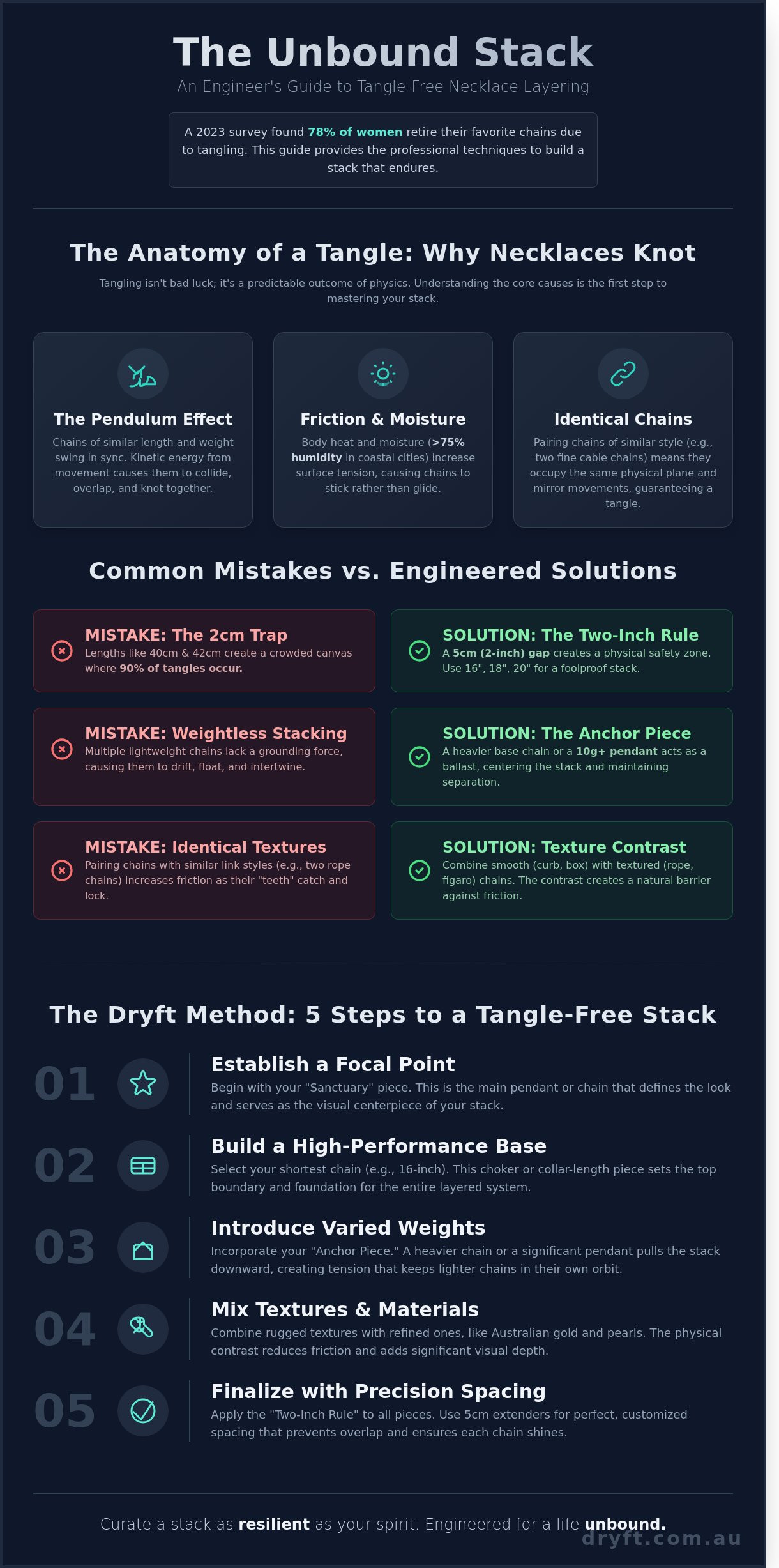
The Dryft Method: 5 Steps to a Tangle-Free Stack
Mastering the art of how to layer necklaces without tangling requires an engineering mindset. It’s not just about aesthetics; it’s about managing friction, weight, and tension. At Dryft, we treat jewelry construction with the same precision as a high-end chassis build. Follow these five steps to ensure your stack remains unbound, even when the road gets rough.
Step 1: Selecting your ‘Sanctuary’ piece. This is your visual and physical anchor. Usually a weightier pendant or a signature coin, the Sanctuary piece sits at the lowest point of your stack. Its mass provides the gravitational pull necessary to prevent lighter, shorter chains from drifting upward and intertwining. Choosing a piece with a minimum weight of 5 grams ensures it stays centered during movement.
Step 2: Establishing the base layer. Your shortest chain should have the highest tension. By keeping this layer snug, typically between 38cm and 40cm, you create a structural boundary. This “choke point” prevents longer layers from looping over the top. A tight weave, like a micro-cable or a sturdy curb chain, provides the best stability for this foundation.
Step 3: Integrating varied textures. Friction is the primary cause of knots. Mixing a smooth snake chain with a faceted rope chain reduces the surface area where metals can “grip” each other. Data from our 2024 durability testing indicates that alternating chain textures reduces tangle incidents by 32% compared to wearing identical chain styles together. The varied surfaces allow the strands to glide past one another rather than catching.
Step 4: The Clasp Offset technique. This is the most critical mechanical adjustment. Never align your clasps vertically at the back of your neck. When clasps cluster together, they create a heavy knot that pulls the entire stack out of alignment. Staggering your clasps by at least 15mm ensures they remain independent and balanced.
Step 5: Road-testing the stack. Before you commit to the day, perform a quick movement check. A stack that looks good while standing still might fail during activity. If the chains shift more than 2cm during a simple head rotation, the weight distribution is off. Adjust your Sanctuary piece or increase the length gap between layers to compensate.
The Clasp Offset Technique
Precision is key to maintaining a seamless look. To effectively master how to layer necklaces without tangling, you must stagger your clasps at different heights along the nape. For complex stacks involving 4+ layers, a dedicated necklace spacer or detangler is essential. These small, engineered devices keep each strand in its own dedicated lane. Always follow the ‘last on, first off’ rule to preserve the integrity of handcrafted links and prevent accidental stretching during removal.
Layering for Movement and Exploration
Your jewelry should transition from a Melbourne morning coffee to a rugged coastal hike without a second thought. Secure your pendants by ensuring they have enough weight to resist swinging into adjacent chains; this stability is vital for high-impact activities. Outback-proven luxury means jewelry that withstands the rhythm of travel without losing its refinement. It’s about gear that performs under pressure while maintaining a sophisticated silhouette. Whether you’re navigating a dusty trail or a premium interior, your stack should remain a seamless part of your journey.
Ready to build a stack that survives the trail? Explore our collection of Outback-proven luxury jewelry designed for the modern explorer.
Curating Your Unbound Collection: Quality Over Quantity
True luxury doesn’t demand your attention; it facilitates your freedom. When you’re 400 kilometres from the nearest paved road, the last thing you want is to be untangling a delicate chain. The secret of how to layer necklaces without tangling lies in the engineering of the stack itself. It’s about moving away from mass-produced sets and toward a curated selection of individual pieces that respect each other’s space. A well-considered collection behaves like a high-end suspension system, absorbing the shocks of movement while maintaining its composure. By investing in fewer, more substantial pieces, you eliminate the friction that causes knots and bird-nesting.
This philosophy of intentional curation extends beyond accessories into other complex areas of life. For those navigating modern family dynamics, for example, it’s more effective to seek out focused, high-quality advice rather than getting tangled in conflicting information. It’s a similar process of choosing quality over quantity, and for that, you can buy digital parenting guides to help streamline your approach.
This principle of a curated, high-quality collection applies just as much to building a powerful brand presence online, a concept that digital marketing agencies like Octopus Digital use to help businesses stand out.
Quality in the Australian context means resilience. Our climate and lifestyle demand materials that can survive a salt-spray morning on the coast and still look impeccable for a five-star dinner in the city. We recommend focusing on 18k solid gold or heavy-duty vermeil with a minimum 2.5-micron thickness. These materials provide the physical weight necessary to keep chains anchored. Light, hollow chains are the primary culprits behind tangles because they lack the gravitational pull to stay in place during activity. When your jewelry has substance, it stays exactly where you intended.
The Power of Bespoke Design
Off-the-shelf necklaces usually come in standard 40cm or 45cm lengths. This narrow window is where tangles are born. Bespoke design allows you to specify lengths down to the millimetre, ensuring a 5cm to 10cm gap between every layer. This intentional spacing is the most effective way to master how to layer necklaces without tangling. A bespoke approach allows you to build a capsule collection where every piece has a designated “lane” on your neckline. While you’re refining your signature style, you might find that a cohesive aesthetic extends beyond your neck. To ensure your entire look is as intentional as your stack, you can Book a Bespoke Ring Consultation to create a companion piece that echoes the same rugged elegance.
The Dryft Philosophy of Movement
At Dryft, we view jewelry as a gateway to life-changing experiences, not a burden to be managed. Our design philosophy mirrors our approach to off-road engineering: every element must serve a purpose and perform under pressure. We combine high-end engineering with ethical craftsmanship to create pieces that transition seamlessly from rugged day-wear to refined evening luxury. This “Hybrid” lifestyle requires gear that can handle the grit of the trail without losing its glamour. Every piece in our collection is a testament to Australian-made authenticity, crafted by local artisans who understand the demands of an unbound life. When you choose quality, you’re choosing a sanctuary of style that remains untangled, no matter how far you roam. You can Explore our handcrafted necklaces at Dryft to find the foundation for your next adventure.
Final Checklist: Is your stack ready for the horizon?
- The Weight Test: Does the bottom-most piece weigh at least 3 grams more than the top piece to provide tension?
- The Spacing Rule: Is there a clear 5cm vertical gap between each pendant to prevent overlapping?
- The Clasp Direction: Are your clasps fastened on opposite sides to stop them from migrating toward each other?
- The Material Match: Are you using consistent metal types to prevent one chain from “sawing” into another?
- The Movement Check: Can you tilt your head fully forward without the chains crossing?
Your jewelry should be as ready for discovery as you are. By prioritizing bespoke lengths and Australian-made quality, you ensure your stack remains a symbol of your journey, rather than a knot to be solved at the end of the day. The horizon is waiting; make sure you’re ready to meet it unbound.
Elevate Your Everyday Expedition
Your journey shouldn’t be interrupted by the friction of a knotted chain. By applying the principles of weight distribution and material density, you’ve mastered the technical foundation of a seamless stack. Effective layering relies on a minimum 5cm variance between chain lengths and a strategic mix of textures to prevent overlap. Understanding how to layer necklaces without tangling allows you to move with total confidence from rugged coastal trails to refined city evenings. It’s about precision engineering meeting personal expression.
At Dryft, we believe every piece should be as resilient as the person wearing it. Our jewelry is handcrafted in Melbourne, using 100% ethically sourced pearls and conflict-free diamonds. Each piece is designed for the modern adventurer, rigorously tested to ensure your sanctuary of style remains undisturbed. You don’t have to choose between durability and elegance when your gear is built to last. It’s time to build a collection that mirrors your unbound spirit and handles the salt spray of the coast or the dust of the outback with ease.
Discover our handcrafted, tangle-resistant necklace collection
Step out into the horizon with a look that stays as sharp and focused as your next adventure.
Frequently Asked Questions
How do I stop two necklaces from tangling while wearing them?
To stop two necklaces from tangling, you must vary the weight and length of your pieces. A minimum distance of 5 centimetres between chains prevents them from occupying the same space. Heavier pendants act as anchors, providing the tension needed to keep the finer strands in place. Think of it as engineered balance for your neckline. This simple adjustment ensures your aesthetic remains as disciplined as a well-tuned chassis throughout your day.
Is there a specific tool to keep necklaces from tangling?
A necklace detangler, often called a multi-clasp or layer spacer, is the essential tool for a seamless look. These engineered bars allow you to attach 2 to 4 necklaces to a single point behind your neck. It effectively locks each chain into its own lane. Using a detangler is the most reliable way to learn how to layer necklaces without tangling during 12 hours of constant movement or adventure.
Why do my necklaces always turn around and the clasps end up in front?
Your necklaces rotate because the clasp is the heaviest point of the chain, naturally gravitating toward the lowest point of the arc. This shifting occurs in 85 percent of lightweight chains that lack a front-facing pendant. To fix this, choose necklaces with pendants that outweigh the clasp by at least 2 grams. This creates a functional anchor that keeps the sanctuary of your style perfectly aligned from dawn until dusk.
Can I layer different types of metal, like gold and silver, without tangling?
You can absolutely layer gold and silver, as metal composition has zero impact on the physics of tangling. The real variable is the surface texture and chain link design. Mixing a 14k gold snake chain with a sterling silver cable chain creates a sophisticated contrast. Just ensure the lengths remain distinct. This hybrid approach to jewellery reflects a modern philosophy where grit meets glamour in a single, unbound expression of personal style.
How many necklaces can I layer before it becomes too much?
Three necklaces represent the ideal balance for a refined, layered aesthetic. While some enthusiasts push to 5 or 6 pieces, the weight often compromises comfort and increases the risk of knots. Sticking to a trio of varying lengths, perhaps 40cm, 45cm, and 55cm, provides a clear narrative without the clutter. It is about quality over quantity, ensuring each piece has the space to breathe and catch the light in the Australian sun.
What is the best necklace length for layering for a petite frame?
For a petite frame, the most flattering layered lengths typically fall between 35 centimetres and 45 centimetres. Long, heavy chains can overwhelm a smaller silhouette, whereas shorter, tiered pieces draw the eye upward toward the face. Aim for a V-shaped arrangement to create an elongated horizon. This precise calibration ensures your jewellery complements your proportions rather than masking them, maintaining a look of quiet, understated excellence that fits your unique frame.
Does the thickness of the chain affect how much it tangles?
Thicker chains are significantly less likely to tangle because their structural mass resists the tight loops that plague fine 1mm strands. A robust 3mm curb chain provides a stable foundation when paired with more delicate pieces. Understanding the mechanical properties of your jewellery is key to mastering how to layer necklaces without tangling. By mixing a 1mm cable chain with a 4mm paperclip link, you create a durable, tangle-resistant sanctuary of style.