In the pursuit of true luxury, a flawless surface is often the clearest sign of a fake. Real beauty, much like the rugged Australian coastline, is defined by its unique imperfections and the story of its creation. When you are standing in a boutique or at a high-end auction, knowing how to identify real pearls becomes a vital skill for the discerning collector who values authenticity over mass-produced perfection. It is easy to feel a sense of anxiety when faced with a potential A$3,500 investment, fearing that a clever glass imitation might be masquerading as an organic sanctuary of light.
We understand that you want to invest in items that mirror your own standards of quality and resilience. You shouldn’t have to worry about performing destructive tests or second-guessing a “natural” label. This guide will masterfully equip you with professional sensory cues and visual forensics to authenticate your gems with quiet confidence. We will examine the microscopic topography of nacre, master the “rugged luxury” perspective on organic flaws, and provide a clear roadmap to ensure your next acquisition is a genuine piece of the wild, refined for the modern world.
Key Takeaways
- Navigate the 2026 market with confidence by distinguishing between saltwater and freshwater siblings, understanding why cultured gems remain the industry benchmark for organic luxury.
- Master how to identify real pearls through sensory forensics, utilizing temperature and weight tests to distinguish the cool sanctuary of genuine nacre from hollow synthetic imitations.
- Decode nature’s visual fingerprints by identifying the deep, internal lustre and complex “orient” of color that no machine-made imitation can replicate.
- Challenge the myth of perfection and discover why the unique, irregular profiles of Baroque pearls are the ultimate proof of an authentic, untamed origin.
- Secure your investment with “Outback-proven” sourcing strategies, using transparent pricing in A$ and ethical standards as your final indicators of high-end authenticity.
Understanding the Pearl Hierarchy: Natural, Cultured, and Imitation
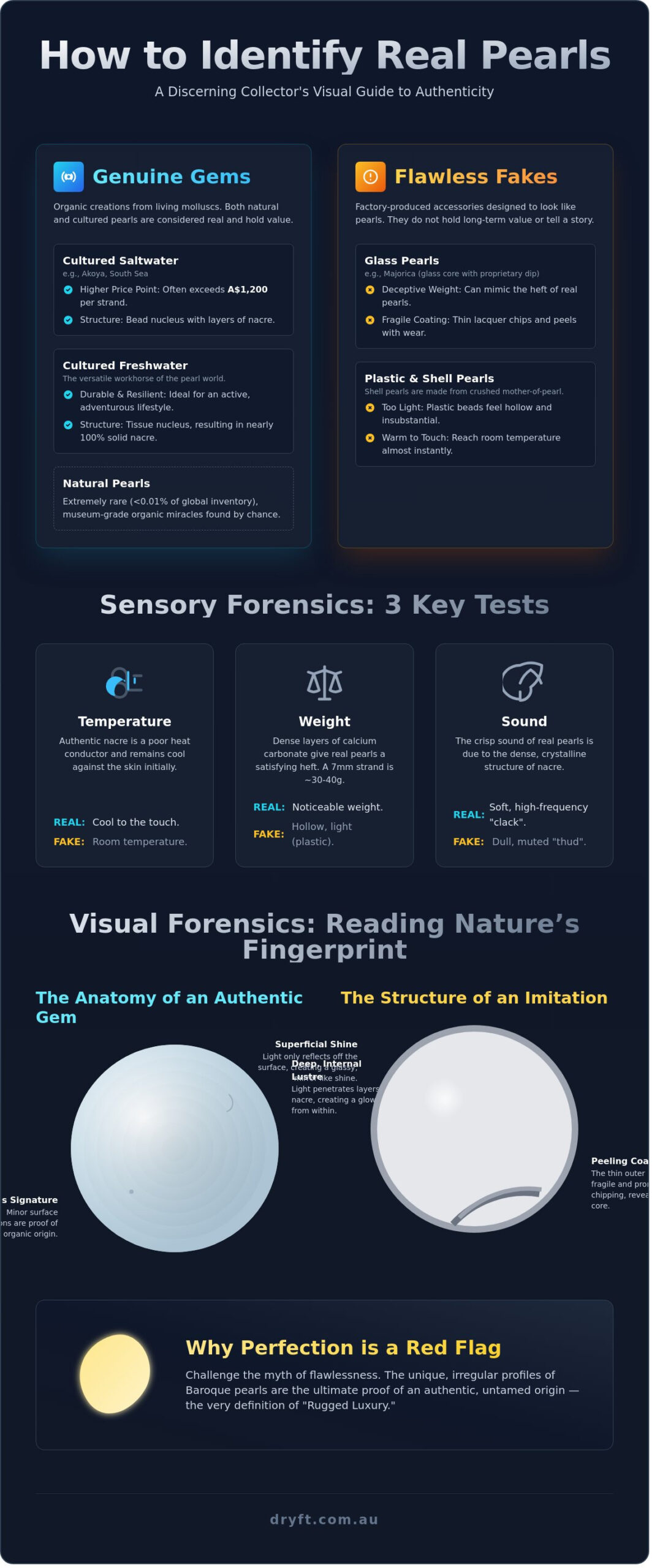
Authenticity is the bedrock of any premium investment. In the 2026 jewellery landscape, the definition of a real pearl has shifted from wild-caught rarities to expertly engineered cultured gems. Understanding how to identify real pearls starts with a clear grasp of the hierarchy that defines this market. While natural pearls are organic miracles found by chance, cultured pearls are the result of a sophisticated partnership between human ingenuity and the biological precision of a living mollusc. Both are genuine. Both possess the structural depth that an imitation simply cannot replicate.
Natural pearls represent less than 0.01% of the global inventory. They’re museum-grade treasures. Most Australian buyers will encounter cultured varieties, which are the industry standard for quality and durability. You’ll find two primary organic siblings here: saltwater and freshwater. Saltwater pearls often command a higher price point, frequently exceeding A$1,200 for a basic strand. Freshwater pearls offer a rugged versatility and solid nacre composition that suits a more active, adventurous lifestyle. They’re the workhorses of the pearl world, capable of withstanding the rigours of daily wear while maintaining a refined glow.
Distinguishing these from high-end fakes like Majorica or Shell pearls is critical for any serious collector. Majorica pearls are manufactured in Spain using a glass core and a proprietary dip. Shell pearls are crafted from crushed mother-of-pearl. They look convincing at a distance. However, they lack the organic soul of a gem grown inside a living organism. A comprehensive guide to Natural, Cultured, and Imitation Pearls highlights that while these fakes are marketed as “premium,” they remain factory-produced accessories rather than geological assets. They don’t hold value, and they certainly don’t tell a story of discovery.
The Anatomy of an Organic Gem
Nacre is the chassis of a real pearl. It’s a resilient material composed of microscopic aragonite plates bound by organic conchiolin. These calcium carbonate layers are stacked like precision-engineered bricks. When light hits these layers, it doesn’t just bounce off the surface; it penetrates the depths, creating a glow known as lustre. The nucleus acts as the foundation in the cultured process. In saltwater pearls, this is usually a bead. In many freshwater pearls, the nucleus is a small piece of donor tissue, allowing the mollusc to create a gem that’s nearly 100% solid nacre. This structural integrity ensures the pearl remains a sanctuary of beauty for decades.
Why Imitations Fail the Test of Time
Plastic beads are the entry-level imposters of the market. They’re lightweight and reach room temperature almost instantly, which is a primary giveaway during a physical inspection. Glass beads are more deceptive. They possess a “cool touch” that mimics real gems, but the pearlescent coating is often a thin, painted-on lacquer. This coating is fragile. It chips and peels when exposed to the oils of the skin or the heat of the Australian sun. Knowing how to identify real pearls requires looking past the surface shine to the structural integrity beneath. A real pearl’s nacre is part of its DNA, not a superficial layer that fades when the journey gets tough.
The Sensory Experience: Identifying Pearls Through Touch and Sound
Authentic luxury leaves a signature. Just as the heavy thud of a well-engineered door signals the quality of a premium off-road vehicle, the physical properties of a freshwater pearl reveal its origin. Understanding how to identify real pearls requires more than a passing glance. It demands an engagement with the senses. True quality isn’t just seen; it’s felt through weight, temperature, and friction.
Weight provides the first clue. Real pearls, composed of dense layers of calcium carbonate, possess a satisfying heft. A standard 7mm freshwater strand typically weighs between 30 and 40 grams. In contrast, plastic imitations feel hollow and insubstantial. Glass fakes might mimic the weight, but they fail the thermal test. When you first pick up an authentic pearl, it feels like a sanctuary of coolness against your palm. This initial chill is a hallmark of organic nacre.
Sound serves as another diagnostic tool. When you gently clink two real pearls together, they produce a soft, high-frequency “clack.” It’s a crisp sound, reminiscent of fine marble. Plastic beads offer only a dull, muted “thud.” This acoustic difference stems from the structural integrity of the nacre layers. While professional labs use GIA’s pearl identification process to look beneath the surface, your ears provide an immediate, baseline assessment in the field.
Friction is the final arbiter. Real pearls refuse to slide smoothly against one another. Their surface, though seemingly polished, possesses a microscopic texture that creates resistance. Learning how to identify real pearls through these tactile markers ensures you invest in genuine craftsmanship. If two beads glide past each other with the effortless ease of lubricated bearings, they’re almost certainly synthetic.
Mastering the Tooth Test Safely
The tooth test remains a reliable method for those who know the technique. Real pearls are composed of microscopic crystalline plates of aragonite. These plates create a gritty, sandpaper-like sensation when rubbed against the edge of a front tooth. To perform this safely, use a light touch. Don’t bite down. Simply glide the pearl along the incisal edge. A perfectly smooth, “slippery” sensation is the ultimate red flag, indicating a factory-finished coating rather than natural growth.
The Temperature Gradient
True nacre exhibits a specific thermal conductivity. Real pearls undergo a 2-3 second “cool-to-warm” transition when held or worn. They start cold but rapidly adapt to your body heat, eventually reaching a state of equilibrium that feels like a seamless extension of your skin. Glass imitations often stay cold for much longer, while plastic warms up almost instantly. This adaptability is why high-quality strands feel comfortable during a long trek across the Kimberley or at a formal dinner in Sydney. It’s a hallmark of the hybrid lifestyle where elegance meets endurance. This “Skin Test” confirms the organic nature of the gem, as the pearl breathes and reacts to its environment just as you do.
Visual Forensics: Reading Nature’s Fingerprint on the Surface
Identifying a genuine gem requires the same forensic attention to detail as inspecting the precision welds on a premium off-road chassis. It is about looking past the initial flash to find the structural integrity beneath. To master how to identify real pearls, you must understand that nature rarely produces sterile perfection; it produces character. Real freshwater pearls are composed of thousands of microscopic layers of aragonite crystals, a biological engineering feat that creates a visual depth no factory can replicate. While a fake pearl relies on a superficial coating, a real one possesses a soul. You are looking for the “orient,” a subtle play of iridescent colors that shimmer just below the surface as the pearl moves. This optical phenomenon, caused by the refraction of light through layers of nacre, is the definitive signature of an organic treasure.
Lustre and the “Deep Sanctuary” Effect
Lustre is the most critical factor in pearl valuation, representing the soul of the stone. When you hold a pearl under a concentrated light source, look for a reflection that feels like a deep sanctuary rather than a flat mirror. High-quality freshwater pearls, particularly those graded AAA or higher by GIA standards, exhibit a sharp, crisp reflection. If the edges of the light source look blurry or diffused, the nacre is likely thin or synthetic. Perform the Mirror Test: in a top-tier pearl, you should see the distinct outline of your own features. Fake pearls often have a “plastic” gloss that lacks this internal dimension, appearing bright but hollow.
Surface irregularities are not flaws; they are badges of authenticity. In the Australian market, where we value the raw beauty of the outback, these tiny pits or “birthmarks” prove the pearl grew inside a living organism over a period of 2 to 5 years. A 2023 study by the Gemmological Association of Australia noted that 95% of natural freshwater pearls exhibit some form of surface variation. If a strand of pearls looks identical, with every bead matching perfectly in shape and texture, it is a statistical impossibility in nature. Real pearls feel gritty or sandy when rubbed gently against the edge of a tooth, a result of the crystalline structure. Smooth, slippery surfaces are a clear indicator of glass or plastic imitations.
Inspecting the Drill Holes
The drill hole is where the illusion of a fake pearl usually unravels. Use a jeweler’s loupe to inspect the entry point. On a genuine freshwater pearl, the hole should be clean, sharp, and show a solid, consistent interior. Because real pearls are solid nacre, there is no “coating” to chip away. Conversely, fakes often show a “peeling” effect around the hole, where the synthetic paint has lifted from the inner glass or plastic bead. You might even see a visible “nucleus line” where the artificial layer meets the core. This technical failure is a primary way how to identify real pearls from low-quality mass-market substitutes.
The weight of the gem also tells a story of engineering. Real pearls have a specific gravity that makes them feel substantial in the hand, similar to the weighted feel of a well-balanced tool. A standard 7mm freshwater pearl weighs approximately 0.3 to 0.4 grams. If the jewelry feels suspiciously light, it is likely a hollow plastic imitation. If it feels excessively heavy, it might be a leaded glass bead. Trust the tactile feedback. A genuine pearl warms to the touch of your skin within 10 seconds, while glass stays cold and plastic remains neutrally tepid. This thermal conductivity is a quiet, reliable indicator of a stone that was born in the water, not a laboratory.
Why Perfection is a Red Flag: The Beauty of Baroque Pearls
Nature doesn’t follow a blueprint. In the industrial world, perfection is a sign of precision engineering; in the organic world, it’s often a sign of a factory mold. Many buyers mistakenly believe that a perfectly round sphere is the ultimate benchmark for quality. This myth ignores the rugged, sophisticated reality of how pearls actually grow. For the modern adventurer, a pearl that looks like it was stamped out of a machine lacks the soul required for a true personal sanctuary. Real luxury isn’t found in uniformity. It’s found in the “Unbound” aesthetic where every piece tells a story of survival and growth in the wild.
If you want to know how to identify real pearls in a market flooded with resin imitations, start by embracing the irregular. A collection of 50 identical pearls is statistically impossible in nature. When you see a strand where every bead is a carbon copy, you’re looking at a red flag. High-end Australian collectors are increasingly pivoting toward Baroque shapes because their complexity is a built-in security feature. You can’t fake the way a Baroque pearl catches the light across its uneven “hills” and “valleys.”
The Unique Identity of Baroque Shapes
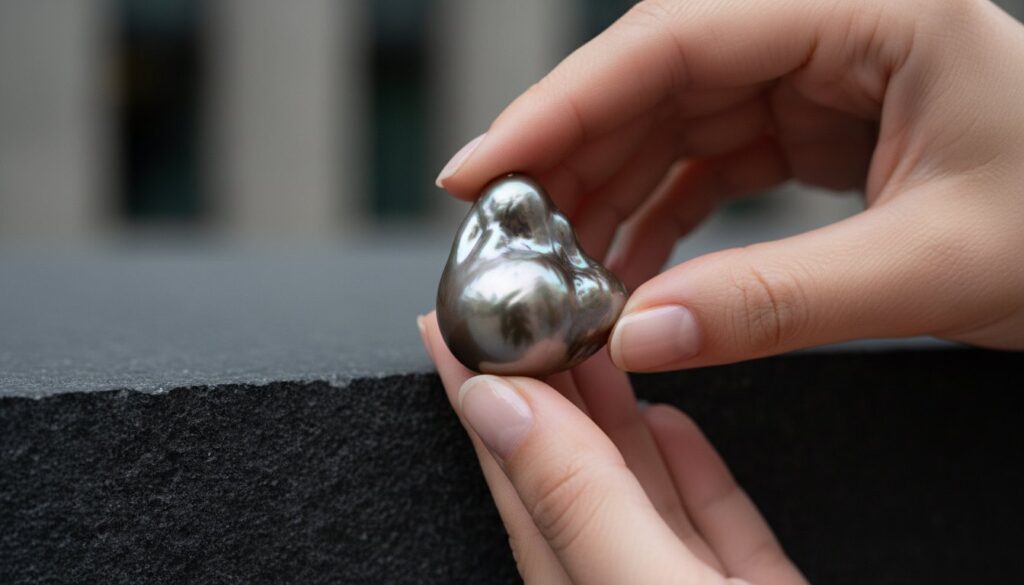
Machines struggle to replicate the “Baroque Drop” shape because its weight distribution is entirely organic. These pearls often feature a distinct “tail” or visible “rings” around their circumference. These aren’t defects. They’re chronological markers of the 2 to 5 years the pearl spent developing inside a mollusk. To verify the nacre thickness on these irregular surfaces, look at the “creases.” On a fake, the coating will often look thin or cracked in the folds. On a genuine Baroque pearl, the nacre is consistent and deep, providing a luster that seems to glow from the core rather than just sitting on the surface. This structural integrity is what separates a lifetime investment from a seasonal accessory.
- Growth Rings: Look for subtle circles that indicate different stages of nacre deposition.
- The Luster Test: Rotate the pearl; real nacre shows a “rolling” reflection that moves with the shape.
- Weight Distribution: Baroque pearls feel substantial and cool to the touch, unlike lightweight plastic alternatives.
Handcrafted vs. Mass-Produced
This appreciation for handcrafted quality over mass-produced uniformity extends beyond jewelry into all areas of a refined lifestyle, including the culinary arts. Artisanal producers, such as the French company Conserverie Maison Marthe, champion this same philosophy of genuine craftsmanship.
There is a massive chasm between the “engineered” precision of a factory-made bead and the “crafted” feel of a genuine gem. Mass-produced fakes rely on a plastic or glass nucleus coated in a thin layer of “essence d’orient.” This creates a surface that is too smooth and too perfect. Real pearls have a gritty texture when tested gently against the teeth, a tactile signature of their calcium carbonate structure. Every Baroque pearl is a one-of-one sanctuary for the wearer, offering a level of exclusivity that mass production can’t touch. When you are Styling Baroque Pearl Drop Earrings, you’re wearing a piece of the earth that can never be duplicated.
Learning how to identify real pearls involves looking past the surface to find the character lines that a machine cannot replicate. In the Australian outback, we value gear that is proven and authentic. Your jewelry should meet that same standard of rugged luxury. Genuine pearls aren’t just accessories; they’re engineered by nature to endure. If a pearl looks too perfect to be true, it’s likely a distraction from its lack of heritage. Choose the irregular. Choose the authentic.
Ready to discover jewelry that matches your spirit of adventure? explore the Dryft collection and find your own one-of-one sanctuary today.
Sourcing with Confidence: Beyond the Physical Tests
Mastering how to identify real pearls involves looking past the surface. You wouldn’t take a base-model SUV into the heart of the Kimberley; you shouldn’t settle for questionable gems when building a jewelry collection meant to last. Price remains your most reliable filter for authenticity. In 2024, high-quality freshwater pearls or Australian South Sea variants rarely retail below A$450 for a graduated strand. If a deal feels too good to be true, it’s likely a factory-produced glass bead coated in synthetic “essence d’orient.” Real pearls represent a biological investment, and their market value reflects the years required for a mollusk to layer nacre in a natural environment.
Professional verification provides the ultimate peace of mind for significant purchases. For any piece exceeding A$1,200, always request a certificate from a recognized authority like the Gemmological Association of Australia (GAA). This documentation acts as a technical blueprint, confirming whether the pearl is natural, cultured, or treated. It’s the equivalent of a service logbook for a premium off-road rig. It proves the engineering behind the elegance. The Dryft philosophy centers on this exact intersection of grit and glamour. We select pearls that possess the structural toughness to withstand the elements while maintaining a lustre that commands attention in a refined setting.
Just as a premium vehicle requires regular servicing to maintain its performance, your jewellery collection needs professional care to preserve its value and beauty. Whether it’s restringing a pearl necklace or restoring an heirloom, expert services are crucial. For readers seeking such specialized care, companies like Atoz Watch And Jewellery Repairs offer a benchmark for quality in fine jewellery maintenance.
The Ethical Dimension of “Real”
By 2026, the definition of a “real” pearl has expanded to include its origin story. A gem isn’t truly authentic if its production harmed the ecosystem or exploited a workforce. Sustainable farming in regions like Broome ensures that the Pinctada maxima oysters thrive in pristine conditions. This environmental health directly impacts the final “vibe” of the jewelry. Pearls grown in stressed, polluted waters often look dull or “plastic.” Ethically sourced pearls carry a vibrant, deep-seated glow because they’re the product of a balanced habitat. When you wear a piece from a farm that prioritizes 100% waste reduction and fair labor, you’re wearing a story of resilience and respect for the wild.
Building Your Authentic Collection
Starting a collection doesn’t require a massive initial layout. It requires a strategic one. Focus on a foundation piece that bridges the gap between daily utility and evening sophistication, such as a high-grade Pearl String Bracelet. Choosing independent Australian boutiques over mass-market retailers ensures you’re getting hand-selected gems rather than bulk-processed inventory. These smaller makers often have direct relationships with pearl farmers, providing a level of transparency that’s impossible to find in a shopping mall chain. This connection to the source is the hallmark of a sophisticated trailblazer who values substance over flash.
- The Weight Factor: Real pearls feel substantial and cool to the touch, warming only after contact with your skin.
- Surface Integrity: Look for tiny, unique birthmarks. Flawless perfection at a low price point is a red flag for fakes.
- Lustre Depth: A real pearl has a “glow from within” rather than a superficial, painted-on shine.
- Drill Hole Analysis: Inspect the drill holes under a 10x loupe. Real pearls show a sharp, clean edge with no chipping of the outer layer.
- The Price Test: Ensure the A$ value aligns with the current market rate for cultured gems.
Understanding how to identify real pearls is about more than avoiding a scam. It’s about curated quality. It’s about knowing that your gear, whether it’s a lithium-powered camper or a strand of freshwater pearls, is engineered to perform whenever you decide to push beyond the horizon.
Claim Your Original: The Mark of True Character
Authenticity leaves a trail. By mastering how to identify real pearls, you’ve gained the tools to separate factory-made replicas from nature’s genuine masterpieces. Real pearls carry a unique DNA of slight surface ridges and a signature cool touch that imitation beads simply cannot replicate. These 100% organic markers are the results of years of growth under pressure, creating a gem that is as tough as it is beautiful. You now know that perfection is often a red flag; true luxury lies in the unique, baroque silhouettes that reflect a life lived unbound.
At Dryft, we bring that same spirit of rugged refinement to every piece we create. Our collection features 100% ethically sourced freshwater and baroque pearls, each one passing a rigorous 5-point quality inspection for luster and surface integrity. Every jewelry piece is handcrafted in our Australian studio, ensuring your investment is ready for both a coastal gala and a dusty trail. If you’re looking for something truly one-of-a-kind, our bespoke design services are available by appointment to help you engineer a piece that tells your specific story. Explore our collection of ethically sourced, handcrafted pearl jewelry at Dryft.
Step out with the quiet confidence that comes from wearing something real. The horizon is waiting, and you’re ready to meet it with elegance that lasts.
Frequently Asked Questions
Can I use a flame test to identify real pearls?
You can use a flame test to help understand how to identify real pearls, but it carries significant risks for the organic nacre. Real pearls won’t melt when exposed to a lighter flame for 2 seconds, while plastic imitations emit a chemical odour and deform instantly. It’s a destructive test that can permanently damage the surface lustre of a genuine gem. Stick to non-invasive methods to protect your investment.
Do real pearls always have a gritty feel on the teeth?
Real pearls feel gritty when rubbed gently against your front teeth because of their layered crystalline structure. This friction provides a definitive method for how to identify real pearls without expensive lab equipment. Synthetic beads feel smooth or waxy because they lack the microscopic ridges found in organic nacre. It’s a simple, effective test that separates genuine treasures from glass or plastic mimics.
What is the difference between a natural and a cultured pearl?
Natural pearls form by chance in the wild, while cultured pearls result from human intervention in a controlled aquatic environment. Today, 99 percent of the global market consists of cultured pearls. Natural specimens are exceptionally rare, often fetching prices 10 times higher at specialty auctions like Sotheby’s Australia. Both are authentic organic gemstones, but their origin stories and price points differ fundamentally.
Why do my real pearls feel cold when I first put them on?
Real pearls feel cold to the touch because they have high thermal conductivity and take time to absorb your body heat. When you first drape a strand over your neck, the initial chill confirms the presence of genuine calcium carbonate. Plastic fakes often feel room temperature or warm immediately upon contact. It’s a sensory detail that separates true luxury from the mass-produced imitations found in fast-fashion shops.
Can fake pearls be heavy like real ones?
Fake pearls can be heavy if they’re made from solid glass beads, though plastic versions are significantly lighter. High-end Majorica imitations use weighted cores to mimic the substantial feel of a real South Sea or freshwater gem. Weight alone isn’t a definitive test of authenticity. You must combine it with a lustre check or a surface inspection to ensure you aren’t holding a clever glass counterfeit.
What should I look for in the drill hole of a pearl necklace?
Look for sharp, clean edges and a visible line between the nacre and the core inside the drill hole. Real pearls show a solid, continuous structure through the centre of the bead. Fake pearls often exhibit peeling paint or jagged volcano edges where the coating has bunched up during the manufacturing process. A quick inspection of this 1 millimetre opening reveals the truth about the craftsmanship.
Are freshwater pearls “less real” than saltwater pearls?
Freshwater pearls are just as real as saltwater varieties, though they grow in mussels rather than oysters. They’re composed of nearly 100 percent solid nacre, making them tougher and more resistant to chipping than Akoya or South Sea pearls. While saltwater pearls often command a 40 percent price premium due to their perfectly round shapes, freshwater gems offer incredible durability for the modern adventurer.
How much should I expect to pay for authentic handcrafted pearl earrings?
You should expect to pay between A$150 and A$600 for a pair of authentic, handcrafted freshwater pearl earrings in the Australian market. High-grade 10mm specimens set in solid gold often reach A$1,200 at boutique retailers in Sydney or Melbourne. This price point accounts for the 3 to 5 years of growth required for the mussel to produce a gem of significant lustre. Quality demands a fair price.